Los Angeles, California UFO Sighting, 1959 — FBI Files
An investigation into a 1959 unidentified object sighting in Los Angeles, documented in FBI files and released via the PURSUE program.
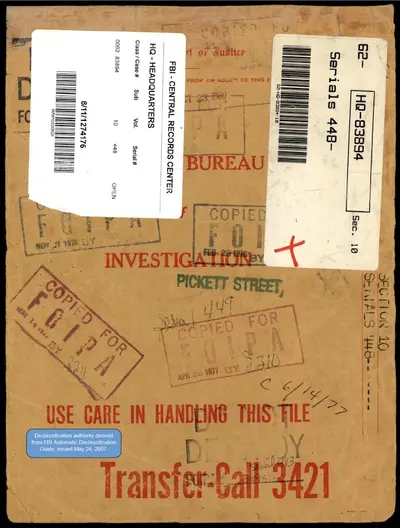
Historical Context
The late 1950s represented a period of heightened atmospheric and aerial anxiety within the United States. As the Cold War intensified, the proliferation of surveillance technology and the rapid advancement of aerospace engineering created a landscape where unidentified aerial phenomena were frequently scrutinized by national security agencies. During this era, the United States Air Force operated Project Blue Book, a systematic study of unidentified flying objects intended to determine if such sightings posed a threat to national security. While Blue Book focused on the scientific and military implications of sightings, the Federal Bureau of Investigation maintained its own parallel interest in reports that could potentially impact the stability of domestic infrastructure or the safety of vital installations.
The geography of Los Angeles played a significant role in the frequency of such reports. As a major hub for the aerospace industry and a primary node in the national defense network, the Southern California region was subject to intense monitoring. The presence of numerous sensitive military installations and high-altitude testing ranges meant that any anomalous activity in the skies was often captured by both civilian observers and government sensors. This density of surveillance and observation contributed to a high volume of reported incidents during the 1950s, many of which were processed through various FBI field offices, including those in Knoxville and Albuquerque, before being routed to headquarters for centralized review.
The 1959 Incident
In 1959, in Los Angeles, California, U.S. government investigators recorded an unidentified-object incident that remained shielded from public view for decades. The documentation regarding this event was later released to the public on May 8, 2026, as part of the Presidential Unsealing and Reporting System for UAP Encounters (PURSUE). This case was investigated under the framework of the Air Force’s Project Blue Book or its predecessors, following established protocols for the protection of vital installations. The reporting of the incident followed the Bureau’s standing procedures, where field offices handled the initial intake of reports involving potential threats to national interests.
The released documentation provides specific details regarding the cultural atmosphere of the time, noting that a previous convention had been held in Los Angeles. This convention featured a large assembly of speakers who claimed contact with extratersterrestrial beings, establishing a precedent for public interest in the subject. This specific gathering in Los Angeles served as a notable point of reference for the later 1966 Reno convention. While the document records the occurrence of the sighting, the exact number of witnesses involved in the 1959 Los Angeles event is not specified in the released text.
Classification and Analysis
The case is classified as a visual sighting reported by ground or air observers. This type of encounter is a common feature of mid-century UFO documentation, where the primary evidence relies on the visual perception of individuals positioned on the ground or within aircraft. Such reports often involve the observation of lights, shapes, or movements that deviate from the expected flight paths of known contemporary aircraft.
The official status of the incident remains unresolved. All records released under the PURSUE program are designated as unresolved by the All-domain Anomaly Resolution Office (AARO) by default. The federal government has not reached a conclusion regarding whether the events documented in these files were anomalous or conventional, and it has not ruled out either possibility. In the context of the late 1950s, several conventional candidates are often considered when analyzing such sightings. These include experimental aircraft testing, weather balloons—specifically those associated with the Project Mogul series from the late 1940s—and various atmospheric optical phenomena such as sundogs or lenticular clouds. Additionally, astronomical objects such as Venus, the Moon, or meteors appearing near the horizon are frequently evaluated as potential explanations for reported unidentified objects.