San Francisco, California UFO Sighting (July 3, 1958) — FBI Files
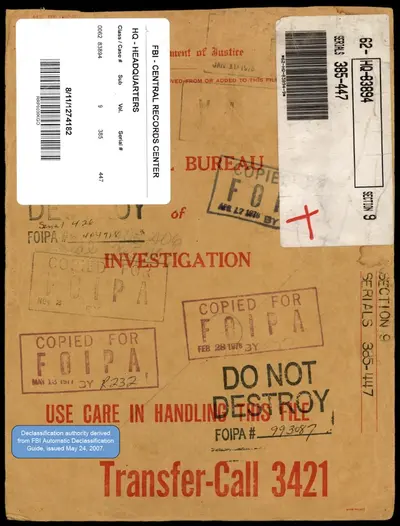
An FBI memorandum from July 3, 1958, details an unidentified object sighting in San Francisco reported by a Colonel from Travis Air Force Base.
Historical Context
The mid-twentieth century represented a period of heightened atmospheric scrutiny within the United States. Following the onset of the Cold War, the presence of unidentified aerial phenomena became a matter of national security, as the potential for advanced Soviet technology to breach American airspace loomed large. During this era, the United States Air Force maintained various programs, most notably Project Blue Book, to investigate reports of Unidentified Flying Objects. These investigations were not merely scientific endeavors but were deeply intertwined with the defense of vital military installations and the monitoring of the electromagnetic spectrum.
San Francisco, as a major coastal hub and a center for significant military infrastructure, was a frequent site for such reports. The presence of numerous airfields and naval facilities necessitated a rigorous reporting structure. During the 1950s, the Federal Bureau of Investigation (FBI) maintained specific protocols for handling reports that could potentially impact the security of these installations. Under these standing protocols, field offices in cities such as Los Angeles, Albuquerque, and Knoxville were tasked with routing UFO reports to FBI headquarters to ensure that any potential intelligence threats were properly vetted by the central intelligence community.
The July 1958 Incident
On July 3, 1958, an incident involving an unidentified object occurred in San Francisco, California. The details of this specific encounter were preserved within government archives and remained shielded from public view for decades. The information only reached the public domain on May 8, 2026, through the Presidential Unsealing and Reporting System for UAP Encounters (PURSUE). This release was part of a broader governmental effort to provide transparency regarding historical Unidentified Anomalous Phenomena (UAP) encounters.
The primary documentation for this case consists of a memorandum dated July 3, 1958, which originated from the San Francisco field office. This memorandum contains information provided by Colonel William E. Zuerner of Travis Air Force Base. The document indicates that Colonel Zuerner shared information developed by the Office of Special Investigations (OSI) regarding an individual identified as Delmaine H. Oveson. While the released document does not specify the total number of witnesses involved in the sighting, the involvement of high-ranking Air Force personnel suggests the report was processed through official military and intelligence channels. Upon reviewing the details, the FBI determined that no further investigative action was required, a decision largely attributed to the subject’s existing affiliation with the United States Air Force.
Classification and Analysis
The case is classified as a visual sighting, a type of encounter reported by observers located either on the ground or within aircraft. Such sightings were common during the 1950s, often characterized by descriptions of lights or metallic objects moving in patterns that appeared inconsistent with known flight paths.
The official status of this case remains unresolved. Under the current guidelines of the All-domain Anomaly Resolution Office (AARO), all records released through the PURSUE program are designated as unresolved by default. The federal government has maintained a position of neutrality regarding the July 1958 sighting, neither concluding that the object was anomalous nor confirming that it was a conventional phenomenon.
When evaluating such sightings, investigators typically consider a range of conventional candidates. During the late 1940s and throughout the 1950s, the presence of experimental aircraft and high-altitude surveillance tools, such as the Project Mogul balloon series, frequently contributed to unidentified reports. Other atmospheric phenomena, including lenticular clouds, sundogs, or the optical effects of meteors and planets like Venus near the horizon, are also frequently cited as potential explanations for visual anomalies. The 1958 San Francisco report remains part of this complex historical dataset, awaiting further technological or archival clarity.