Great Meadows, New Jersey UFO Sighting (March 14, 1957) — FBI Files
In March 1957, a prominent media figure reported an unidentified flying object near Great Meadows, New Jersey, prompting an investigation by the FBI.
Historical Context
The mid-twentieth century was defined by heightened atmospheric anxiety and the technological tensions of the Cold War. During this era, the United States government maintained a rigorous, albeit often fragmented, system for monitoring unidentified aerial phenomena. The period saw the height of the Air Force’s Project Blue Book, a systematic study of UFO sightings intended to determine if such objects posed a threat to national security. While the primary responsibility for investigating aerial anomalies rested with military intelligence, the Federal Bureau of Investigation (FBI) played a secondary, logistical role. Under established Bureau protocols, field offices in cities such as Knoxville, Albuquerque, and Los Angeles were instructed to route reports involving unidentified objects to headquarters, particularly when the sightings occurred near vital installations or sensitive infrastructure.
The geography of Northern New Jersey, specifically the area surrounding Great Meadows, placed it within a corridor of significant strategic interest. As part of the broader Atlantic defense network, the region was subject to frequent aerial monitoring. During the 1950s, the presence of high-altitude surveillance projects, such as the Project Mogul balloon series, contributed to a climate of frequent misidentifications, where experimental technology was often mistaken for extraterrestrial or adversary craft.
The Incident of March 14, 1957
On March 14, 1957, an unidentified-object incident occurred in the vicinity of Great Meadows, New Jersey. The details of this encounter were later brought to the attention of federal authorities by John Stuart Martin, a figure of significant public standing as a founder of Time magazine and a film editor. Martin reported observing an unidentified flying object two days prior to his contact with investigators. While the released documentation does not specify the total number of witnesses present during the sighting, Martin’s personal observation was documented with high specificity.
The documentation reveals that Martin had already engaged with both military authorities and various civilian UFO research groups regarding the sighting. However, dissatisfied with the handling of his information by these entities, Martin took the unusual step of seeking out an FBI agent. He requested that an agent meet with him to personally evaluate the data he had collected. This request was made despite Martin’s own acknowledgment that the FBI lacked the formal jurisdiction to investigate aerial phenomena. The primary motivation for involving the Bureau appeared to be a desire for a more rigorous or perhaps more authoritative validation of his findings.
Documentation and Evidence
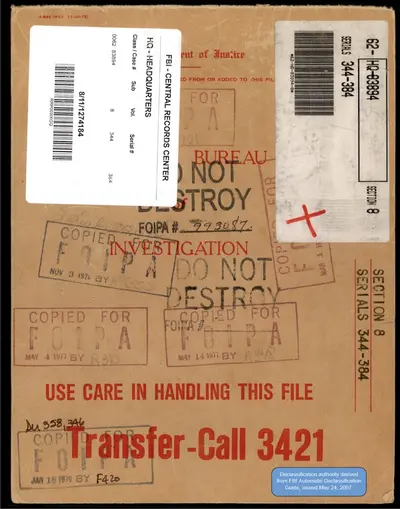
The FBI files pertaining to this case, which were released to the public on May 8, 2026, through the Presidential Unsealing and Reporting System for UAP Encounters (PURSUE), contain specific verbatim notations from the investigation. The records state that Martin “is run into a situation which has to do with an unidentified flying object observed two days in the Great Meadows vicinity.” The files further note Martin’s directness, stating, “He said frankly he wanted an Agent to call upon him so that the Agent could evaluate his information.” The Bureau’s response, however, remained grounded in its operational mandate, noting that “flying saucers,” and similar phenomena, “were not within the scope of the FBI’s interest nor jurisdiction.”
Crucially, the case file includes the mention of photographic or video evidence captured of the unidentified object. The existence of such physical media distinguishes this case from purely anecdotal reports and provides a level of empirical data that often characterizes high-profile sightings of the 1950s.
Current Classification
The status of the Great Meadows incident remains officially unresolved. Under the current guidelines of the All-domain Anomaly Resolution Office (AARO), all records released through the PURSUE program are designated as unresolved by default. The federal government has maintained a neutral stance, neither concluding that the event was the result of anomalous activity nor confirming it as a conventional occurrence.
In the broader context of 1950s aerial sightings, investigators frequently considered several conventional candidates. These included experimental high-altitude aircraft, atmospheric optical phenomena such as lenticular clouds or sundogs, and astronomical bodies like Venus or meteors appearing near the horizon. Because the government has not ruled out either the possibility of conventional technology or an anomalous origin, the March 14, 1957, sighting remains a subject of archival study.