Baku to Tiflis, Russia UFO Sighting (October 1955) — FBI Files
During a train journey in 1955, Senator Russell and his party observed a glowing green-yellow orb and a rotating object over the route from Baku to Tiflis.
Background
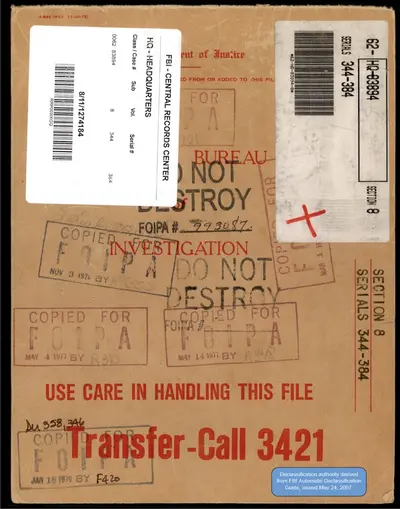
In October 1955, during a period of intense geopolitical tension between the United States and the Soviet Union, an unidentified-object incident occurred along the transit route between Baku and Tiflis, Russia. The details of this event were preserved within United States government archives and were later released to the public on May 8, 2026, as part of the Presidential Unsealing and Reporting System for UAP Encounters (PURSUE). This specific case emerged from the era of Cold War surveillance, where the movement of unidentified aerial phenomena was scrutinized through the lens of national security and the potential for unauthorized reconnaissance.
The investigation of this incident was conducted under the framework of the Air Force’s Project Blue Book or its preceding investigative programs. During this period, the Federal Bureau of Investigation (FBI) maintained a structured protocol for handling reports of unidentified flying objects, particularly those that might impact the security of vital installations. Under these standing protocols, various FBI field offices, including those in Knoxville, Albuquerque, and Los and Angeles, were responsible for routing such sightings to headquarters. This centralized approach ensured that any phenomenon observed near sensitive military or industrial zones was documented for federal oversight.
The Incident
The primary documentation of the event records a sighting that occurred while traveling by train. Senator Russell and members of his party observed a small, greenish-yellow glowing ball rising rapidly into the sky. Following the ascent of the first object, the witnesses observed a second object. This subsequent entity was described through varying accounts, with some witnesses noting lights that resembled eyes, while others perceived a shadowy object accompanied by rotating lights. A consensus among the witnesses indicated that the object was rotating as it ascended.
While the specific number of witnesses present on the train is not specified in the released documentation, the presence of a high-ranking official like Senator Russell contributed to the formal recording of the event within the FBI files. The visual nature of the sighting, characterized by distinct colors and specific movement patterns, placed it within the category of visual sightings reported by ground or air observers.
Historical Context and Analysis
The mid-1950s represented a peak in aerial anomaly reporting, driven by the rapid advancement of aerospace technology and the proliferation of high-altitude surveillance. During this era, the scientific and intelligence communities struggled to categorize sightings that did not align with known aeronautical capabilities. The transition from early post-war balloon monitoring to the era of sophisticated jet propulsion created a landscape where atmospheric phenomena and experimental hardware were often indistinguishable to the naked eye.
When analyzing the Baku to Tiflis sighting, researchers often consider conventional candidates that were prevalent during the 1950s. These include the Project Mogul series of high-altitude weather balloons, which were designed to detect Soviet nuclear tests, as well as experimental aircraft undergoing testing in the region. Additionally, atmospheric optical phenomena, such as sundogs or lenticular clouds, and astronomical bodies like Venus or meteors near the horizon, are frequently cited as potential explanations for luminous or moving lights.
The status of this case remains officially unresolved. Under the protocols of the All-domain Anomaly Resolution Office (AARO), all records released through the PURSUE program are designated as unresolved by default. The federal government has maintained a neutral stance, neither concluding that the events were anomalous nor confirming they were the result of conventional technology. The lack of a definitive conclusion reflects the broader difficulty in verifying mid-century sightings where primary sensor data is unavailable and reliance is placed solely on eyewitness testimony.