Modena, Italy UFO Sighting (September 28, 1954) — FBI Files
An FBI-recorded incident in Modena, Italy, involving a shattered windshield and a near-collision, remains an unresolved Cold War-era aerial anomaly.
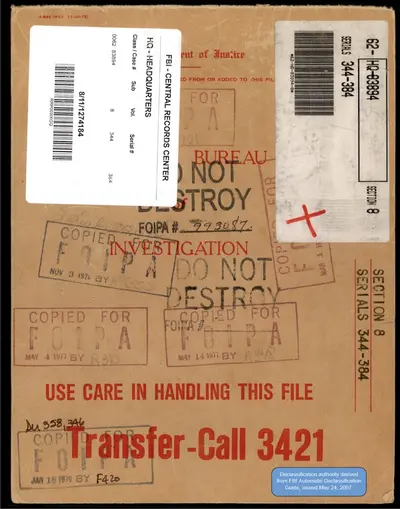
Historical Context
The mid-twentieth century was a period of heightened global tension, as the Cold War transformed the landscape of aerial surveillance and atmospheric observation. During the 1950s, the presence of unidentified flying objects became a matter of significant concern for various national intelligence agencies. In the United States, the Air Force maintained programs such as Project Blue Book to investigate these reports, while the Federal Bureau of Investigation (FBI) played a secondary but vital role. The Bureau’s involvement was largely driven by the need to protect vital installations and ensure that unidentified aerial phenomena did not represent a breach of national security or a threat to strategic assets.
Under the standing protocols of the era, various FBI field offices, including those in Knoxville, Albuquerque, and Los Angeles, were tasked with routing UFO reports to headquarters. This centralized system was designed to monitor potential incursions into restricted airspace. This specific era of investigation was also characterized by the presence of high-altitude surveillance technology, such as the Project Mogul series of balloons, which often contributed to the ambiguity of aerial sightings. When analyzing reports from this period, researchers must consider the geopolitical climate, where the line between atmospheric phenomena and experimental military hardware was frequently blurred.
The Modena Incident
On September 28, 1954, an incident occurred in Modena, Italy, that was eventually documented within FBI files. The details of this event were not made public for decades, only surfacing on May 8, 2026, as part of the Presidential Unsealing and Reporting System for UAP Encounters (PURSUE). The documentation describes a sudden and violent event involving Dr. Farinetti, who was driving to a clinic when his windshield exploded. The force of the glass shattering resulted in facial lacerations to the doctor and caused him to briefly lose control of his vehicle. The sudden disruption nearly resulted in the car driving into a ditch as the driver attempted to bring the vehicle to a stop.
The records indicate that this event did not occur in isolation, but was instead described as the latest in a series of similar incidents occurring across Italy. While the released document does not specify the total number of witnesses to the event, the physical impact on the vehicle and the driver suggests a significant localized occurrence. The nature of the document classifies this as a visual sighting reported by ground or air observers, though the specific mechanism of the windshield’s destruction remains a central mystery of the case.
Classification and Resolution Status
The Modena case remains categorized as an unidentified-object incident. Within the framework of modern archival analysis, the All-domain Anomaly Resolution Office (AARO) designates all records released under the PURSUE program as unresolved by default. The federal government has maintained a position of neutrality regarding the event, neither concluding that the occurrence was anomalous nor confirming that it was the result of conventional means. The investigation has not ruled out either possibility, leaving the cause of the windshield explosion and the associated aerial phenomena open to debate.
In the broader context of 1950s aerial sightings, several conventional explanations are often applied to similar reports. These include the presence of experimental aircraft, weather balloons, or various atmospheric optical phenomena such as sundogs and lenticular clouds. Astronomical objects, including the Moon, Venus, or meteors appearing near the horizon, are also frequently cited as potential sources of confusion. However, the specific physical damage recorded in the Modena case presents a unique challenge to these standard explanations, as the destruction of the glass implies a kinetic or high-energy component that is not typically associated with simple optical illusions or distant astronomical bodies.