Cincinnati, Ohio UFO Sighting (September 28, 1954) — FBI Files (D34P49)
An investigation into a 1954 Cincinnati unidentified object sighting reveals high-level military admissions regarding the existence of extraterrestrial craft.
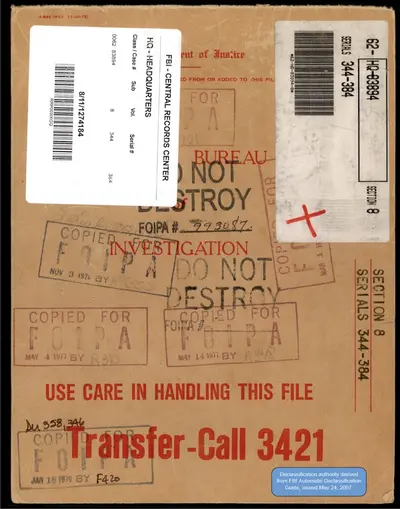
Historical Context of the 1954 Incident
On September 28, 1954, an unidentified object incident occurred in Cincinnati, Ohio, an event that remained largely obscured from public view for decades. The details of this encounter were eventually released to the public on May 8, 2026, through the Presidential Unsealing and Reporting System for UAP Encounters (PURSUE). This specific case emerged during the height of the Cold War, a period characterized by intense atmospheric surveillance and heightened anxiety regarding aerial incursions. During this era, the United States government maintained various investigative arms to monitor unidentified aerial phenomena, most notably the Air Force’s Project Blue Book and its preceding initiatives.
The geographic significance of Cincinnati, situated near vital industrial and logistical hubs, placed it within a sensitive zone for national security monitoring. During the mid-1950s, the Federal Bureau of Investigation (FBI) maintained strict protocols for handling reports of unidentified objects that could potentially threaten vital installations. Under these standing protocols, field offices in cities such as Knoxville, Albuquerque, and Los Angeles were tasked with routing UFO reports directly to FBI headquarters. This centralized approach ensured that any aerial anomaly capable of bypassing conventional defense systems was documented within the broader intelligence framework of the United States.
The Investigation and Military Admissions
The released documentation provides a rare glimpse into the internal discussions regarding the validity of aerial anomalies. The file contains an interview conducted by Leonard Stringfield, a former Air Force intelligence officer, with Lt. Col. John O’Mara of Wright Field. The contents of this interview are notable for the candid nature of the military officer’s responses regarding flying saucers. During the exchange, Col. O’Mara admitted to the existence of flying saucers and acknowledged that official government statements had been marked by contradictions in the past.
In analyzing the nature of these sightings, Col. O’Mara provided a structural breakdown of the phenomena into three distinct categories. The first category comprised controlled American devices, which included experimental or classified domestic technology. The second category involved unexplained natural phenomena, such as atmospheric or astronomical events. The third and most significant category involved objects of potentially extraterrestrial origins. The gravity of these admissions is underscored by the verbatim statements recorded in the file, where the officer stated that flying saucers do exist and that something does exist. Most provocatively, the document records his declaration that, based on the evidence within his files, certain flying saucers definitely originate from outer space.
Classification and Current Status
The incident is classified as a visual sighting reported by ground or air observers. While the released document does not specify the exact number of witnesses involved in the Cincinnati event, the involvement of high-ranking military personnel in the subsequent debriefing suggests a high level of concern regarding the observation.
As of the current era, all records released under the PURSUE program are designated as unresolved by the All-domain Anomaly Resolution Office (AARO) by default. The federal government has maintained a position of neutrality, neither concluding that the events were anomalous nor confirming them as conventional. This lack of a definitive conclusion reflects the difficulty in distinguishing between unidentified phenomena and the various conventional candidates prevalent during the 1950s. These candidates included experimental aircraft, meteors near the horizon, and astronomical objects such as the Moon or Venus. Furthermore, the era was marked by the deployment of the Project Mogul series of high-altitude weather balloons, which often caused confusion among observers. Other possibilities considered by investigators include atmospheric optical phenomena, such as lenticular clouds or sundogs, which can mimic the appearance of structured aerial craft.