Pontiac, Michigan UFO Sighting (August 5, 1952) — FBI Files
An August 1952 FBI report details a correspondence from a Michigan resident regarding the sighting of flying disks over Pontiac.
Historical Context
The early 1950s represented a period of heightened atmospheric and terrestrial anxiety within the United States. Following the conclusion of World War II, the onset of the Cold War introduced a new era of surveillance and technological competition. This era was characterized by the rapid development of aerospace technology and the constant threat of aerial intrusion by foreign adversaries. During this time, the phenomenon of unidentified flying objects, often referred to as flying saucers, became a significant subject of public concern and government scrutiny.
The cultural landscape of the American Midwest during this period was defined by a mix of industrial growth and a growing preoccupation with the unknown. As the nation integrated more deeply into the jet age, the sight of unidentified objects in the sky became more frequent in public discourse. This specific period of sightings is often categorized by historians as part of the secondary wave of UFO phenomena that followed the landmark 1947 Kenneth Arnold sighting and the controversial Roswell incident. These earlier events had established a template for how the public perceived anomalous aerial activity, moving it from the fringes of science fiction into the realm of national security concerns.
The Pontiac Incident
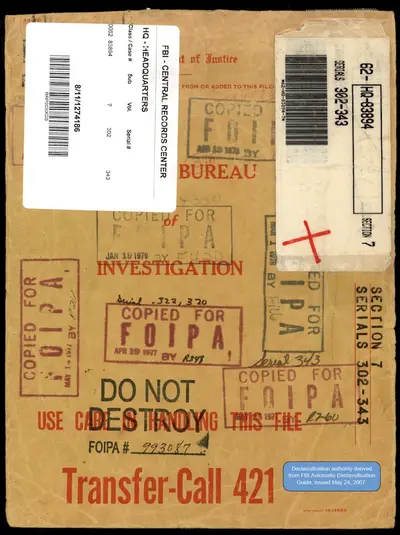
On August 5, 1952, an incident involving unidentified objects was recorded in Pontiac, Michigan. The details of this specific event emerged decades later, as the documentation was released to the public on May 8, 2026, through the Presidential Unsealing and Reporting System for UAP Encounters (PURSUE). The documentation originates from the archives of the Federal Bureau of Investigation (FBI), which maintained a systematic approach to processing reports of anomalous aerial phenomena during this era.
The primary record of this event consists of a letter written by Mr. We He Jennings, a resident of Pontiac. In this correspondence, Mr. Jennings addressed the FBI regarding the presence of flying disks. While the letter serves as the foundational evidence for the case, the specific contents of his observations are considered self-explanatory within the context of the original filing and are not detailed further in the released document. The number of individuals who witnessed the objects is not specified in the official paperwork.
The administrative handling of the report followed established Bureau protocols. During this period, FBI field offices in cities such as Knoxville, Albuquerque, and Los Angeles were tasked with monitoring and routing UFO reports to headquarters. This procedure was part of a standing protocol designed to ensure the protection of vital installations and to maintain oversight of any potential threats to national security. Upon receiving the letter from Mr. Jennings, the FBI acknowledged the communication and subsequently forwarded the information to the United States Air Force for further attention. The Bureau itself took no further investigative action regarding the claims made in the letter.
Analytical Framework
The Pontiac case is classified as a visual sighting reported by ground or air observers. In the broader study of mid-century aerial phenomena, such cases are often evaluated against various conventional explanations. During the late 1940s and early 1950s, the skies were frequently occupied by experimental aircraft and high-altitude reconnaissance tools, such as the Project Mogul series of weather balloons. Additionally, atmospheric optical phenomena, including lenticular clouds, sundogs, and the positioning of bright celestial bodies like Venus or the Moon near the horizon, often provided plausible explanations for unidentified lights.
Under the current regulatory framework of the All-domain Anomaly Resolution Office (AARO), all records released via the PURSUE program are designated as unresolved by default. The federal government maintains a neutral stance regarding the Pontiac incident, neither concluding that the objects were anomalous nor confirming they were conventional. The lack of definitive classification remains a standard feature of declassified historical archives, as the technology required to definitively identify such objects was not available to investigators at the time of the original report.