Grand Blanc, Michigan UFO Sighting (February 21, 1950) — FBI Files
An FBI-documented case from 1950 involving a photograph of a saucer-like object silhouetted against the moon in Grand Blanc, Michigan.
Background
On February 21, 1950, in Grand Blanc, Michigan, U.S. government investigators recorded an unidentified-object incident later released to the public on May 8, 2026, as part of the Presidential Unsealing and Reporting System for UAP Encounters (PURSUE). This event occurred during a period of heightened public and governmental anxiety regarding aerial phenomena. The incident is part of the first wave of “flying saucer” reports that swept the United States following the Kenneth Arnold sighting of June 1947 and the Roswell incident of July 1947. During this era, the sudden influx of reports regarding unidentified aerial phenomena led to significant scrutiny of the national airspace, as the Cold War era necessitated heightened vigilance against potential technological advancements by foreign adversaries.
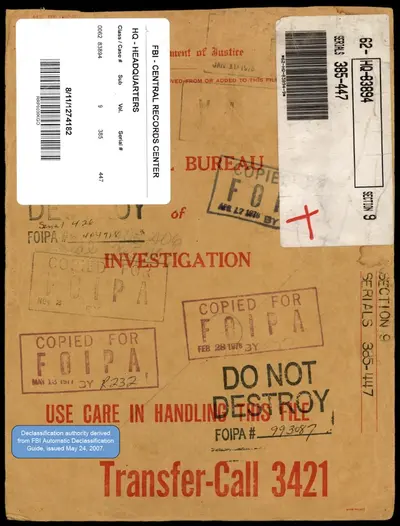
The administrative handling of this specific case reflects the bureaucratic landscape of mid-century American intelligence. The case was filed with the Federal Bureau of Investigation, whose Knoxville, Albuquerque, Los Angeles, and other field offices routed UFO reports to headquarters under the Bureau’s standing protocols for the protection of vital installations. At the time, the FBI focused on these reports primarily through the lens of national security, investigating whether unidentified objects posed a threat to the integrity of sensitive military or industrial sites. This procedural approach meant that many sightings were documented not as scientific inquiries into extraterrestrial life, but as potential intelligence-gathering activities by unknown actors.
What the document records
The primary evidence in this case involves photographic documentation rather than eyewitness testimony. A professional photographer, Joseph Perry, claimed to have photographed a saucer-like object silhouetted against the moon using a homemade telescope. Perry had been engaged in the hobby of taking photographs of the moon for thirty years, suggesting a level of technical familiarity with lunar photography and telescopic equipment. The identification of the object as a potential aerial phenomenon was not initially prompted by the photographer himself, but rather by a customer at his pizza restaurant, who suggested that the photograph might depict a flying saucer.
While the visual evidence provides a specific focal point for the investigation, the released document does not specify the total number of witnesses present or involved in the observation. The reliance on a single photographic capture places this case within a specific subset of mid-century sightings where physical or visual artifacts served as the primary basis for official government inquiry.
Type of case
The case includes photographic or video evidence of the unidentified object. Such cases are often considered higher priority in archival investigations due to the presence of a tangible medium that can be subjected to forensic analysis, even if the original film or prints are no longer available for contemporary review.
Status
All records released under the PURSUE program are designated unresolved by the All-domain Anomaly Resolution Office (AARO) by default. The federal government has not concluded that the events were anomalous, has not concluded that they were conventional, and has not ruled out either possibility. The ambiguity of the status reflects the difficulty in verifying decades-old photographic evidence without secondary corroboration.
Conventional candidates for sightings of this period include experimental aircraft, weather balloons, particularly the Project Mogul series active in the late 1940s, and atmospheric optical phenomena such as sundogs and lenticular clouds. Additionally, astronomical objects including Venus, the Moon, and meteors near the horizon are frequently cited as potential sources of misidentification. In the context of Grand Blanc, the presence of the moon in the photograph introduces the possibility of optical artifacts or known celestial bodies being misinterpreted through the lens of the era’s prevailing cultural fascination with unidentified flying objects.