Koshkonong, Missouri UFO Sighting (August 14, 1952) — FBI Files
An FBI-documented report from Koshkonong, Missouri, details an unidentified object sighting recorded during the height of the 1950s flying saucer era.
Background
On August 14, 1952, in Koshkonong, Missouri, U.S. government investigators recorded an unidentified-object incident later released to the public on May 8, 2026, as part of the Presidential Unsealing and Reporting System for UAP Encounters (PURSUE). This event occurred during a period of heightened national anxiety regarding aerial unidentified phenomena. The sighting belongs to the first wave of “flying saucer” reports that swept the United States following the Kenneth Arnold sighting of June 1947 and the Roswell incident of July 1947. During this era, the sudden influx of aerial reports led to widespread public speculation and increased scrutiny of the American airspace.
The geography of Koshkonong, situated within the Ozark Plateau region of Missouri, provided a landscape characterized by rolling hills and dense vegetation, which often influenced the visibility and perception of aerial objects. During the early 1950s, the United States was deeply entrenched in the early Cold War, a period where the monitoring of the skies was considered a matter of national security. The presence of unidentified objects in the upper atmosphere was often viewed through the lens of potential technological advancements by foreign adversaries. Consequently, the reporting of such sightings was not merely a matter of civilian curiosity but was integrated into the defensive posture of the federal government.
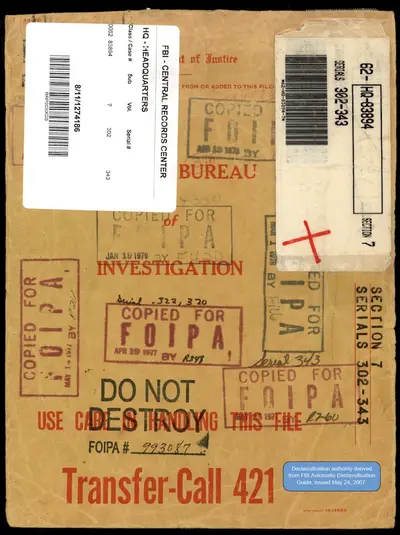
The case was filed with the Federal Bureau of Candlestick Investigation, whose Knoxville, Albuquerque, Los Angeles, and other field offices routed UFO reports to headquarters under the Bureau’s standing protocols for the protection of vital installations. This administrative structure ensured that any reported anomaly that could potentially threaten sensitive military or governmental sites was centralized for analysis. This systematic approach to documentation reflected the era’s preoccupation with domestic security and the potential for clandestine aerial incursions.
What the document records
The primary evidence for this event consists of a letter from a Mr. Chotnski containing observations, which was received by the FBI. While the document confirms the receipt of these observations, the specific content of the visual or physical details of the object is not detailed in the released paperwork. This lack of granular detail is common in many archival files from this period, where the focus of the Bureau was often on the administrative processing and routing of the report rather than the exhaustive forensic reconstruction of the sighting itself.
The FBI forwarded a copy of the letter to the Air Force for further investigation, following the established procedure for handing off technical aerial observations to the branch of the military responsible for aerospace defense. The number of witnesses involved in the Koshkonong incident is not specified in the released document, leaving the scale of the observation unquantified.
Type of case
The case is classified as a visual sighting reported by ground or air observers. This category encompasses a wide variety of phenomena, ranging from high-altitude atmospheric events to low-altitude encounters with unidentified craft.
Status
All records released under the PURSUE program are designated unresolved by the All-domain Anomaly Resolution Office (AARO) by default. The federal government has not concluded that the events were anomalous, has not concluded that they were conventional, and has not ruled out either possibility. The ambiguity of the Koshkonong report is consistent with the broader scientific and governmental uncertainty regarding the mid-century phenomenon.
Conventional candidates for sightings of this period include experimental aircraft, weather balloons, particularly the Project Mogul series utilized in the late 1940s to detect Soviet nuclear tests, and atmospheric optical phenomena such as sundogs and lenticular clouds. Additionally, astronomical objects including Venus, the Moon, and meteors near the horizon frequently provided explanations for reported unidentified objects. Without specific descriptive data from the Chotnski letter, the Koshkonong sighting remains an unverified entry in the historical record of aerial anomalies.