Philadelphia, Pennsylvania UFO Sighting (September 26, 1950) — FBI Files (D6P8)
Two Philadelphia police officers reported observing a glowing, six-foot-wide object that disintegrated into a purplish mist during a 1950 patrol.
Historical Context
The sighting in Philadelphia occurred during a period of heightened atmospheric and aerial anxiety in the United States. Following the 1947 Kenneth Arnold sighting and the subsequent Roswell incident, the American public and government agencies were confronted with a surge of reports involving unidentified flying objects. This era, often characterized by the “flying saucer” phenomenon, saw a transition in how such sightings were processed by federal authorities. During the early Cold War, the emergence of advanced aerospace technology and the development of sophisticated radar systems meant that unidentified aerial phenomena were increasingly viewed through the lens of national security.
Philadelphia, as a major industrial and logistical hub in Pennsylvania, sat within a landscape of significant infrastructure and vital installations. During the 1950s, the presence of various military and research facilities necessitated a standardized reporting procedure for any anomalous aerial activity. The Federal Bureau of Investigation (FBI) maintained a structured protocol for such events, ensuring that reports from regional field offices—including those in Knoxville, Albuquerque, and Los Angeles—were routed to headquarters. This centralized system was designed to monitor potential threats to the protection of vital installations and to document any deviations from known flight patterns or atmospheric conditions.
The Incident of September 26, 1950
On the night of September 26, 1950, two Philadelphia police officers were conducting a routine patrol when they encountered an unidentified object. The officers observed a slow-descending object that initially resembled a parachute. As they approached the site of the descent, the nature of the object became more distinct. The investigators documented a six-foot diameter object that emitted a purplish glow, described in the official file as a glow that was almost a mist.
The physical properties of the object’s descent and subsequent dissolution were notable for their lack of kinetic impact. According to the recorded observations, the object was so light that when it hit the field, it did not even bend the weeds or the grass it fell on. The object did not remain intact for long; over a period of approximately 25 minutes, the object underwent a process of disintegration. This breakdown left behind an odorless residue in the area, yet the event left the surrounding vegetation entirely undisturbed. While the document confirms the presence of the two patrolling officers, the total number of witnesses to the event is not specified in the released records.
Documentation and Classification
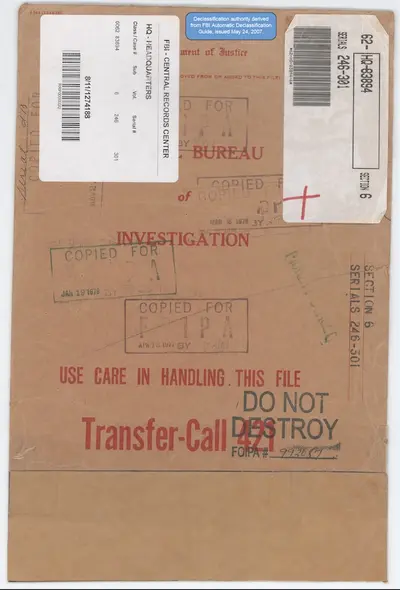
The details of this incident remained largely out of the public eye for decades, preserved within FBI files. The information was eventually released to the public on May 8, 2026, as part of the Presidential Unsealing and Reporting System for UAP Encounters (PURSUE). This release was part of a broader governmental effort to provide transparency regarding unidentified anomalous phenomena.
The case is classified as a visual sighting reported by ground observers. Within the framework of the All-domain Anomaly Resolution Office (AARO), all records released under the PURSUE program are designated as unresolved by default. The federal government has maintained a neutral stance regarding the nature of the Philadelphia object, neither concluding that the event was anomalous nor confirming that it was the result of conventional means.
In the context of 1950s aerial phenomena, researchers often consider several conventional candidates for such sightings. These include experimental aircraft, the deployment of weather balloons—specifically those associated with the Project Mogul series—or atmospheric optical phenomena such as sundogs and lenticular clouds. Additionally, astronomical objects like Venus, the Moon, or meteors near the horizon are frequently evaluated as potential explanations for luminous, descending objects. The Philadelphia case remains a documented instance of an unidentified aerial event that lacks a definitive terrestrial or astronomical attribution.