Philadelphia, Pennsylvania UFO Sighting (September 26, 1950) — FBI Files
On September 26, 1950, two Philadelphia police officers witnessed a lavender, parachute-like object descend and evaporate in a field.
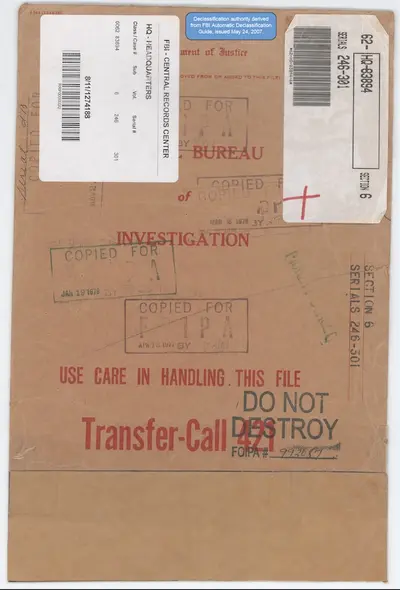
Historical Context
The sighting in Philadelphia occurred during a period of intense national preoccupation with unidentified aerial phenomena. Following the June 1947 Kenneth Arnold sighting and the July 1947 Roswell incident, the United States experienced a significant surge in reports of “flying saucers.” This era was characterized by the early Cold War, a time when the rapid advancement of aerospace technology and the emergence of long-range radar capabilities heightened public and governmental sensitivity to any unidentified movement in the skies. During the late 1940s and early 1950s, the presence of unidentified objects was often viewed through the lens of national security, as the possibility of advanced Soviet technology or extraterrestrial intrusion became a central theme in the American consciousness.
The administrative handling of such reports was highly structured within the federal government. During this period, the Federal Bureau of Investigation maintained protocols to manage reports that might impact the security of vital installations. Field offices in cities such as Knoxville, Albuquerque, and Los Angeles were responsible for routing UFO-related intelligence to FBI headquarters. This systematic approach ensured that any sighting that could potentially involve espionage or technological breaches was documented and centralized for analysis by federal authorities.
The September 1950 Incident
On the evening of September 26, 1950, in Philadelphia, Pennsylvania, two police officers encountered an unidentified object that would later become a part of the federal investigative record. The documentation, which was released to the public on May 8, 2026, through the Presidential Unsealing and Reporting System for UAP Encounters (PURSUE), details a specific and unusual physical phenomenon. The officers observed a round, lavender-colored object, measuring approximately six feet in circumference, descending slowly toward the earth.
The object’s descent was described as being similar to that of a parachute, yet it possessed physical properties that defied standard expectations of weight and mass. Despite its size, the object was remarkably light, failing to even bend the surrounding weeds upon landing in a field. The visual characteristics of the object were noted in the file with the description “round object about six feet in circumference slowly float down to the ground.” The witnesses also noted a texture or residue described as “dewy, sort of like soap suds.”
The duration of the event was brief. Within 15 to 20 minutes of landing, the object began to evaporate. As it vanished, it left behind nothing but a slight, sticky residue on the area where it had rested. The official file contains the headline “Flying Saucer Just Dissolves,” reflecting the perplexing nature of the object’s disappearance. While the document provides these specific physical details, the total number of witnesses to the event is not specified in the released materials.
Investigation and Classification
The Philadelphia incident remains classified as an unidentified-object event. Under the current oversight of the All-domain Anomaly Resolution Office (AARO), all records released via the PURSUE program are designated as unresolved by default. The federal government has maintained a position of neutrality regarding the nature of the encounter, neither concluding that the event was the result of an anomalous phenomenon nor confirming it as a conventional occurrence.
In the broader context of mid-century aerial sightings, investigators often considered several conventional explanations for such reports. These included the presence of experimental aircraft, the use of weather balloons—specifically the Project Mogul series deployed in the late 1940s to detect Soviet nuclear tests—or atmospheric optical phenomena such as lenticular clouds and sundogs. Additionally, bright astronomical objects like Venus, the Moon, or meteors near the horizon were frequently evaluated as potential sources for sightings of luminous objects. The Philadelphia case, with its unique lavender color and rapid evaporation, remains a distinct entry in the archive of documented aerial anomalies.