Balearic Islands, Spain UFO Sighting (April 1950) — FBI Files
An investigation into an unidentified object sighting over the Balearic Islands in April 1950, documented within declassified FBI files.
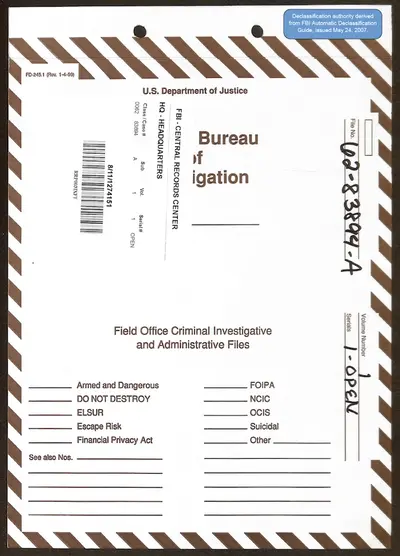
Background
In April 1950, within the Balearic Islands of Spain, U.S. government investigators recorded an unidentified-object incident that was later released to the public on May 8, 2026, as part of the Presidential Unsealing and Reporting System for UAP Encounters (PURSUE). This period of the mid-twentieth century was characterized by a global surge in reports concerning unidentified aerial phenomena. The incident occurred during the first wave of “flying saucer” reports that swept the United States following the Kenneth Arnold sighting of June 1947 and the Roswell incident of July 1947. During this era, the sudden appearance of objects exhibiting non-ballistic flight patterns prompted significant interest from intelligence agencies and military branches worldwide.
The Balearic Islands, an archipelago in the Mediterranean Sea, provided a geographically significant backdrop for such observations due to their position along various maritime and aerial transit corridors. The administrative handling of this specific case was managed through the Federal Bureau of Investigation. Under the Bureau’s standing protocols for the protection of vital installations, various field offices, including those in Knoxville, Albuquerque, and Los Angeles, were responsible for routing UFO reports to headquarters. This centralized reporting structure ensured that any aerial phenomenon that could potentially threaten or involve sensitive government interests was documented and analyzed by federal authorities.
Documentation and Evidence
The released documentation provides a specific account of the sighting but lacks a confirmed witness count. While the report details the occurrence of the event, the number of individuals who observed the object remains unspecified in the official record. The investigation into the event included the examination of photographs allegedly taken in the Balearic Islands. However, investigators treated these photographic records with significant skepticism. The images were considered potentially unreliable and were ultimately dismissed as a possible hoax.
The difficulty in verifying such evidence was a common theme in post-war investigations. The author of the report notes the inherent difficulty in separating credible reports from false ones, a challenge that plagued investigators throughout the 1940s and 1950s. The prevalence of high-altitude surveillance technology and the rise of amateur photography meant that while more visual data was being captured, the authenticity of that data was frequently compromised by the era’s burgeoning interest in sensationalist media and deceptive practical effects.
Classification and Analysis
The case is classified as a visual sighting reported by ground or air observers. Such classifications are standard for phenomena involving direct ocular or photographic observation of an object in flight. Because the documentation remains part of the PURSUE release, all records are designated unresolved by the All-domain Anomaly Resolution Office (AARO) by default. The federal government has not concluded that the events were anomalous, nor has it concluded that they were conventional, and the possibility of either remains open.
When analyzing sightings from this specific historical window, researchers often consider several conventional candidates. During the late 1940s and early 1950s, the proliferation of experimental aircraft and the deployment of the Project Mogul series of high-altitude weather balloons created significant atmospheric noise. Other natural explanations frequently cited in similar investigations include atmospheric optical phenomena, such as sundogs and lenticular clouds, or astronomical objects like Venus, the Moon, and meteors appearing near the horizon. The 1950 Balearic Islands incident remains a subject of study within the broader context of these documented aerial anomalies.