Atlanta, Georgia UFO Sighting (March 7, 1950) — FBI Files
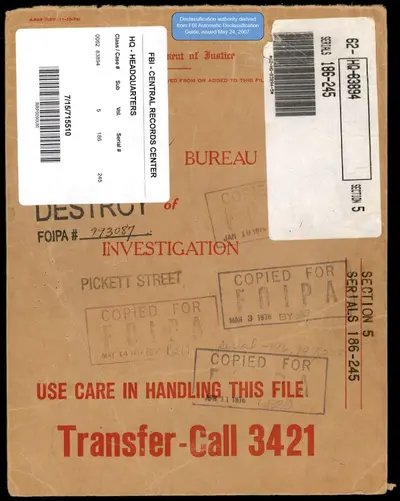
Federal Bureau of Investigation records document an unidentified object sighting in Atlanta, Georgia, reported to military authorities in March 1950.
Historical Context
The early years of the Cold War were characterized by intense anxiety regarding aerial surveillance and the potential for sudden, unannounced air strikes. Following the 1947 Kenneth Arnold sighting and the subsequent Roswell incident, the United States experienced a significant surge in reports of unidentified flying objects, often referred to as “flying saucers.” This era saw the emergence of a new type of national security concern, as the public and military officials struggled to distinguish between secret Soviet technology, experimental American aerospace projects, and potentially extraterrestrial phenomena.
During this period, the Federal Bureau of Investigation maintained a systematic approach to documenting such anomalies. Under established protocols designed to protect vital installations and national infrastructure, various FBI field offices, including those in Knoxville, Albuquerque, and Los Angeles, were tasked with routing UFO reports to headquarters. This centralized processing ensured that any sighting that could represent a breach of domestic airspace or a threat to military assets was cataloged within the federal intelligence framework.
The March 1950 Incident
On March 7, 1950, an unidentified-object incident occurred in Atlanta, Georgia. The details of this event were preserved in government files and remained shielded from public view for decades. The documentation was eventually released to the public on May 8, 2026, as part of the Presidential Unsealing and Reporting System for UAP Encounters (PURSUE).
The specific details of the sighting involve a report made by a Mr. Woodside. On the morning of the incident, Woodside contacted authorities at the Atomic Energy Commission (AEC) and various military forces to report the presence of the unidentified object. Following pre-arranged defense plans intended to mitigate the risks of an air assault, Woodside also contacted Colonel John Meade at both the 3rd Army Headquarters and the 14th Air Force Headquarters. The purpose of these communications was to alert high-level command to the potential threat posed by the object.
The released documentation indicates that while there was cooperation between the various responding agencies, the reporting process was hampered by a lack of clear responsibility. There was no definitive authority established to verify the nature of the object or to address the potential threat it presented to the region. While the incident was documented with high-level military involvement, the released files do not specify the total number of witnesses present during the sighting.
Classification and Analysis
The Atlanta case is classified as a visual sighting reported by ground or air observers. Within the broader scope of mid-century aerial anomalies, such cases are often analyzed alongside other sightings of the era to determine if patterns of movement or characteristics suggest a common origin.
The status of the Atlanta sighting remains unresolved. According to the All-domain Anomaly Resolution Office (AARO), all records released under the PURSUE program are designated as unresolved by default. The federal government has maintained a neutral stance, neither concluding that the event was the result of anomalous phenomena nor confirming that it was caused by conventional means.
When evaluating sightings from the 1950s, researchers often consider several conventional candidates. These include the presence of experimental aircraft or high-altitude weather balloons, such as the Project Mogul series utilized during the late 1940s for detecting Soviet nuclear tests. Other possibilities include atmospheric optical phenomena, such as lenticular clouds or sundogs, as well as astronomical objects like the Moon, Venus, or meteors appearing near the horizon. The Atlanta incident remains part of the ongoing effort to categorize these historical observations within the framework of known or unknown aerial activity.