Chanute Air Force Base UFO Sighting (December 1049) — USAF Files
U.S. government investigators recorded a bright white unidentified object moving rapidly across the sky over Chanute Air Force Base in December 1949.
Historical Context
The sighting at Chanute Air Force Base occurred during a period of intense atmospheric scrutiny and heightened national security concerns in the United States. Following the Kenneth Arnold sighting in June 1947 and the subsequent Roswell incident in July 1947, the American public and military establishment entered an era defined by frequent reports of unidentified flying objects. This period, often referred to as the first wave of “flying saucer” reports, coincided with the early stages of the Cold War, a time when the rapid advancement of aerospace technology and the emergence of nuclear-capable aircraft necessitated constant vigilance regarding unidentified aerial phenomena.
Chanute Air Force Base, located in Illinois, served as a significant installation for the United States Air Force, primarily focused on technical training and aeronautical research. The presence of trained weather observers and military personnel at such a facility provided a structured environment for the recording of aerial anomalies. During this era, the identification of such objects often involved distinguishing between known aerial assets, such as the Project Mogul high-altitude balloons used for detecting Soviet nuclear tests, and unknown phenomena. The documentation of this specific event was preserved within U.S. Department of Defense records, remaining shielded from public view until its release on May 8, 2026, via the Presidential Unsealing and Reporting System for UAP Encounters (PURSUE).
The December 1949 Incident
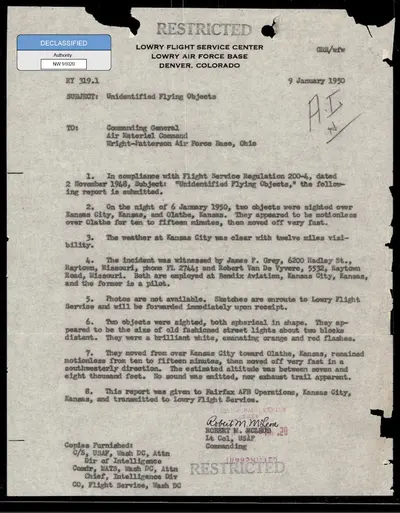
In December 1949, weather observers stationed at Chanute Air Force Base documented the passage of an unidentified object across the sky. According to the official records, the object was observed moving on a trajectory from the northeast toward the south-southwest. The object was characterized by a bright white luminosity. The movement of the object was notably rapid, as it appeared to ascend at an angle of fifteen degrees while traversing thirty-five degrees of the horizon in a duration of only three seconds.
The technical observations provided in the document noted a lack of audible sound accompanying the object’s flight. Furthermore, investigators found no evidence of an exhaust trail or any visible propulsion residue following the object’s path. While the movement was highly dynamic, the released documentation does not specify the total number of witnesses present at the time of the sighting.
Classification and Analysis
The Chanute Air Force Base incident is classified as a visual sighting reported by ground or air-based observers. In the broader context of Unidentified Aerial Phenomena (UAP) research, this case shares characteristics with other mid-century sightings involving high-velocity, silent, and luminous objects. Such reports frequently prompted investigations into whether the phenomena were the result of newly developed military technology or natural atmospheric occurrences.
The status of this case remains officially unresolved. Under the protocols of the All-domain Anomaly Resolution Office (AARO), all records released through the PURSUE program are designated as unresolved by default. The federal government has maintained a neutral stance, neither concluding that the object was an anomalous phenomenon nor confirming it was a conventional craft. Within the scientific and military community, several conventional explanations are typically considered for sightings of this nature. These include experimental aircraft testing, atmospheric optical phenomena such as sundogs or lenticular clouds, and astronomical bodies like the Moon, Venus, or meteors passing near the horizon. The absence of an exhaust trail and the extreme speed of the object’s transit remain the primary features that distinguish this specific observation from standard meteorological or astronomical events.