Alexandria, Louisiana UFO Sighting (July 10, 1949) — FBI Files
FBI records from 1949 document a convention in Alexandria, Louisiana, organized by a local business club to discuss recent reports of flying saucer sightings.
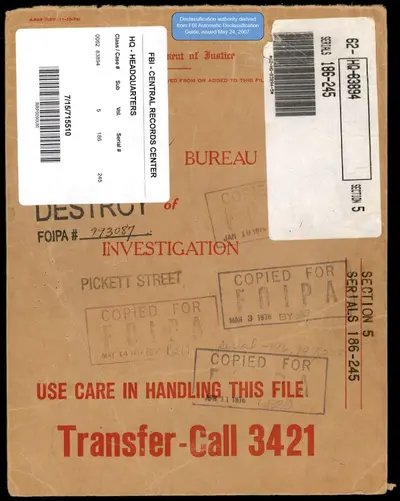
Background
On July 10, 1949, in Alexandria, Louisiana, U.S. government investigators recorded an unidentified-object incident later released to the public on May 8, 2026, as part of the Presidential Unsealing and Reporting System for UAP Encounters (PURSUE). This specific event occurred during a period of heightened public and governmental interest in unidentified aerial phenomena. The incident is categorized as part of the first wave of “flying saucer” reports that swept the United States following the Kenneth Arnold sighting of June 1947 and the Roswell incident of July 1947. During this era, the sudden influx of aerial reports led to widespread speculation regarding the nature of these objects, ranging from extraterrestrial visitors to secret military technology.
The documentation of this event was handled through official intelligence channels. The case was filed with the Federal Bureau of Investigation, whose Knoxville, Albuquerque, Los Angeles, and other field offices routed UFO reports to headquarters under the Bureau’s standing protocols for the protection of vital installations. During the late 1940s, the FBI maintained a systematic approach to monitoring reports that could potentially impact national security or involve unauthorized incursions into restricted airspace. The geographical location of Alexandria, situated in the central part of Louisiana, placed it within a region of the American South that, while not a primary hub for military installations, was subject to the same federal surveillance protocols as more strategic aerospace corridors.
What the document records
The released FBI documentation details an unusual social response to the phenomenon within the local community. The Young Men’s Business Club of Alexandria, Louisiana, announced a convention specifically for people who have seen flying saucers, intending for them to compare notes. This gathering was organized as a means for witnesses to consolidate their observations and identify patterns in the sightings. The information regarding this convention was shared within the FBI files as a matter of intelligence, suggesting the Bureau was monitoring the social and communicative aspects of the UFO phenomenon in the region.
Prior to the publication of a news article announcing the convention, reports of flying disks had been made twice in the week leading up to the event. These preceding reports provided the impetus for the club’s organized meeting. While the document confirms the occurrence of these sightings and the subsequent organized response by the business club, the number of witnesses involved in the specific sightings or the convention is not specified in the released document.
Type of case
The case is classified as a visual sighting reported by ground or air observers. This type of report is characteristic of the era, where the primary method of detection relied on the naked eye of individuals located on the ground or within aircraft. Such sightings are often difficult to verify due to the lack of secondary sensor data, such as radar, which was not as widely integrated into civilian or local law enforcement monitoring during this period.
Status
All records released under the PURSUE program are designated unresolved by the All-domain Anomaly Resolution Office (AARO) by default. The federal government has not concluded that the events were anomalous, has not concluded that they were conventional, and has not ruled out either possibility. The ambiguity of the case reflects the broader scientific and intelligence-based challenges of the 1940s, where the lack of high-resolution imagery or multi-spectral data made definitive classification nearly impossible.
Conventional candidates for sightings of this period include experimental aircraft, weather balloons, particularly the Project Mogul series in the late 1940s, and atmospheric optical phenomena such as sundogs and lenticular clouds. Additionally, astronomical objects including Venus, the Moon, and meteors near the horizon frequently provided explanations for unidentified lights in the night sky. The Alexandria incident remains part of the broader historical record of unverified aerial phenomena that continue to be studied for their potential implications regarding national security and atmospheric science.