Tyndall Air Force Base UFO Sighting (April 12, 1948) — USAF Files
U.S. government investigators recorded an unidentified flying disc incident at Tyndall Air Force Base on April 12, 1948, later released via the PURSUE program.
Historical Context
The period following the summer of 1947 marked a significant shift in the American consciousness regarding aerial phenomena. Following the Kenneth Arnold sighting in June 1947 and the subsequent reports surrounding the Roswell incident in July 1947, the United States experienced a massive surge in reports of unidentified flying objects. This era, often characterized by the term “flying saucer,” saw the emergence of a new category of aerial mystery that challenged the existing understanding of aeronautical capabilities. During this time, the United States was navigating the early tensions of the Cold War, a geopolitical climate that heightened sensitivity toward any unidentified presence within domestic airspace.
Tyndall Air Force Base, located along the Florida Panhandle, serves as a critical site for much of this historical scrutiny. As a primary training installation for air defense, the base has historically been a focal point for monitoring atmospheric and aerial activity. The geographical positioning of the base, near the Gulf of Mexico, places it within a region frequently subject to complex meteorological patterns and high-traffic military corridors, making it a likely location for the observation of both natural and man-made aerial anomalies.
The April 12 Incident
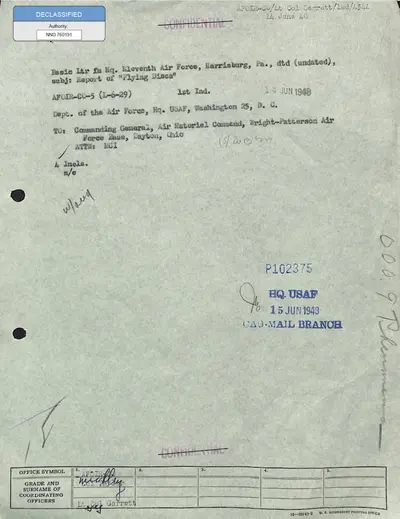
On April 12, 1948, investigators within the United States government recorded an unidentified-object incident at Tyndall Air Force Base. The details of this specific event were not made available to the general public for decades, eventually surfacing on May 8, 2026, as part of the Presidential Unsealing and Reporting System for UAP Encounters (PURSUE). The documentation regarding this event is contained within official U.S. Department of Defense records.
The released documentation consists of a report regarding unidentified “flying discs” that was forwarded from the Headquarters of Tyndall Air Force Base. The report originated on the date of the sighting and was processed through various official channels within the Air Force for review and potential subsequent action. While the existence of the report and its movement through the military hierarchy are confirmed, the specific descriptive content of the sighting remains limited in the available documentation. The released files do not specify the number of witnesses involved in the observation, nor do they provide a detailed description of the objects’ flight paths or physical characteristics.
Classification and Investigation
The incident is classified as a visual sighting reported by ground or air observers. In the context of 1948, such reports were often evaluated against the backdrop of emerging technologies and atmospheric science. The investigation of such phenomena during this era often focused on determining whether the objects were products of known human activity or natural occurrences.
Under the current framework of the All-domain Anomaly Resolution Office (AARO), all records released under the PURSUE program are designated as unresolved by default. The federal government has maintained a neutral stance regarding the Tyndall sighting, neither concluding that the objects were anomalous nor confirming that they were conventional. The possibility of both remains open.
When evaluating sightings from the late 1940s, investigators frequently consider several conventional candidates. These include the testing of experimental aircraft or the presence of weather balloons, particularly those associated with the Project Mogul series, which utilized high-altitude balloons to detect Soviet nuclear tests. Additionally, atmospheric optical phenomena such as sundogs, lenticular clouds, or even the positioning of astronomical bodies like Venus, the Moon, or meteors near the horizon are often analyzed as potential explanations for the visual identification of discs or unidentified lights in the sky.