Sterling, Utah UAP Encounter, 1948 — USAAF Box 7 #186
U.S. Army Air Forces records document a 1948 unidentified object sighting near Sterling, Utah, reported by an automobile dealer and airplane mechanic.
Historical Context
The year 1948 represented a period of significant transition in the American perception of the skies. Following the June 194 novembere Kenneth Arnold sighting and the July 1947 Roswell incident, the United States experienced a massive surge in reports of unidentified aerial phenomena. This era, often characterized by the “flying saucer” phenomenon, coincided with the early stages of the Cold War and rapid advancements in aerospace technology. During this time, the public and military observers were increasingly confronted with objects that did not align with known aeronautical capabilities, leading to a period of intense scrutiny regarding aerial unidentified objects.
Geographically, the region surrounding Sterling, Utah, sits within a landscape shaped by the Great Basin and the Rocky Mountains. This area, characterized by vast stretches of open terrain and varying atmospheric conditions, has historically been a site for various aerial observations. During the late 1940s, the American Southwest and the Intermountain West were frequently the focus of such reports, as the lack of heavy industrial light pollution and the presence of high-altitude flight corridors provided ideal conditions for both the sighting of astronomical objects and the observation of experimental military hardware.
Incident Documentation
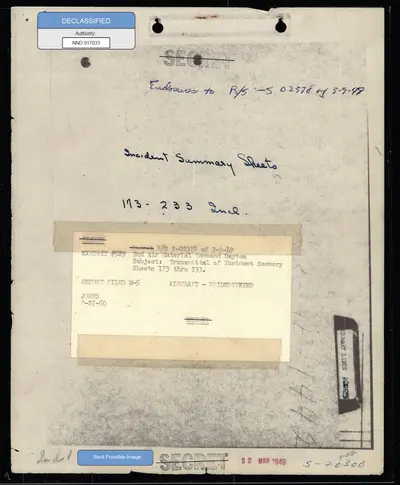
The specific details of the Sterling encounter are preserved within the U.S. Army Air Forces “Check-List - Unidentified Flying Objects” series, specifically identified as Incident #186. These records are located in Box 7 of file 38_143685. The documentation was made public by the Department of War on May 8, 2026, through the Presidential Unsealing and Reporting System for UAP Encounters (PURSUE). The official form records a sighting reported by Mr. Fred Nash, residing at 20 Hast Crystal, Salt Lake City, Utah. The reporting individual was noted to be a used car dealer and airplane mechanic, a professional background that suggests a degree of familiarity with aeronautical mechanics and visual identification of aircraft. The record also notes an affiliation with the Latter-day Saints.
The nature of the case is classified as a visual sighting, a category that encompasses reports made by observers on the ground or from within other aircraft. This type of encounter relies heavily on the subjective visual interpretation of the observer, which was a common characteristic of the 1947-1948 wave of sightings. Because the report originated from an individual with mechanical training, the sighting carries the weight of an observer capable of distinguishing between standard propulsion systems and more anomalous flight characteristics.
Investigative Status and Analysis
As of the release of these documents, the status of the Sterling encounter remains officially unresolved. All records released under the PURSUE program are designated as unresolved by the All-domain Anomaly Resolution Office. The federal government has maintained a neutral stance regarding the nature of the object, neither concluding that the sighting was anomalous nor confirming that it was caused by conventional means. This lack of a definitive ruling reflects the broader difficulty in investigating mid-century aerial phenomena, where physical evidence is rarely recovered alongside eyewitness testimony.
When analyzing the 1947-era saucer wave, researchers often consider several conventional candidates that could explain such sightings. During this period, Project Mogul balloon flights were active over the American Southwest, intended to detect Soviet nuclear tests via high-altitude acoustic monitoring. Additionally, the development of experimental jet and rocket aircraft, along with various atmospheric optical effects and the misidentification of astronomical objects at unusual angles, provided plausible, non-anomalous explanations for many reported objects. The Sterling incident remains part of this complex historical dataset, awaiting further clarity that the current official record does not provide.