Pasadena, California UFO Sighting (December 7, 1948) — FBI Files
FBI investigators documented a disc-shaped object embedded in the ground on private property near Pasadena, California, in December 1948.
Background
On December 7, 1948, in Pasadena, California, U.S. government investigators recorded an unidentified-object incident later released to the public on May 8, 2026, as part of the Presidential Unsealing and Reporting System for UAP Encounters (PURSUE). This event occurred during a period of significant public and governmental preoccupation with aerial anomalies. The incident is one of the first wave of “flying saucer” reports that swept the United States following the Kenneth Arnold sighting of June 1947 and the Roswell incident of July 1947. During the late 1940s, the emergence of these reports coincided with the early stages of the Cold War, a period characterized by intense scrutiny of the American airspace due to the potential for Soviet incursions.
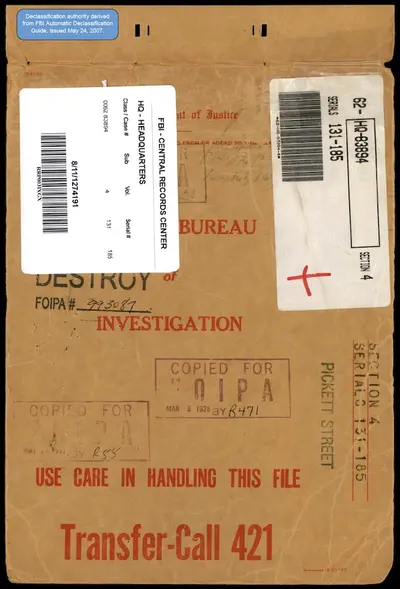
The administrative handling of this case reflects the bureaucratic landscape of the era. The case was filed with the Federal Bureau of Investigation, whose Knoxville, Albuquerque, Los Angeles, and other field offices routed UFO reports to headquarters under the Bureau’s standing protocols for the protection of vital installations. At the time, the FBI functioned as a primary repository for reports involving potential threats to national security, including unidentified aerial phenomena that might represent advanced foreign technology. The centralization of these reports in Washington, D.C., ensured that intelligence regarding unusual aerial activity was monitored by federal authorities tasked with domestic security.
The Incident and Documentation
The specific details of the encounter are derived from investigative records that describe a physical impact on private land. On December 7, 1948, FBI agents accompanied Mr. Nathan Smith and his wife to a location approximately 150 miles from Pasadena, California, where a disc-shaped object had reportedly landed. The object, described as a ‘flying wing’, was found on Mr. Smith’s private property, embedded in the ground at a 45-degree angle. Investigators estimated the object to be around seven feet in diameter before the crash and noted that it had slid approximately 300-400 feet after impact.
While the physical evidence of the impact was documented by agents on-site, the number of witnesses to the initial descent or the object’s presence is not specified in the released document. The description of the object as a ‘flying wing’ suggests a departure from purely spherical or disc-like geometries, pointing toward a more complex aerodynamic structure. Such descriptions were common in the post-1947 era as observers attempted to categorize objects that did not align with the recognizable silhouettes of contemporary propeller-driven or early jet-engine aircraft.
Classification and Investigation Status
The witnesses described the object as disc- or saucer-shaped, a terminology that became the standard nomenclature for such sightings throughout the mid-twentieth century. This classification aligns the Pasadena incident with the broader phenomenon of perceived saucer-shaped craft that dominated the news media and scientific inquiries of the late 1940s.
All records released under the PURSUE program are designated unresolved by the All-domain Anomaly Resolution Office (AARO) by default. The federal government has not concluded that the events were anomalous, has not concluded that they were conventional, and has not ruled out either possibility. The investigation into the 1948 event remains open in a historical sense, as the physical object and the circumstances of its impact were not definitively attributed to any known technology of the period.
Conventional candidates for sightings of this period include experimental aircraft, weather balloons, especially the Project Mogul series in the late 1940s, and atmospheric optical phenomena such as sundogs and lenticular clouds. Additionally, astronomical objects including Venus, the Moon, and meteors near the horizon were frequently cited as potential explanations for unidentified lights and objects. The difficulty in distinguishing between these natural or man-made phenomena and truly anomalous objects remains a primary challenge in the study of the 1948 Pasadena records.