Oslo, Norway UAP Encounter, 1948 — USAAF Box 7 #150
An unidentified object was reported near Oslo, Norway, in 1948, as documented in the declassified U.S. Army Air Forces archives.
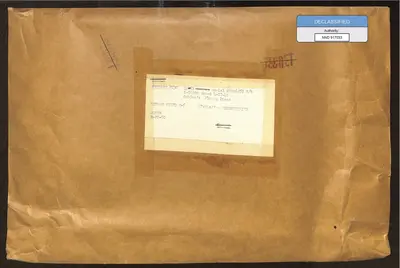
Incident Overview
In 1948, near Oslo, Norway, the U.S. Army Air Forces recorded an unidentified-object incident that became Incident #150 in the “Check-List - Unidentified Flying Objects” series archived in Box 7 of file 38_143685. The records pertaining to this sighting were released by the Department of War on May 8, 2026, as part of the Presidential Unsealing and Reporting System for UAP Encounters (PURSUE). The summary records within the official documentation indicate that an unspecified observer reported a sighting in the vicinity of the Norwegian capital.
Historical Context
The timing of the Oslo report places it within a significant period of global atmospheric interest. This case is one of the first wave of “flying saucer” reports that swept the United States and influenced international aviation monitoring following the Kenneth Arnold sighting of June 1947 and the Roswell incident of July 1947. During the late 1940s, the sudden influx of reports involving unidentified aerial phenomena prompted military and scientific bodies to begin systematic cataloging of anomalous flight patterns. While much of the contemporary focus remained centered on North American airspace, the presence of such reports in Europe, specifically near major administrative hubs like Oslo, contributed to the growing complexity of post-war aerial surveillance.
The era was characterized by rapid advancements in aeronautical engineering, which simultaneously increased the potential for misidentifications. The emergence of high-altitude reconnaissance, the development of early jet propulsion, and the deployment of sophisticated balloon-based monitoring systems created a landscape where conventional objects could easily be perceived as anomalous. The Oslo encounter, though brief in its documented details, emerged from this broader climate of heightened vigilance regarding unidentified objects in the sky.
Classification and Analysis
The case is classified as a visual sighting reported by ground or air observers. Within the archival framework of the U.S. Army Air Forces, such sightings were categorized based on the nature of the observation and the available data at the time of the report. The lack of specific observer identification in the released summary highlights the challenges faced by early investigators in verifying the source and perspective of such sightings.
The status of the Oslo incident remains officially unresolved. All records released under the PURSUE program are designated as unresolved by the All-domain Anomaly Resolution Office. The federal government has maintained a neutral stance regarding the nature of the 1947-era incidents, having not concluded that these sightings were anomalous, nor having concluded that they were conventional. The authorities have not ruled out either possibility, leaving the true identity of the object in the Norwegian sky as an open question within the historical record.
Potential Explanations
When analyzing the “saucer wave” of the late 1940s, researchers often consider several conventional candidates that could account for such sightings. During this period, Project Mogul balloon flights were active over the U.S. Southwest, and the proliferation of experimental jet and rocket aircraft provided new, high-speed aerial signatures. Furthermore, atmospheric optical effects and astronomical objects misidentified at unusual angles frequently provided plausible explanations for sightings of unidentified objects. While these factors are often applied to domestic U.S. reports, they remain the primary scientific framework used to evaluate the 1948 Oslo encounter.