Ompt Glenn Buber, Base UAP Encounter, 1948 — USAAF Box 7 #191
Documentation from the U.S. Army Air Forces records a 1948 unidentified object sighting near Ompt Glenn Buber, Base, released via the PURSUE program.
Historical Context
The year 1948 represented a period of profound transition in American aerospace history and public perception of the skies. Following the conclusion of the Second World War, the United States was navigating the early complexities of the Cold War, a period characterized by rapid advancements in aeronautical engineering and heightened atmospheric surveillance. This era saw the emergence of the “saucer wave,” a phenomenon where reports of unidentified flying objects surged across the American landscape. This wave was largely catalyzed by the June 1947 Kenneth Arnold sighting and the subsequent July 1947 Roswell incident, both of which fundamentally altered the cultural and military approach to aerial anomalies.
During this time, the United States Army Air Forces (USAAF) maintained various internal tracking mechanisms to document aerial phenomena that could potentially impact national security. These records were often categorized within administrative checklists used to monitor unidentified objects that deviated from known flight paths or exhibited unusual physical characteristics. The atmosphere of the late 1940s was one of both technological optimism and intense suspicion, as the deployment of high-altitude reconnaissance and early radar technology frequently produced ambiguous data that was difficult to categorize using the scientific frameworks of the day.
The Incident at Ompt Glenn Buber, Base
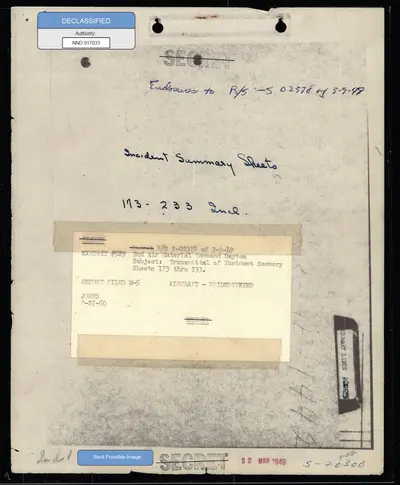
In 1948, near Ompt Glenn Buber, Base, the U.S. Army Air Forces recorded an unidentified-object incident that became Incident #191 in the “Check-List - Unidentified Flying Objects” series. This specific documentation is archived within Box 7 of file 38_143685. The details of the encounter were not made public for decades, remaining part of restricted military archives until the records were released by the Department of War on May 8, 2026, as part of the Presidential Unsealing and Reporting System for UAP Encounters (PURSUE).
The summary provided within the official form records indicates that an unspecified observer reported a sighting in the vicinity of Ompt Glenn Buber, Base. The nature of the report is classified as a visual sighting, which implies the observation was made by either ground-based or air-based observers who directly perceived the object with the naked eye. While the specific trajectory, luminosity, or velocity of the object were not detailed in the brief summary of Incident #191, the existence of the report within the USAAF checklist confirms that the event was deemed significant enough for military notation during the 1948 reporting period.
Investigation and Classification
The status of Incident #191 remains officially unresolved. Under the protocols of the All-domain Anomaly Resolution Office, all records released through the PURSUE program are designated as unresolved. This classification indicates that the federal government has not reached a definitive conclusion regarding the nature of the object. The authorities have neither confirmed that the sighting was anomalous in a way that suggests non-conventional technology nor have they concluded that the object was a known, conventional craft.
The ambiguity of the 1948 report is consistent with many other cases from the post-war saucer wave. At the time of the sighting, investigators often struggled to differentiate between emerging military technology and unidentified phenomena. Potential conventional candidates for such sightings during this era include the Project Mogul balloon flights, which were active over the American Southwest to detect Soviet nuclear tests, as well as experimental jet and rocket aircraft. Additionally, atmospheric optical effects and the misidentification of astronomical objects at unusual angles frequently contributed to the volume of unidentified reports. Because the official record for the Ompt Glenn Buber, Base encounter lacks a definitive resolution, it remains a subject of study within the broader context of mid-century aerial anomalies.