Observer! (4. @. UAP Encounter, 1948 — USAAF Box 7 #23
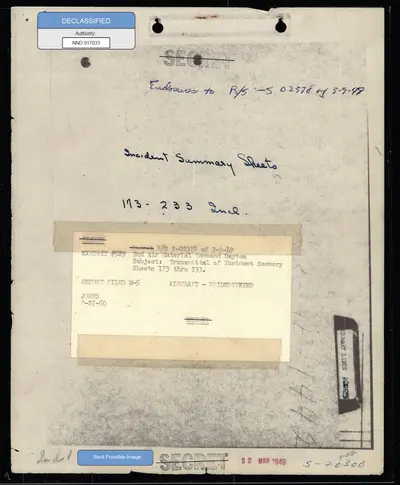
An archived 1948 U.S. Army Air Forces report details an unidentified object sighting near Observer! (4. @., ground, air, “oer eit one ered se RE phe SP eaas Syn…
Historical Context
The year 1948 represented a period of significant transition in American aerospace history and national security protocols. Following the conclusion of World War II, the United States was navigating the early complexities of the Cold War, characterized by rapid advancements in aeronautical engineering and the emergence of new aerial threats. This era saw the widespread dissemination of “flying saucer” reports across the American landscape, a phenomenon triggered by high-profile sightings such as the Kenneth Arnold event in June 1947 and the controversial Roswell incident in July 1947. During this period, the public and military consciousness were increasingly preoccupied with objects that appeared to defy the known laws of aerodynamics.
The reporting of such phenomena was often handled through various military and civil channels, as the formal frameworks for investigating Unidentified Anomalous Phenomena (UAP) had not yet been standardized. The U.S. Army Air Forces maintained internal documentation to track anomalous aerial activity, often utilizing checklists to categorize sightings based on their observable characteristics. These records, while often fragmentary, provide a primary source for understanding how the military categorized unidentified objects during the initial wave of post-war aerial anomalies.
The Incident
In 1948, near Observer! (4. @., ground, air, “oer eit one ered se RE phe SP eaas Syn Captain A, the U.S. Army Air Forces recorded an unidentified-object incident that became Incident #23 in the “Check-List - Unidentified Flying Objects” series archived in Box 7 of file 38_143685. The specific details of this encounter were preserved within military archives and were later released to the public by the Department of War on May 8, 2026, as part of the Presidential Unsealing and Reporting System for UAP Encounters (PURSUE).
The documentation for Incident #23 provides a summary of the event, noting that an unspecified observer reported a sighting in the vicinity of Observer! (4. @., ground, air, “oer eit one ered se RE phe SP eaas Syn Captain A. The nature of the report is classified as a visual sighting, which could have originated from either ground-based or air-based observers. The specific parameters of the object’s flight path, speed, or physical appearance are not elaborated upon in the released summary, leaving the precise characteristics of the object unverified.
Investigative Analysis and Status
The investigation into Incident #23 remains officially inconclusive. All records released under the PURSUE program are designated as unresolved by the All-domain Anomaly Resolution Office. The federal government has maintained a neutral stance regarding the nature of this specific 1948 encounter, having neither concluded that the sighting was anomalous nor confirmed that it was the result of conventional phenomena. This lack of a definitive ruling is consistent with the handling of many 1947-era incidents, where the absence of radar data or multi-sensor corroboration prevented a conclusive determination.
When analyzing the “saucer wave” of the late 1940s, researchers often consider several conventional candidates that could account for such sightings. During this period, the Project Mogul balloon flights were active over the U.S. Southwest, intended to detect Soviet nuclear tests, and these high-altitude instruments were sometimes mistaken for unidentified objects. Additionally, the development of experimental jet and rocket aircraft, alongside atmospheric optical effects and the misidentification of astronomical objects at unusual angles, provided plausible, non-anomalous explanations for many reported sightings. However, without further data, the status of Incident #23 remains officially unverified.