Observer, Atlanta UAP Encounter, 1948 — USAAF Box 7 #165
A 1948 U.S. Army Air Forces report documents an unidentified flying object sighting near Atlanta, Georgia, released via the PURSUE program in 2026.
Historical Context of the 1948 Saucer Wave
The year 1948 represented a period of profound transition in American aerospace awareness. Following the summer of 1947, the United States experienced a sudden surge in reports of unidentified aerial phenomena, a phenomenon historians often refer to as the “flying saucer” wave. This era of mass sightings was catalyzed by the Kenneth Arnold sighting in June 1947 and the subsequent, highly controversial Roswell incident in July 1947. During this period, the rapid advancement of aeronautical technology, including the development of early jet engines and high-altitude reconnaissance, created a climate where the distinction between known experimental hardware and unknown intruders was frequently blurred.
In the American Southeast, particularly around the burgeoning aviation hubs of Atlanta, Georgia, the skies were increasingly populated by military and commercial traffic. As the United States Army Air Forces (USAAF) worked to establish air superiority and domestic surveillance protocols in the post-war era, the systematic recording of anomalous sightings became a matter of departmental interest. These reports were often processed through standardized checklists designed to categorize visual anomalies for military intelligence.
The Atlanta Incident: USAAF Box 7 #165
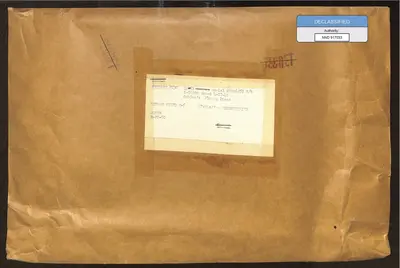
The specific case known as Incident #165 is documented within the “Check-List - Unidentified Flying Objects” series, a collection of military records archived in Box 7 of file 38_143685. The documentation regarding this event was not accessible to the public for decades, remaining part of classified military archives until its release by the Department of War on May 8, 2026. This release was executed as part of the Presidential Unsealing and Reporting System for UAP Encounters (PURSUE), a modern initiative aimed at providing transparency regarding historical aerial anomalies.
The summary provided within the official USAAF form records a visual sighting of an unidentified object. The report originated from an unspecified observer who witnessed the phenomenon near Observer, Atlanta. While the specific flight characteristics or physical descriptions of the object are not detailed in the brief summary, the incident is categorized as a visual sighting reported by ground or air observers. The documentation serves as a primary source for tracking the frequency and geographic distribution of unidentified objects during the late 1940s.
Investigation and Classification
The investigation of such incidents in 1948 was largely decentralized, often relying on the reporting of military personnel and civilian observers to populate departmental checklists. Unlike modern investigations that utilize multi-spectral sensor data, the 1948-era records are primarily dependent on human visual perception. This makes the Atlanta sighting part of a broader class of cases involving visual-only observations, which are historically difficult to verify due to the lack of corroborating radar or infrared data.
The All-domain Anomaly Resolution Office has designated all records released under the PURSUE program, including Incident #165, as unresolved. The federal government maintains a neutral stance regarding the nature of these 1947-era incidents. Official findings have not concluded that these sightings were anomalous or extraterrestrial, nor have they concluded that the objects were conventional. The possibility of both remains open within the official record.
When analyzing the 1948 Atlanta encounter, researchers often consider several conventional candidates that were active during the same period. These include the Project Mogul balloon flights, which were conducting high-altitude acoustic monitoring over the American Southwest, as well as the testing of experimental jet and rocket aircraft. Additionally, atmospheric optical effects and the misidentification of astronomical objects at unusual angles are frequently cited as potential explanations for the visual sightings that characterized the post-war saucer wave.