Los Alamos, New Mexico UFO Sighting (December 5, 1948) — FBI Files
FBI records document a bright, yellow-green light observed near Starvation Peak in Los Alamos, New Mexico, in late 1948.
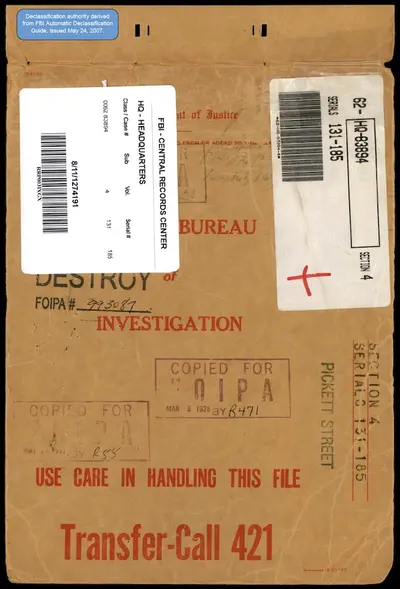
Background
On December 5, 1948, in Los Alamos, New Mexico, U.S. government investigators recorded an unidentified-object incident later released to the public on May 8, 2026, as part of the Presidential Unsealing and Reporting System for UAP Encounters (PURSUE). The incident occurred during a period of heightened national anxiety regarding aerial unidentified phenomena. This sighting was part of the first wave of “flying saucer” reports that swept the United States following the Kenneth Arnold sighting of June 1947 and the Roswell incident of July 1947. During this era, the sudden influx of reports regarding metallic, disc-shaped objects led to significant speculation regarding both extraterrestrial visitors and secret Soviet technology.
The geographic location of the sighting, Los Alamos, added a layer of strategic importance to the investigation. As the site of the Los Alamos National Laboratory, the area was a highly sensitive installation central to the United States’ nuclear weapons program. Because of the high concentration of classified scientific research and military activity in the region, the Federal Bureau of Investigation (FBI) maintained strict monitoring protocols. The case was filed with the FBI, and the Bureau’s Knoxville, Albuquerque, and Los Angeles field offices followed standing protocols to route UFO reports to headquarters, specifically to ensure the protection of vital installations from potential aerial threats or espionage.
What the document records
Around December 5, 1948, a bright, yellow-green phenomenon was observed near Starvation Peak. The observation was documented by Dr. La Paz, who provided a technical description of the event. Dr. La Paz described the phenomenon as a light with constant intensity, traveling horizontally at a constant angular velocity for approximately two seconds, and without any accompanying noise. The lack of acoustic signatures or deceleration during the transit was a notable detail in the report. Based on the visual characteristics and the trajectory of the light, the observation was determined to not be a typical meteorite fall.
The released document does not specify the exact number of witnesses present during the observation near Starvation Peak. The nature of the report suggests a visual sighting, likely captured by observers on the ground or potentially from aerial vantage points, though the specific orientation of the observers remains unconfirmed in the primary text.
Type of case
The case is classified as a visual sighting reported by ground or air observers. Such cases are common in the mid-century archives, often characterized by descriptions of luminous, maneuvering lights that lack the predictable trajectory of known celestial bodies or the atmospheric dissipation patterns of falling debris.
Status
All records released under the PURSUE program are designated unresolved by the All-domain Anomaly Resolution Office (AARO) by default. The federal government has not concluded that the events were anomalous, has not concluded that they were conventional, and has not ruled out either possibility. The ambiguity of the status reflects the difficulty of verifying sightings from decades-old documentation where physical evidence is absent.
Conventional candidates for sightings of this period include experimental aircraft, weather balloons, particularly the Project Mogul series which utilized high-altitude balloons to detect Soviet nuclear tests in the late 1940s. Other possibilities include atmospheric optical phenomena such as sundogs and lenticular clouds, or astronomical objects including Venus, the Moon, and meteors near the horizon. The specific yellow-green hue and the horizontal, constant-velocity movement recorded in the Los Alamos case remain the primary points of interest for researchers attempting to differentiate this event from standard atmospheric or astronomical occurrences.