Canjilon, New Mexico UFO Sighting (July 22, 1947) — FBI Files
FBI records document a 1947 sighting in Canjilon, New Mexico, involving unidentified lights and explosions reported by a forest ranger.
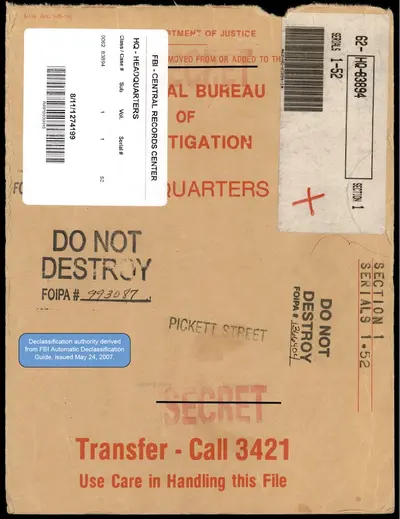
Background
On July 22, 1947, in Canjilon, New Mexico, U.S. government investigators recorded an unidentified-object incident later released to the public on May 8, 2026, as part of the Presidential Unsealing and Reporting System for UAP Encounters (PURSUE). The location of the event, situated in the high desert of the American Southwest, placed it within a region that would soon become central to much of the mid-century aerial anomaly discourse. This incident occurred during a period of intense public and governmental scrutiny regarding unidentified aerial phenomena, serving as one of the first wave of “flying saucer” reports that swept the United States following the Kenneth Arnold sighting in June 1947 and the Roswell incident in July 1947.
During this era, the phenomenon of unidentified flying objects was often viewed through the lens of early Cold War anxieties. The rapid advancement of aerospace technology and the emergence of long-range ballistic capabilities led many observers to interpret unusual aerial activity as potential threats to national security. The case was filed with the Federal Bureau of Investigation, whose Knoxville, Albuquerque, Los Angeles, and other field offices routed UFO reports to headquarters under the Bureau’s standing protocols for the protection of vital installations. This bureaucratic process highlights how the federal government approached such sightings not merely as astronomical curiosities, but as potential intelligence matters related to the integrity of domestic airspace and sensitive infrastructure.
What the document records
The specific details of the event are preserved through official communications rather than direct eyewitness testimony. Forest Ranger Frank Burtram reportedly observed a flying object near Canjilon, New Mexico, as relayed through informant GWYNNE M. MERCHANT. The object was described as part of a series of lights seen at night, which were allegedly followed by explosions. The nature of these lights and the subsequent detonations provided a sense of kinetic activity that contributed to the gravity of the report. Merchant believed these objects might be missiles, reflecting the contemporary tendency to categorize unidentified aerial phenomena as man-made, albeit potentially hostile, technological developments.
While the documentation provides a clear account of the observations made by Burtram and the interpretations offered by Merchant, the number of witnesses is not specified in the released document. This lack of a definitive witness count is common in historical FBI files, where the focus often remained on the reliability of the primary informant and the potential for the event to impact national security interests rather than the breadth of public awareness.
Type of case
The case is classified as a visual sighting reported by ground or air observers. Such reports are a staple of the mid-century aerial anomaly corpus, often characterized by descriptions of luminous, moving objects that defy immediate identification by the observer.
Status
All records released under the PURSUE program are designated unresolved by the All-domain Anomaly Resolution Office (AARO) by default. The federal government has not concluded that the events were anomalous, has not concluded that they were conventional, and has not ruled out either possibility. This official ambiguity reflects the difficulty of verifying historical sightings without modern sensor data or physical debris.
Conventional candidates for sightings of this period include experimental aircraft, weather balloons, especially the Project Mogul series in the late 1940s, atmospheric optical phenomena such as sundogs and lenticular clouds, and astronomical objects including Venus, the Moon, and meteors near the horizon. The possibility of clandestine surveillance or testing of new propulsion systems remains a subject of historical analysis within the context of the era’s rapid military-industrial expansion.