Hollywood, California UFO Sighting (December 6, 1948) — FBI Files
On December 6, 1948, an unidentified flying disk was tracked from the Hollywood area to a location 150 miles northeast of Pasadena.
Historical Context
The late 1940s represented a transformative period in the study of unidentified aerial phenomena within the United States. Following the June 1947 Kenneth Arnold sighting and the July 1947 Roswell incident, the American public and various government agencies were suddenly confronted with a surge of reports involving metallic, disc-shaped objects. This era, often characterized by the “flying saucer” phenomenon, coincided with the early stages of the Cold War and the rapid advancement of aerospace technology. During this time, the presence of unidentified objects in the sky was frequently viewed through the lens of national security, as the possibility of advanced Soviet aeronautics or unconventional aerial surveillance became a primary concern for domestic intelligence agencies.
The geography of Southern California, specifically the region surrounding Hollywood and the high deserts of the Mojave, provided a frequent backdrop for such sightings. The area’s proximity to various military installations and aerospace research facilities made it a focal point for both official surveillance and civilian observation. As the United States expanded its radar networks and atmospheric monitoring, the frequency of reported anomalies increased, leading to the establishment of formal reporting protocols within federal law enforcement.
The December 1948 Incident
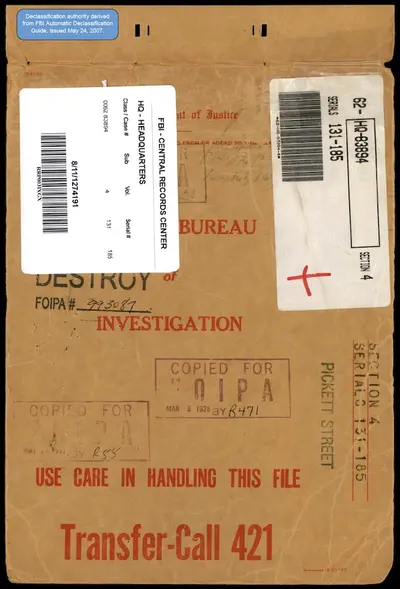
On December 6, 1948, an unidentified-object incident occurred in Hollywood, California, which was later documented by U.S. government investigators. The details of this specific case were released to the public on May 8, 2026, as part of the Presidential Unsealing and Reporting System for UAP Encounters (PURSUE). The documentation of this event was handled through the Federal Bureau of Investigation, following established bureaucratic procedures of the era. The FBI’s various field offices, including those in Knoxville, Albuquerque, and Los Angeles, were tasked with routing UFO reports to headquarters under standing protocols designed to protect vital installations and monitor potential threats to national security.
The released records indicate that on the date of the sighting, an individual identified as R.C. Person observed what he described as a flying disk in a desert area near Hollywood. Following this initial observation, Person shared the information with Lonnie Noack. The two individuals subsequently engaged in a search for the object. This search led them to a secondary location approximately 150 miles northeast of Pasadena, where they eventually located the object. While the document provides a clear trajectory for the sighting and the subsequent search, the total number of witnesses involved in the event is not specified in the released text.
Classification and Analysis
This case is classified as a visual sighting reported by ground or air observers. Within the framework of modern anomalous studies, the incident remains categorized as an unidentified aerial phenomenon. Under the current guidelines of the All-domain Anomaly Resolution Office (AARO), all records released through the PURSUE program are designated as unresolved by default. The federal government has maintained a neutral stance regarding the Hollywood sighting, having neither concluded that the event was anomalous nor confirmed that it was caused by conventional means.
When analyzing sightings from the late 1940s, investigators often consider several conventional candidates. These include the presence of experimental aircraft developed during the post-war aerospace boom, or the deployment of weather balloons, specifically those associated with the Project Mogul series, which utilized high-altitude balloons to detect Soviet nuclear tests. Other possibilities include atmospheric optical phenomena, such as lenticular clouds or sundogs, as well as astronomical objects like Venus, the Moon, or meteors appearing near the horizon. The Hollywood case remains part of the broader historical record of unverified aerial phenomena that continue to be studied for their potential implications.