Helendale, California UFO Sighting (December 29, 1948) — FBI Files
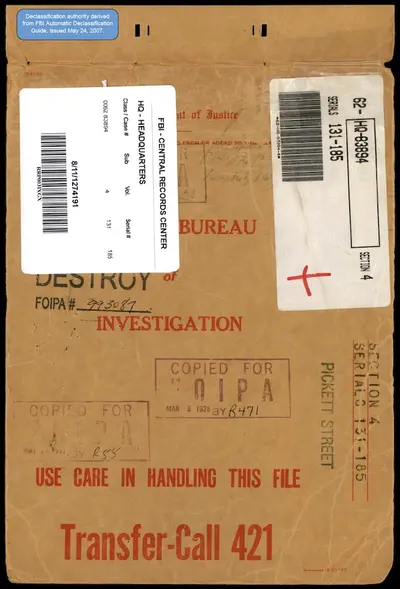
FBI records detail a 1948 investigation in Helendale, California, where a reported flying disk was identified as components of a model tow target.
Historical Context
The late 1940s represented a period of profound transition in American aerospace technology and public perception of the skies. Following the conclusion of World War II, the sudden emergence of unidentified aerial phenomena created a sense of widespread atmospheric uncertainty. This era was defined by the initial wave of “flying saucer” reports that began in the summer of 1947, following the Kenneth Arnold sighting in June and the highly publicized Roswell incident in July. During this time, the United States was rapidly entering the Cold War, leading to heightened sensitivity regarding any unidentified objects appearing near domestic airspace or vital military installations.
The geographic region of Helendale, situated in the high desert of the Mojave, provided a frequent backdrop for such sightings due to its proximity to various military testing ranges and airfields. In the late 1940s, the presence of experimental aeronautics and high-altitude surveillance projects contributed to a landscape where the distinction between known technology and anomalous phenomena was often blurred. The federal government, through various agencies, maintained a rigorous, albeit often clandestine, protocol for monitoring these reports, particularly when they intersected with the security of national infrastructure.
The Helendale Incident
On December 29, 1948, in Helendale, California, U.S. government investigators recorded an unidentified-object incident that remained largely out of the public eye for decades. The details of this case were eventually released to the public on May 8, 2026, as part of the Presidential Unsealing and Reporting System for UAP Encounters (PURSUE). The reporting of this event followed the established bureaucratic channels of the era. The case was filed with the Federal Bureau of Investigation, which utilized a standardized system where field offices in locations such as Knoxville, Albuquerque, and Los Angeles routed UFO reports to headquarters. This routing was conducted under the Bureau’s standing protocols designed specifically for the protection of vital installations and the monitoring of potential security threats.
The investigation into the reported “flying disk” focused on determining the origin and nature of the object observed in the Helendale sky. Through investigative efforts, officials were able to identify three specific parts of the object as components belonging to a model tow target. The records indicate that this target had been subjected to testing over Nathan Smith’s airfield. During the course of its operation, the target crashed and was subsequently abandoned. Investigators were able to trace the origin of the materials to a plastics molding company owned by Claude L. Wolford. Upon establishing this link to a known, terrestrial source, investigators determined that no further investigation into the matter was warranted. While the released documentation provides the technical resolution of the object, the specific number of witnesses to the sighting is not specified in the official file.
Classification and Analysis
The Helendale case is classified as a visual sighting reported by ground or air observers. In the broader context of mid-century aerial phenomena, such cases often fall into a category of “misidentification,” where conventional objects are perceived as anomalous due to distance, lighting, or lack of context. During this period, many sightings were later attributed to the Project Mogul series of high-altitude balloons, experimental aircraft, or atmospheric optical phenomena such as sundogs and lenticular clouds. Astronomical objects, including the Moon, Venus, or meteors near the horizon, also frequently served as the source of reported unidentified objects.
Under the current framework of the All-domain Anomaly Resolution Office (AARO), all records released under the PURSUE program are designated as unresolved by default. This designation reflects a neutral investigative stance. The federal government has not reached a definitive conclusion regarding whether the events documented in these files are anomalous or conventional. Consequently, the Helendale incident remains part of a larger archive of reports where the official record provides a terrestrial explanation for the object, yet the broader classification of the event remains subject to the strict parameters of the ongoing analytical protocols.