Colusbus Area, Mrs UAP Encounter, 1948 — USAAF Box 7 #138
An archived U.S. Army Air Forces record details a 1948 unidentified object sighting near the Colusbus Area, released via the PURSUE program in 2026.
Background
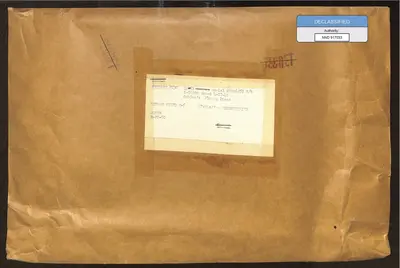
In 1948, near the Colusbus Area, the U.S. Army Air Forces recorded an unidentified-object incident that became Incident #138 in the “Check-List - Unidentified Flying Objects” series archived in Box 7 of file 38_143685. The records were released by the Department of War on May 8, 2026, as part of the Presidential Unsealing and Reporting System for UAP Encounters (PURSUE). This specific documentation emerged as part of a larger wave of “flying saucer” reports that swept the United States following the Kenneth Arnold sighting of June 1947 and the Roswell incident of July 1947. During this era, the sudden appearance of unidentified aerial phenomena prompted significant interest within military intelligence and scientific communities, as the post-war period saw rapid advancements in aviation technology and the dawn of the jet age.
The period following 1947 was characterized by a heightened state of vigilance regarding aerial incursions. As the Cold War began to solidify, the ability to distinguish between conventional aircraft, atmospheric phenomena, and potential adversary technology became a primary concern for national defense. The “Check-List” series used by the U.S. Army Air Forces served as a systematic method for tracking these occurrences, attempting to categorize sightings that defied immediate identification. Such archives provide a window into how military bureaucracy attempted to manage the growing public and internal preoccupation with objects moving in ways that were not yet understood by contemporary radar or visual observation capabilities.
Incident Details
Incident #138 of the U.S. Army Air Forces “Check-List - Unidentified Flying Objects” series, archived in Box 7 of file 38_143685 and released by the Department of War on May 8, 2026, as part of the Presidential Unsealing and Reporting System for UAP Encounters (PURSUE), contains limited descriptive data. The summary records that an unspecified observer reported a sighting near the Colusbus Area. The nature of the report is classified as a visual sighting, which typically involves observations made by ground-based or air-based observers. Due to the brevity of the archival entry, the specific characteristics of the object, such as its velocity, luminosity, or flight pattern, are not detailed within this particular document.
The lack of granular detail in the 1948 report is reflective of the reporting standards of the time, where many entries were brief summaries of larger, often fragmented, intelligence reports. While the specific visual parameters of the Colusbus sighting remain unknown, the existence of the entry within the official military checklist confirms that the event was deemed significant enough to be formally logged by the U.S. Army Air Forces. This type of documentation is common among the many unclassified files released during the 2026 declassification efforts, which often consist of high-level summaries rather than exhaustive eyewitness testimonies.
Classification and Analysis
The case is categorized as a visual sighting reported by ground or air observers. Within the framework of historical UAP studies, such sightings are often analyzed alongside other contemporary reports to determine if patterns of movement or shared characteristics exist across different geographic regions. The classification of the event as a UFO indicates that the object’s identity could not be immediately verified through existing military or civilian tracking methods available in 1948.
All records released under the PURSUE program are designated unresolved by the All-domain Anomaly Resolution Office. The federal government has not concluded these 1947-era incidents were anomalous, has not concluded they were conventional, and has not ruled out either possibility. Researchers examining the 1947-era saucer wave often consider several conventional candidates to explain such sightings. These include the Project Mogul balloon flights, which were active over the U.S. Southwest at the time, as well as experimental jet and rocket aircraft undergoing testing. Other possibilities include atmospheric optical effects or astronomical objects that were misidentified due to unusual viewing angles. The Colusbus Area incident remains part of this broader, unresolved historical dataset.