Albuquerque, New Mexico UFO Sighting (December 5-20, 1948) — FBI Files
During December 1948, investigators documented sightings of silent, green fireballs moving horizontally across the skies of Albuquerque, New Mexico.
Historical Context
The period following the summer of 1947 marked a significant shift in the American consciousness regarding unidentified aerial phenomena. The June 194 existence of the Kenneth Arnold sighting and the July 1947 Roswell incident had established a new framework for public and governmental attention toward objects in the sky. During this era, the term “flying saucer” became part of the common lexicon, and the United States was navigating the early complexities of the Cold War. As the nation grappled with the technological advancements of the jet age and the burgeoning nuclear arms race, the sight of unidentified objects over domestic soil was often viewed through a lens of national security and potential espionage.
Albuquerque, New Mexico, occupied a critical position within this geopolitical landscape. As a hub for aerospace development and military operations, the region was home to significant installations that required constant monitoring. The presence of high-altitude research and defense-related infrastructure meant that any anomalous activity in the New Mexican skies was subject to rigorous scrutiny by federal agencies.
The Incident Records
Between December 5 and December 20, 1948, a series of unusual aerial observations were documented in Albuquerque. These reports, which were later released to the public on May 8, 2026, through the Presidential Unsealing and Reporting System for UAP Encounters (PURSUE), describe the presence of bright green fireballs. These objects were observed moving horizontally across the sky, a trajectory that deviated from the typical descent patterns associated with celestial debris.
The characteristics of these fireballs distinguished them from standard meteor sightings. Observers noted that the objects maintained a consistent brightness and operated at a notably low altitude. Furthermore, the phenomenon was characterized by a lack of accompanying noise, an absence of the sonic booms or rushing sounds often produced by larger bolides entering the atmosphere. While the released documentation does not specify the exact number of witnesses involved in these sightings, the reports were processed through formal investigative channels.
Investigative Procedures
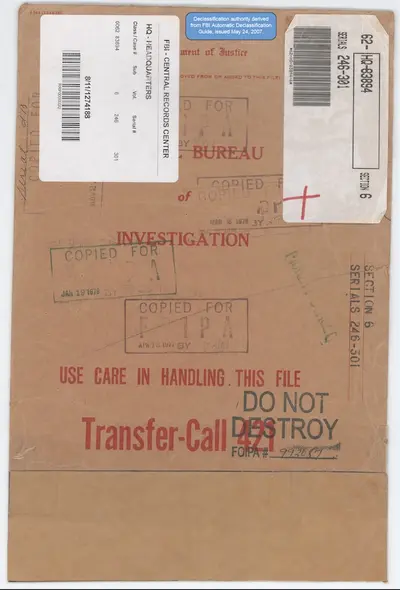
The documentation of these events was handled through the established protocols of the Federal Bureau of Investigation. During this period, the Bureau maintained a structured system for managing reports of unidentified objects, particularly when they occurred near sensitive or vital installations. Field offices in Knoxville, Albuquerque, and Los Angeles were tasked with the initial intake of such reports, which were then routed to FBI headquarters for centralized processing. This procedure ensured that any potential threat to national security or interference with military assets was evaluated by the highest levels of the Bureau.
The handling of the Albuquerque sightings reflects the standard administrative response of the late 1940s, where the focus was on the protection of domestic infrastructure. The integration of these reports into the Bureau’s files suggests that the sightings were treated as matters of potential interest to the federal government, even if they did not immediately trigger a large-scale public investigation.
Classification and Analysis
The Albuquerque case is classified as a visual sighting reported by ground or air-based observers. Within the framework of modern analysis, all records released under the PURSUE program are designated as unresolved by the All-domain Anomaly Resolution Office (AARO) by default. This designation indicates that the federal government has not reached a definitive conclusion regarding whether the events were anomalous or conventional.
The investigation remains open to various scientific and military explanations. Conventional candidates for sightings during this specific window of the late 1940s include the presence of experimental aircraft or the deployment of weather balloons, specifically those associated with the Project Mogul series. Other possibilities include atmospheric optical phenomena, such as sundogs or lenticular clouds, as well as astronomical objects like Venus, the Moon, or meteors positioned near the horizon. Despite these possibilities, the specific horizontal movement and silent nature of the green fireballs remain a subject of historical interest within the archive.