Proctor St, Waco UAP Encounter, 1948 — USAAF Box 7 #275
An archived U.S. Army Air Forces report details an unidentified object sighting near a neon sign manufacturer in Waco, Texas, in 1948.
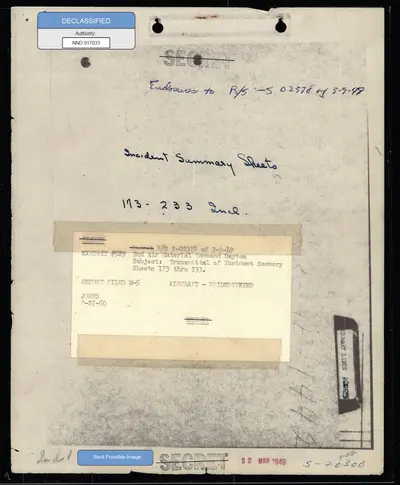
Overview of Incident #275
In 1948, near Proctor Street in Waco, Texas, the United States Army Air Forces documented an unidentified object encounter that is cataloged as Incident #275 within the “Check-List - Unidentified Flying Objects” series. This specific record is preserved in Box 7 of file 38_143685. The documentation regarding this event remained classified for decades until the Department of War released the files on May 8, 2026, under the mandate of the Presidential Unseponymous and Reporting System for UAP Encounters (PURSUE).
The summary contained within the official form records an observation made by an unspecified individual. The sighting occurred in the vicinity of A. Buble Angier, located at 2620 Proctor Street in Waco. The records identify the location’s function at the time of the incident as a neon sign manufacturing facility. While the specific visual characteristics of the object are not detailed in the brief summary, the classification of the event within the military’s checklist identifies the type of case as a pilot or aircrew sighting, indicating the object was observed from a cockpit during flight.
Historical Context of the 1948 Saucer Wave
The Proctor Street encounter occurred during a period of intense public and military interest in unidentified aerial phenomena, often referred to by historians as the first “flying saucer” wave. This era of mass sightings was precipitated by the Kenneth Arnold sighting in June 1947 and the subsequent Roswell incident in July 1947. During this window, the American public became increasingly sensitized to reports of metallic, disc-shaped objects traversing the skies. This period was characterized by a lack of established frameworks for interpreting such sightings, leading to widespread speculation regarding both extraterrestrial origins and secret domestic technology.
Geographically, the American Southwest and the Southern United States, including Texas, became frequent focal points for such reports. The presence of various military installations and experimental flight corridors in these regions contributed to the density of sightings. The Waco incident reflects the broader pattern of military-recorded observations that sought to categorize these phenomena using standardized checklists, even as the nature of the objects remained a subject of intense debate.
Investigative Status and Anomalous Classification
The official status of the Proctor Street sighting remains officially unverified. All records released under the PURSUE program are designated as unresolved by the All-domain Anomaly Resolution Office. The federal government has maintained a position of neutrality regarding the 1947-era incidents, meaning it has neither concluded that these sightings were anomalous nor confirmed them to be conventional. The government has not ruled out either possibility, leaving the event in a state of permanent investigative ambiguity.
When evaluating the legitimacy of such sightings, researchers often consider several conventional candidates that were active in the United States during the late 1940s. These include the Project Mogul balloon flights, which were deployed over the American Southwest to detect Soviet nuclear tests, as well as the testing of experimental jet and rocket aircraft. Other potential explanations for the era’s high volume of reports include atmospheric optical effects or the misidentification of astronomical objects viewed at unusual angles. Despite these possibilities, the specific nature of the object observed near the Waco neon sign manufacturer remains an open question within the historical archive.