WO alles sot of Taher KR UAP Encounter, 1947 — USAAF Box 7 #225
An archived 1947 U.S. Army Air Forces report documents an unidentified flying object sighting near Highway 60, released via the PURSUE program in 2026.
Historical Context of the 1947 Wave
The year 1947 represents a pivotal moment in the history of aerial anomaly documentation. Following the conclusion of World War II, the United States entered a period of intense technological transition and heightened atmospheric surveillance. This era was characterized by the emergence of the “flying saucer” phenomenon, a cultural and military preoccupation triggered by high-profile sightings that suggested the presence of craft possessing flight capabilities beyond known aeronautical science. The most notable of these was the Kenneth Arnold sighting in June 1947, which introduced the concept of objects moving in a manner similar to a saucer skipping across water. This was quickly followed by the controversial events surrounding the Roswell incident in July 1947. These reports created a surge in unidentified flying object (UFO) documentation within military archives, as the U.S. Army Air Forces sought to categorize and track objects that could potentially represent new developments in foreign aerospace technology or atmospheric phenomena.
The Documented Incident
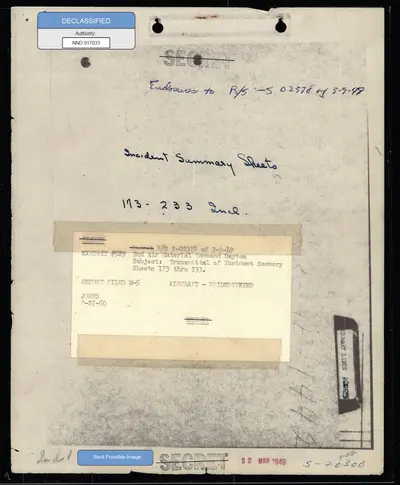
In 1947, near WO alles sot of Taher KR, - Highway 60 om 3 or 4th Mov lis Fe aces Star dA contr, the U.S. Army Air Forces recorded an unidentified-object incident that became Incident #225 in the “Check-List - Unidentified Flying Objects” series archived in Box 7 of file 38_143685. The specific details of this sighting were preserved within military logs and were later released by the Department of War on May 8, 2026, as part of the Presidential Unsealing and Reporting System for UAP Encounters (PURSUE). The summary records that an unspecified observer reported a sighting near the location designated as WO alles sot of Taher KR, - Highway 60 om 3 or 4th Mov lis Fe aces Star dA contr.
The case is classified as a visual sighting reported by ground or air observers. Because the observer remains unidentified in the released documentation, the precise perspective and duration of the sighting cannot be determined. The entry exists as a formal part of a larger systematic effort by the military to maintain a checklist of aerial anomalies that deviated from standard flight patterns or known aircraft profiles.
Investigative Status and Anomalous Classification
All records released under the PURSUE program are designated unresolved by the All-domain Anomaly Resolution Office. This designation reflects a lack of definitive evidence to categorize the object as either a known technological entity or a truly anomalous phenomenon. The federal government has maintained a neutral stance regarding these 1947-era incidents, having neither concluded they were anomalous nor confirmed them to be conventional. Consequently, the possibility of both extraordinary and mundane explanations remains open within the official record.
When analyzing the 1947 saucer wave, researchers often look to conventional candidates that were active in the airspace during this period. One prominent theory involves the Project Mogul balloon flights, which were being deployed over the American Southwest to detect Soviet nuclear tests via high-altitude acoustic sensors. Other potential explanations include the testing of experimental jet and rocket aircraft, which were rapidly advancing during the early Cold War. Furthermore, atmospheric optical effects, such as temperature inversions or light refraction, and the misidentification of astronomical objects at unusual angles are frequently cited as possible sources for such sightings. Incident #225 remains a part of this complex historical puzzle, representing a single data point in the broader study of mid-century aerial anomalies.