Sgt Fredrick M. Wright UAP Encounter, 1947 — USAAF Box 7 #205
An archived U.S. Army Air Forces report documents an unidentified object sighting near the 18th Maintenance Squadron in 1947.
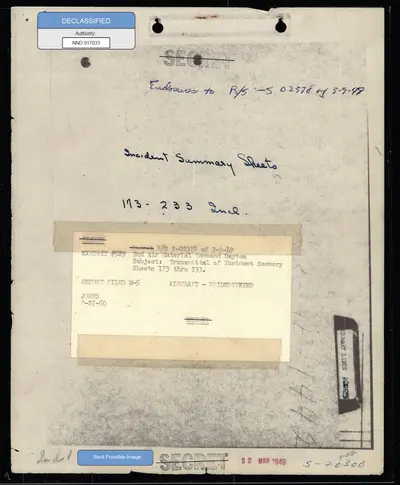
Historical Context
The year 1947 represents a pivotal era in the history of aerial unidentified phenomena. Following the conclusion of World War II, the United States entered a period of rapid technological advancement and heightened atmospheric surveillance. This period saw the emergence of the first modern wave of “flying saucer” reports, a phenomenon triggered largely by the Kenneth Arnold sighting in June 1947 and the subsequent high-profile events surrounding the Roswell incident in July 1947. During this time, the concept of Unidentified Flying Objects was transitioning from fringe speculation into a matter of military and scientific scrutiny. The United States Army Air Forces (USAAF) began utilizing standardized checklists to document sightings, attempting to categorize aerial anomalies within the framework of existing aeronautical knowledge.
The geographic and institutional landscape of the era was defined by a dense network of military installations and supply depots. These bases served as the logistical backbone for the post-war military presence, often situated in regions where high-altitude surveillance and experimental flight testing were commonplace. The emergence of sightings near established military structures, such as maintenance and supply squadrons, provided a unique intersection between civilian observation and military record-keeping.
The Incident
In 1947, near the location identified as Sgt Fredrick M. Wright, 18th Maintenance Sq, Sche Mats & Saply 8, care uP Base, the U.S. Army Air Forces recorded an unidentified-object incident. This event was officially designated as Incident #205 within the “Check-List - Unidentified Flying Objects” series. The specific details of the sighting were preserved in Box 7 of file 38_143685. The documentation indicates that the encounter was a visual sighting reported by an unspecified observer, who noted the presence of an unidentified object in the vicinity of the 18th Maintenance Squadron.
The details of this specific report remained largely inaccessible to the public for decades. The records were officially released by the Department of War on May 8, 2026, through the implementation of the Presidential Unsealing and Reporting System for UAP Encounters (PURSUE). This release was part of a broader institutional effort to provide transparency regarding historical aerial anomalies documented by the federal government.
Classification and Analysis
The case is classified as a visual sighting, a category that encompasses reports made by both ground-based and air-based observers. Such sightings are among the most frequent types of entries found in the 1947-era archives, as they rely on direct ocular observation of an object’s flight path, luminosity, or movement.
The status of Incident #205 remains officially unresolved. Under the protocols of the All-domain Anomaly Resolution Office, all records released through the PURSUE program are designated as unresolved. The federal government has maintained a neutral stance regarding the nature of the object, neither concluding that the sighting was anomalous nor confirming that it was caused by conventional means. The possibility of either an unidentified phenomenon or a known technological or natural occurrence remains open.
When analyzing the 1947 “saucer wave,” researchers often consider several conventional candidates that could account for such reports. During this period, the Project Mogul balloon flights were active over the American Southwest, utilizing high-altitude balloons to detect nuclear tests, which could have been misidentified by observers. Additionally, the development of experimental jet and rocket aircraft, alongside various atmospheric optical effects and the misidentification of astronomical objects at unusual angles, provides a framework of plausible conventional explanations that continue to be investigated alongside more anomalous theories.