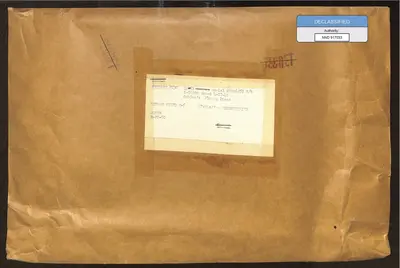
Sgt Win RB, Carter UAP Encounter, 1947 — USAAF Box 7 #16
An archival record from the U.S. Army Air Forces details an unidentified flying object sighting near Sgt Win RB, Carter, in 1947.
Historical Context
The year 1947 represents a pivotal moment in the history of aerial unidentified phenomena, marking the beginning of what researchers often categorize as the first “saucer wave.” This period was characterized by a sudden surge in reports of metallic, disc-shaped objects traversing the American skies. The cultural and scientific landscape of the post-World War II era provided a unique backdrop for these sightings, as the rapid advancement of aeronautical engineering and the dawn of the Jet Age led to a proliferation of new, high-altitude technologies. During this time, the public and military observers were increasingly encountering objects that defied immediate classification using the conventional aeronautical knowledge of the period.
The emergence of these reports followed closely on the heels of the Kenneth Arnold sighting in June 194 and the subsequent Roswell incident in July 1947. These events fundamentally altered the way the United States military and the general public perceived unidentified aerial phenomena. While the term “UFO” was not yet the standard nomenclature, the sudden appearance of these objects prompted the United States Army Air Forces to begin documenting such occurrences through formalized checklists and tracking systems, as seen in the archival records of the era.
The Carter Incident
In 1947, near Sgt Win RB, Carter, the U.S. Army Air Forces recorded an unidentified-object incident that became Incident #16 in the “Check-List - Unidentified Flying Objects” series archived in Box 7 of file 38_143685. The specific details of this sighting were preserved within military administrative files, which were later released to the public by the Department of War on May 8, 2026, as part of the Presidential Unsealing and Reporting System for UAP Encounters (PURSUE).
The summary records contained within this specific entry indicate that an unspecified observer reported a sighting in the vicinity of Sgt Win RB, Carter. The documentation identifies the nature of the case as a visual sighting reported by ground or air observers. Due to the nature of the archived form, the specific characteristics of the object’s flight path, speed, or physical appearance are not detailed in the primary summary, leaving the visual specifics of the encounter as an unverified component of the official report.
Investigative Status and Analysis
All records released under the PURSCO program are designated as unresolved by the All-domain Anomaly Resolution Office. The federal government has maintained a strictly neutral stance regarding the 1947-era incidents, stating that it has not concluded these sightings were anomalous, nor has it concluded they were conventional. The government has not ruled out either possibility, leaving the true nature of the Carter encounter within the realm of historical ambiguity.
When analyzing the 1947 wave of sightings, researchers often consider several conventional candidates that could account for such reports. During this era, the United States Southwest was the site of active Project Mogul balloon flights, which utilized high-altitude sensors to detect Soviet nuclear tests. These large, drifting balloons could easily be misidentified by observers as unidentified objects. Additionally, the development of experimental jet and rocket aircraft, alongside various atmospheric optical effects and the misidentification of astronomical objects at unusual angles, provides a framework of plausible conventional explanations. Despite these possibilities, the lack of a definitive conclusion by official agencies ensures that the Carter sighting remains a subject of ongoing archival study.