Saybrook, Illinois UFO Sighting (July 26, 1947) — FBI Files
An FBI investigation into a reported flying disc in Saybrook, Illinois, concluded the object was a mechanical hoax constructed from household items.
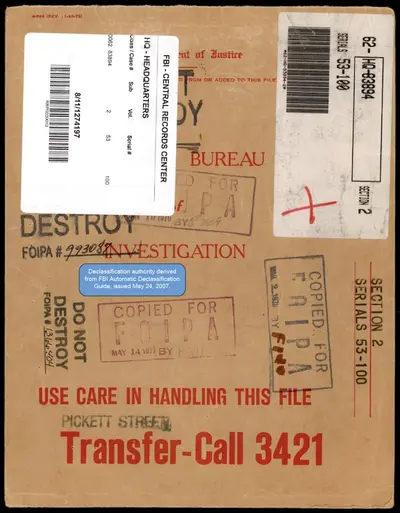
Background
On July 26, 194
7, in Saybrook, Illinois, U.S. government investigators recorded an unidentified-object incident later released to the public on May 8, 2026, as part of the Presidential Unsealing and Reporting System for UAP Encounters (PURSUE). This event occurred during a period of intense public and governmental preoccupation with aerial phenomena. The incident is categorized as part of the first wave of “flying saucer” reports that swept the United States following the Kenneth Arnold sighting in June 1947 and the Roswell incident in July 1947. During this era, the sudden influx of reports regarding metallic, disc-shaped objects led to widespread speculation regarding advanced technology or extraterrestrial presence, prompting various agencies to monitor aerial anomalies.
The case was formally filed with the Federal Bureau of Investigation. At the time, the Bureau maintained specific administrative procedures for handling such reports, with field offices in Knoxville, Albuquerque, Los Angeles, and other locations routing UFO reports to headquarters. These protocols were established under the Bureau’s standing mandates for the protection of vital installations and the monitoring of potential threats to national security. The geographic location of Saybrook, situated within the American Midwest, placed it within a region frequently subject to such surveillance due to the proximity of various industrial and logistical hubs.
The Incident and Investigation
On the morning of July 26, 1947, Mrs. June Anderson of Saybrook, Illinois, reported finding a “flying disc” in her front yard. While the released document does not specify the total number of witnesses to the object’s presence, the report was significant enough to trigger an official response from federal authorities. The witnesses described the object as being disc- or saucer-shaped, consistent with the prevailing descriptions of unidentified aerial phenomena during the summer of 1947.
Upon receiving the report, an FBI agent conducted an on-site investigation to determine the nature of the object. The investigation revealed that the object was not an aerial craft of unknown origin, but rather a terrestrial construction. The agent determined that the object was likely a hoax constructed by local juveniles. The physical components of the device were identified as a wooden platter, a silver plate, a spark plug, a timer, and brass tubing. The assembly of these common materials allowed the object to mimic the appearance of a metallic disc when viewed from a distance or under specific lighting conditions.
Classification and Status
The Saybrook incident is classified as a UFO case involving a disc-shaped object. Within the broader context of mid-century sightings, such hoaxes were common, often serving as a way for local populations to engage with the burgeoning national phenomenon of unidentified aerial phenomena. These terrestrial fabrications often mimicked the characteristics of the more controversial sightings of the era, such as those involving experimental military hardware or atmospheric phenomena.
All records released under the PURSUE program are designated unresolved by the All-domain Anomaly Resolution Office (AARO) by default. The federal government has not concluded that the events were anomalous, has not concluded that they were conventional, and has not ruled out either possibility. While the specific Saybrook case was investigated and attributed to a hoax, the broader category of sightings from this period remains subject to various scientific and historical interpretations. Conventional candidates for sightings of this period include experimental aircraft, weather balloons—specifically the Project Mogul series active in the late 1940s—and atmospheric optical phenomena such as sundogs and lenticular clouds. Additionally, astronomical objects including Venus, the Moon, and meteors near the horizon are frequently cited as potential sources for unidentified sightings during this era.