Oregon and Arizona UFO Sighting (August 4, 1947) — FBI Files
Federal investigators documented multiple reports of unidentified flying objects over Oregon and Arizona during the summer of 1947.
Historical Context
The summer of 1947 represents a pivotal period in the history of unidentified aerial phenomena in the United States. Following the Kenneth Arnold sighting in June 1947 and the subsequent reports surrounding the Roswell incident in July 1947, the American public and government agencies entered an era of heightened scrutiny regarding objects in the sky. This period saw the emergence of the “flying saucer” phenomenon, a term coined to describe the perceived movement of metallic, disc-shaped objects. During this era, the scientific and military communities were navigating the complexities of the early Cold War, an environment characterized by rapid advancements in aeronautics and the emergence of high-altitude surveillance technologies.
The geographic scope of these sightings, spanning from the Pacific Northwest in Oregon to the desert landscapes of Arizona, reflects the widespread nature of the reports during this window. The presence of significant military installations and sensitive aerospace research facilities in these regions often necessitated rigorous monitoring of the airspace. Consequently, sightings of unidentified objects were frequently processed through official channels to ensure that no unauthorized incursions or experimental domestic technologies were compromising national security.
The August 4, 1947 Incident
On August 4, 1947, U.S. government investigators recorded an unidentified-object incident that would later become part of the public record. The documentation for this event was released to the public on May 8, 2026, as a component of the Presidential Unsealing and Reporting System for UAP Encounters (PURSUE). The reports contained within this file describe the sighting of additional flying discs observed across Oregon and Arizona.
The documentation provided by Major William R. Graham included copies of reports that detailed these specific sightings along with the results of investigations conducted at the time. These investigations were carried out prior to the commencement of formal inquiries by the Federal Bureau of Investigation. While the released documents confirm the receipt of these reports, the specific number of witnesses involved in the Oregon and Arizona sightings is not specified in the available text.
Investigative Protocols and Bureau Records
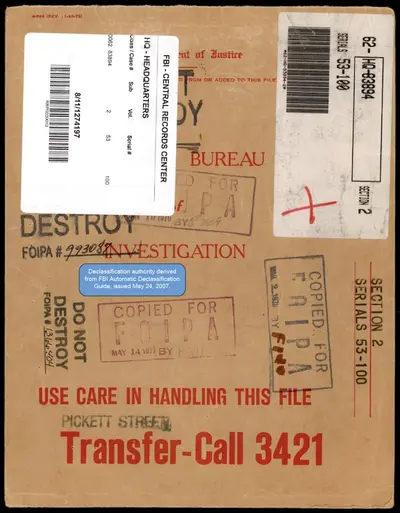
The administrative handling of this case highlights the established protocols of the Federal Bureau of Investigation during the mid-twentieth century. At the time, the Bureau’s various field offices, including those in Knoxville, Albuquerque, and Los Angeles, were tasked with managing reports of unidentified objects. Under standing protocols designed for the protection of vital installations, these regional offices routed UFO reports directly to FBI headquarters. This centralized approach ensured that any phenomenon that could potentially impact sensitive government or military infrastructure was documented and analyzed by central authorities.
The filing of this case within the FBI archives demonstrates that the agency treated these aerial reports as matters of potential interest to national security. The movement of information from regional offices to headquarters suggests a structured, albeit reactive, system for monitoring the skies for any objects that could not be immediately identified as conventional.
Classification and Resolution Status
The case is classified as a visual sighting reported by ground or air observers. Within the modern framework of aerial anomaly investigation, all records released under the PURSUE program are designated as unresolved by the All-domain Anomaly Resolution Office (AARO) by default. The federal government has maintained a neutral stance regarding the nature of the August 4, 1947, sightings, neither concluding that the events were anomalous nor confirming that they were caused by conventional means.
When evaluating sightings from this period, investigators consider several conventional candidates. These include the presence of experimental aircraft or the widespread use of weather balloons, particularly those associated with the Project Mogul series active in the late 1940s. Other possibilities include atmospheric optical phenomena, such as sundogs or lenticular clouds, as well as astronomical objects like the Moon, Venus, or meteors appearing near the horizon. The lack of a definitive conclusion in the official records leaves the August 4, 1947, sightings as an open inquiry within the historical archive.