Oklahoma City, Oklahoma UFO Sighting (July 23, 1947) — FBI Files
An FBI-documented report from July 1947 details a pilot's sighting of a massive, disc-shaped object over Oklahoma City.
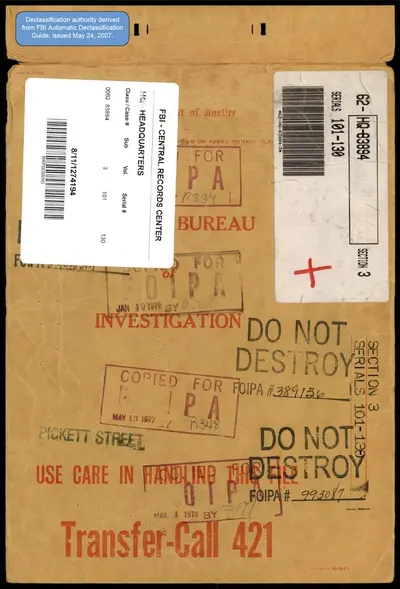
Background
On July 23, 1947, in Oklahoma City, Oklahoma, U.S. government investigators recorded an unidentified-object incident later released to the public on May 8, 2026, as part of the Presidential Unsealing and Reporting System for UAP Encounters (PURSUE). This specific report emerged during a period of intense public and governmental scrutiny regarding aerial phenomena. The incident is one of the first wave of “flying saucer” reports that swept the United States following the Kenneth Arnold sighting of June 1947 and the Roswell incident of July 1947. During this era, the term “flying saucer” had entered the common lexicon, fueled by a series of sightings that suggested the presence of advanced, non-conventional technology in the American airspace.
The administrative handling of the report reflects the Cold War-era security landscape. The case was filed with the Federal Bureau of Investigation, whose Knoxville, Albuquerque, Los Angeles, and other field offices routed UFO reports to headquarters under the Bureau’s standing protocols for the protection of vital installations. At a time when the United States was rapidly expanding its domestic defense infrastructure and monitoring Soviet technological advancements, any unidentified aerial presence near major metropolitan areas or strategic hubs was treated as a potential matter of national security. The FBI’s role in collecting such data was primarily focused on determining if these objects posed a threat to the integrity of sensitive military or governmental sites.
The Observation
The core of the documentation rests on the testimony of Byron Savage, a field engineer and private pilot. Savage reported observing a disc-shaped object over Oklahoma City between May 17 and May 21, 1947. His observations were characterized by a shift in his understanding of the object’s nature; while he initially thought it was an aircraft, he realized it was unconventional in shape, appearing elliptical then round and flat. Savage provided specific technical estimates regarding the object’s movement and scale, estimating the object’s altitude between 10,000 and 18,000 feet and its speed as three times that of a jet aircraft.
The released document does not specify the total number of witnesses to the event. However, the descriptive details provided in the file offer a glimpse into the visual characteristics of the object. The file contains specific fragments of testimony, noting that “a big white plane was coming over” and that “it appeared perfectly round and wes flate.” Most strikingly, the report includes an estimation of the object’s immense scale, stating “it appeared to be in bulk as big as the bulk:of six B-29s.” This description of a massive, multi-aircraft-sized object flying at high speeds and high altitudes places the sighting within the category of pilot or aircrew sightings, where the phenomenon is observed directly from the cockpit during flight.
Analysis and Classification
The classification of this incident remains subject to the ongoing assessments of modern oversight bodies. All records released under the PURSUE program are designated unresolved by the All-domain Anomaly Resolution Office (AARO) by default. The federal government has not concluded that the events were anomalous, has not concluded that they were conventional, and has not ruled out either possibility.
When evaluating sightings from the mid-1940s, investigators often consider various conventional candidates that could mimic the appearance of unidentified objects. These include experimental aircraft being tested in secret, weather balloons—particularly the Project Mogul series utilized in the late 1940s for detecting Soviet nuclear tests—and atmospheric optical phenomena such as sundogs and lenticular clouds. Additionally, astronomical objects including Venus, the Moon, and meteors near the horizon are frequently cited as potential sources of misidentification. The Oklahoma City case, with its emphasis on a massive, disc-shaped structure, remains a significant piece of the archival record regarding the 1947 aerial phenomenon wave.