Lake Forest, Illinois UFO Sighting (September 19, 1947) — FBI Files
FBI records detail a 1947 investigation in Lake Forest, Illinois, involving allegations of illegal information sales regarding unidentified flying objects.
Background
On September 19, 1947, in Lake Forest, Illinois, U.S. government investigators recorded an unidentified-object incident later released to the public on May 8, 2026, as part of the Presidential Unsealing and Reporting System for UAP Encounters (PURSUE). This specific report emerged during a period of intense national preoccupation with aerial phenomena. The incident is categorized among the first wave of “flying saucer” reports that swept the United States following the Kenneth Arnold sighting in June 1947 and the Roswell incident in July 1947. During this era, the sudden influx of reports regarding metallic, disc-shaped objects created a sense of widespread public and governmental scrutiny.
The geographical context of Lake Forest, situated in the affluent northern suburbs of Chicago, placed this incident within a densely populated region of the American Midwest. At the time, the United States was navigating the early stages of the Cold War, a period characterized by heightened vigilance regarding airspace security and the potential for technological breakthroughs by foreign adversaries. The case was filed with the Federal Bureau of Investigation, whose Knoxville, Albuquerque, Los Angeles, and other field offices routed UFO reports to headquarters under the Bureau’s standing protocols for the protection of vital installations. This administrative structure ensured that any reports potentially involving espionage or threats to national infrastructure were centralized for federal review.
What the document records
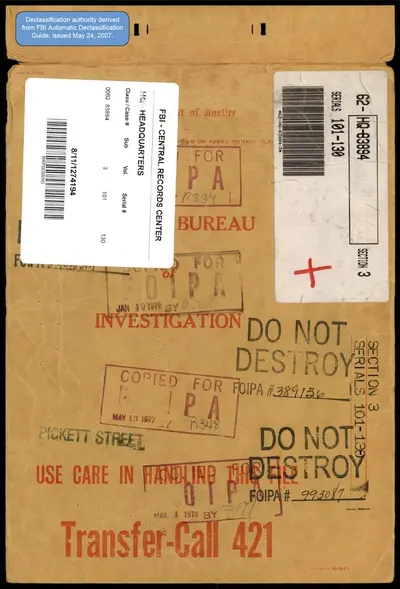
The released documentation details an investigation initiated regarding C. Wast Stevens, formerly of Lake Forest, Illinois, concerning a possible violation of law related to “flying discs.” The inquiry was not a direct investigation of a specific aerial sighting, but rather an investigation into the illicit trade of information. A Post Office Inspector requested information from the FBI regarding Stevens’ record and any associated details. This specific inquiry stemmed from allegations that Stevens was engaged in the sale of information pertaining to these unidentified objects.
While the document focuses on the investigation of Stevens and the potential for illegal information dissemination, it does not specify the number of witnesses involved in the underlying sightings. The nature of the investigation suggests that the primary concern for federal authorities at that moment was the unauthorized distribution of data regarding aerial anomalies, rather than the physical identification of the objects themselves.
Type of case
The case is classified as a visual sighting reported by ground or air observers. Such reports were common during the late 1940s, as the proliferation of civilian aviation and improved meteorological monitoring increased the frequency of unidentified aerial observations across the continental United States.
Status
All records released under the PURSUE program are designated unresolved by the All-domain Anomaly Resolution Office (AARO) by default. The federal government has not concluded that the events were anomalous, has not concluded that they were conventional, and has not ruled out either possibility. The investigation into Stevens remains a matter of historical record without a definitive federal conclusion regarding the legitimacy of the objects he was alleged to have documented.
Conventional candidates for sightings of this period include experimental aircraft, weather balloons, particularly the Project Mogul series in the late 1940s, and atmospheric optical phenomena such as sundogs and lenticular clouds. Additionally, astronomical objects including Venus, the Moon, and meteors near the horizon frequently provided explanations for sightings that lacked clear physical evidence. The Lake Forest case remains a significant piece of the broader 1947 phenomenon, highlighting how the era’s preoccupation with unidentified objects extended into the realms of domestic law enforcement and the monitoring of information security.