Andrews AF Base, The UAP Encounter, 1947 — USAAF Box 7 #207
An archival record from 1947 documents an unidentified object sighting near Andrews Air Force Base, part of the early post-war wave of UFO reports.
Historical Context
The year 1947 represents a pivotal moment in the history of aerial anomaly documentation within the United States. During this period, the transition from the Second World War to the Cold War era brought about rapid advancements in aviation technology, including the development of early jet engines and high-altitude reconnaissance capabilities. This technological shift occurred alongside a sudden surge in public and military interest in unidentified aerial phenomena. The phenomenon is often categorized by historians as the “first wave” of sightings, a period characterized by reports of metallic, disc-shaped objects traversing the skies.
Geographically, Andrews Air Force Base, located in Maryland, served as a critical hub for military aviation and logistics. Given its proximity to the nation’s capital and its role in high-level military transport, the airspace around the installation was subject to rigorous monitoring. The presence of significant military personnel and advanced radar installations made the area a likely site for the observation of any aerial anomaly that deviated from standard flight paths.
The Incident Records
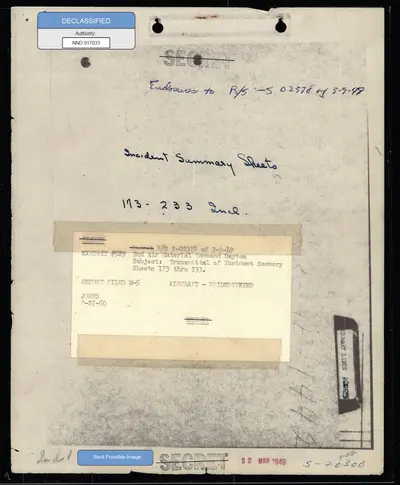
The documentation for this specific event is preserved within the U.S. Army Air Forces “Check-List - Unidentified Flying Objects” series, identified as Incident #207. This particular entry is housed in Box 7 of file 38_143685. The details of the encounter were made available to the public on May 8, 2026, following their release by the Department of War through the Presidential Unsealing and Reporting System for UAP Encounters (PURSUE).
The contents of the form are relatively brief, providing a summary of a sighting reported by an unspecified observer near Andrews Air Force Base. The record classifies the event as a visual sighting, which implies the phenomenon was observed directly by ground or air-based personnel. While the specific characteristics of the object’s flight path or physical appearance are not detailed in this particular summary, the existence of the report within the official military checklist confirms that the event was noted by the U.S. Army Air Forces during the height of the 1947 saucer wave.
Comparative Analysis and Classification
Incident #207 emerged during a period of intense scrutiny following the Kenneth Arnold sighting in June 1947 and the Roswell incident in July 1947. These events collectively shaped the cultural and military understanding of unidentified objects, moving the topic from fringe speculation into official military consideration. The timing of the Andrews sighting places it directly within this era of heightened-altitude observation and increased atmospheric monitoring.
The nature of the case is defined as a visual sighting. In the context of 1947, such reports were often evaluated against a variety of known aerial phenomena. The All-domain Anomaly Resolution Office has designated all records released under the PURSUE program, including this one, as unresolved. The federal government maintains a neutral stance regarding the origin of the object, neither confirming an anomalous nature nor a conventional explanation.
When analyzing the 1947 era, researchers often consider several conventional candidates for such sightings. These include the Project Mogul balloon flights, which were active over the American Southwest at the time, as well as experimental jet and rocket aircraft testing. Other possibilities include atmospheric optical effects or the misidentification of astronomical objects viewed at unusual angles. Despite these possibilities, the official status of the Andrews Air Force Base encounter remains officially undetermined.