Helendale, California UFO Sighting (December 27, 1918) — FBI Files
An investigation into a disc-shaped object sighted in Helendale, California, in 1918 concluded the object was an abandoned model tow target.
Historical Context
The incident in Helendale, California, occurred during a transformative era in aviation history. In late 1918, the world was transitioning out of the First World War, a period that saw unprecedented advancements in aeronautical engineering and the rapid development of fixed-wing flight. During this early-aviation period, the baseline expectations for aerial capabilities were still being established. The presence of unknown objects in the sky often triggered intense scrutiny, as the boundaries of human-made flight were expanding daily. In the high desert regions of the American Southwest, the vast, open landscapes provided clear vistas that made any anomalous aerial phenomenon highly visible to ground observers.
During this period, the reporting of unidentified aerial phenomena followed specific bureaucratic channels. The Federal Bureau of Investigation maintained a protocol for monitoring activities that could potentially threaten vital installations or national security. Reports originating from field offices in locations such as Knoxville, Albuquerque, and Los Angeles were routinely routed to headquarters. This systemic approach ensured that any sightings of unidentified objects were documented within the federal archives, even if the primary concern was the protection of infrastructure rather than the investigation of extraterrestrial activity.
The Helendale Incident
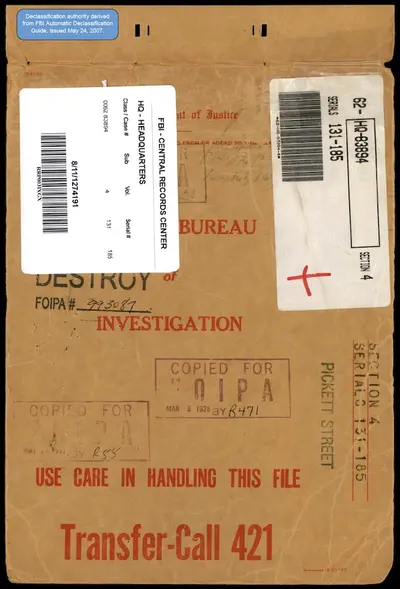
On December 27, 1918, an unidentified-object incident took place in the vicinity of Helendale, California. The details of this sighting were preserved within FBI files and were later released to the public on May 8, 2026, as part of the Presidential Unsealing and Reporting System for UAP Encounters (PURSUE). The documentation indicates that Lonnie Edward Noack and several other individuals located an object in the desert landscape. The witnesses described the physical appearance of the object as resembling a flying disc.
Following the sighting, an investigation was conducted to determine the nature of the object. The investigation led to the conclusion that the object was not an anomalous craft, but rather a model tow target or a kite. It was determined that this object had been abandoned following unsuccessful testing procedures. Henry T. and manufacturer, identified specific portions of the object as belonging to the model target, effectively providing a conventional explanation for the disc-shaped appearance reported by the observers. While the released documentation does not specify the exact number of witnesses involved in the sighting, the presence of Noack and others is clearly established in the official record.
Analytical Classification
The witnesses characterized the object using terms consistent with later UFO nomenclature, describing it as being disc- or saucer-shaped. In the context of early 20th-century sightings, such descriptions often coincided with the observation of experimental aeronautical equipment or atmospheric phenomena.
The status of the Helendale case remains officially unresolved under current federal classification standards. All records released through the PURSUE program are designated as unresolved by the All-domain Anomaly Resolution Office (AARO) by default. This designation reflects a neutral investigative stance; the federal government has not reached a definitive conclusion regarding whether the event was anomalous or conventional. While the specific investigation in 1918 identified the object as a model target, the official administrative status of the record remains open to both possibilities.
In the broader study of unidentified aerial phenomena, researchers often compare such cases to other known conventional candidates. These include experimental aircraft, weather balloons—such as the Project Mogul series utilized in the late 1940s—and various atmospheric optical phenomena like sundogs or lenticular clouds. Additionally, astronomical objects such as Venus, the Moon, or meteors positioned near the horizon are frequently considered when evaluating historical sightings of disc-shaped objects.