Chicago, Illinois UFO Sighting (May 20, 1919) — FBI Files
An investigation into a 1919 Chicago report involving theories of supernatural flying discs and allegations of espionage within FBI documentation.
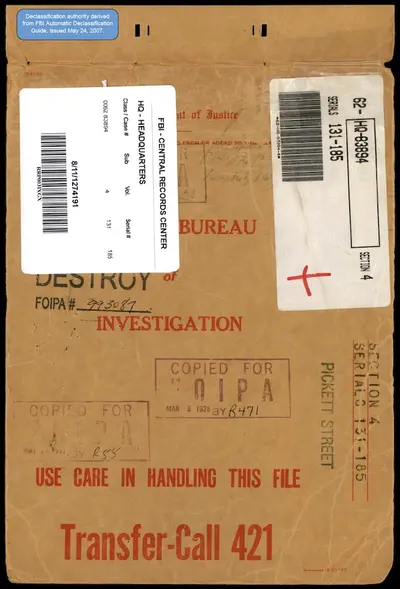
Historical Context of Early Aerial Anomalies
The early twentieth century represented a period of profound transition in the human understanding of the skies. In 1919, the world was emerging from the aftermath of the Great War, a conflict that had fundamentally altered the perception of aerial capabilities through the rapid development of reconnaissance and combat aircraft. During this era of nascent aviation, the boundaries of flight were still being defined, and the appearance of any unidentified object in the atmosphere often triggered intense scrutiny. The technological landscape was characterized by the emergence of fixed-wing flight, yet the presence of objects moving in ways that defied the mechanical limitations of contemporary engines remained a subject of speculation and fear.
In the United States, the federal government began formalizing the monitoring of unusual aerial phenomena as part of broader efforts to secure national interests. The Federal Bureau of Investigation, through its various field offices in cities such as Knoxville, Albuquerque, and Los Angeles, maintained protocols for routing reports of unidentified objects to headquarters. These procedures were primarily designed to ensure the protection of vital installations and to monitor any potential threats to domestic security. The documentation of such sightings was often integrated into broader intelligence-gathering efforts, where the distinction between atmospheric phenomena and potential espionage was a primary concern for investigators.
The May 1919 Chicago Incident
On May 20, 1919, in Chicago, Illinois, U.S. government investigators recorded an unidentified-object incident that remained largely shielded from public view for over a century. The details of this case were released to the public on May 8, 2026, as part of the Presidential Unsealing and Reporting System for UAP Encounters (PURSUE). The released documentation provides a window into the specific nature of the reports processed by the Bureau during this period.
The records detail a report filed by Kaye Lochrie, which centered on a theory proposed by Roy Palmer, a managing editor. Palmer’s theory suggested that the flying discs observed in the sky were actually explosives utilized in a conflict between benevolent and malevolent souls who had transitioned into the afterlife. This metaphysical interpretation of aerial anomalies highlights the intersection of emerging technology and long-standing spiritualist beliefs prevalent in the early 1900s. Accompanying these theories was a personal dimension to the report, as Lochrie sought to clear her name from any suspicion that the FBI was investigating her for involvement in espionage. While the document provides this specific narrative, the total number of witnesses to the phenomena described by Palmer is not specified in the released text.
Classification and Analytical Status
The incident is classified as a visual sighting reported by ground or air observers. In the taxonomy of aerial phenomena, such cases are categorized by the direct observation of an object’s movement and appearance against the celestial or atmospheric background. Because the report involves a specific theory regarding the nature of the objects, it occupies a unique space between traditional sighting reports and the documentation of psychological or sociological responses to perceived anomalies.
The status of the case remains officially unresolved. Under the mandates of the All-domain Anomaly Resolution Office (AARO), all records released under the PURSUE program are designated as unresolved by default. The federal government has maintained a position of neutrality regarding the 1919 Chicago event, having neither concluded that the sighting was anomalous nor that it was the result of conventional means. The investigation has not ruled out either possibility.
In the broader study of historical aerial sightings, investigators often consider several conventional candidates to explain such reports. These include experimental aircraft, weather balloons, or atmospheric optical phenomena such as sundogs and lenticular clouds. Additionally, astronomical objects like Venus, the Moon, or meteors appearing near the horizon are frequently cited as potential sources of misidentification. The 1919 Chicago case remains a significant entry in the archive of documented phenomena due to its integration into official federal investigative files.