Wisconsin Rapids Multi-Light UFO Sighting
Multiple lights appear simultaneously across the sky over rural Wisconsin Rapids, lasting ten minutes. Former FBI agent rules out conventional explanations.
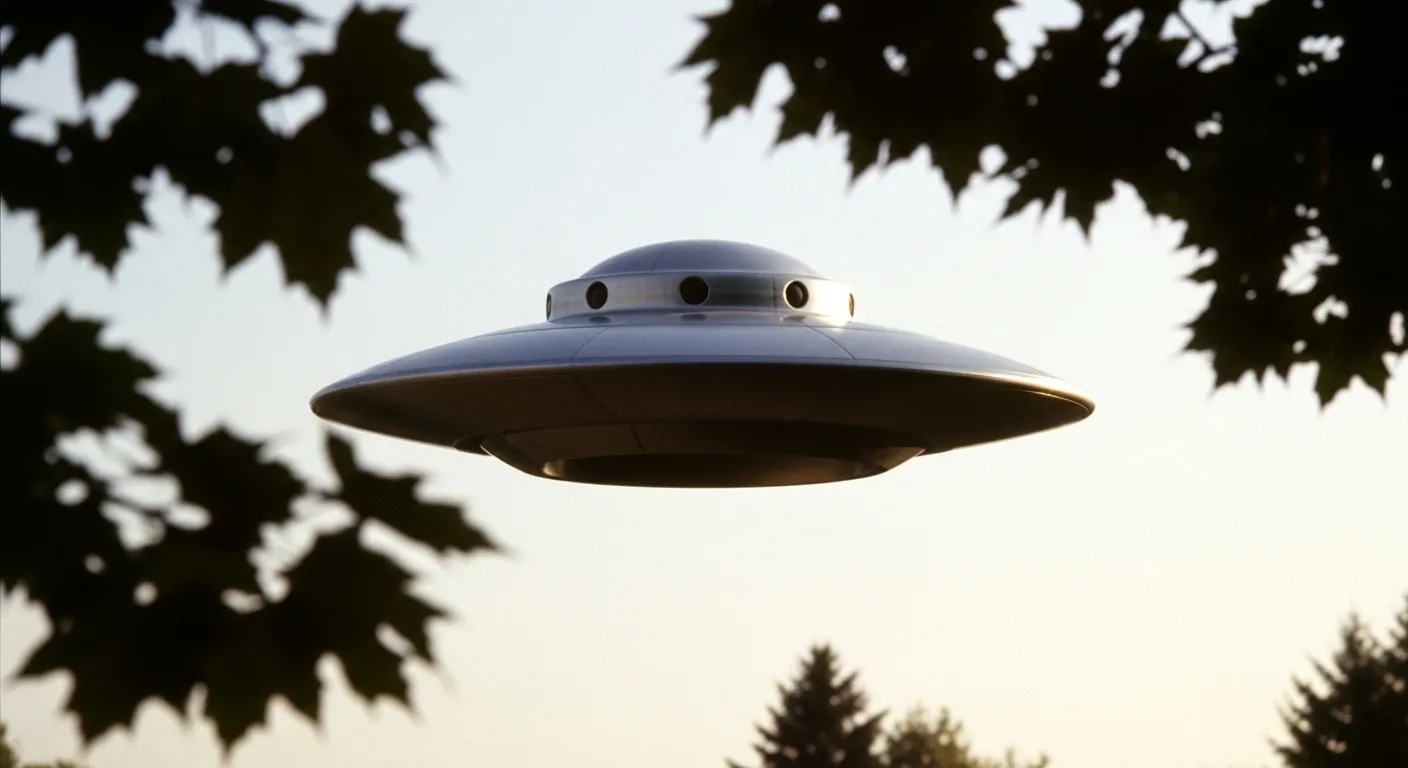
On the evening of February 11, 2026, as families across Wisconsin Rapids sat down to dinner, the winter sky above the rural countryside surrounding the city produced a display that no one who witnessed it has been able to explain. What began as a single point of light drifting across the darkening sky escalated within moments into a coordinated spectacle of multiple luminous objects appearing simultaneously in widely separated positions overhead. The sighting lasted approximately ten minutes, long enough for witnesses to observe the lights carefully, to rule out the obvious explanations that first came to mind, and to be left with a lingering certainty that what they had seen was not ordinary.
A Light That Was Not a Shooting Star
The primary witness was driving along a rural road outside Wisconsin Rapids when the event began. The countryside around the city is flat and open, characterized by farmland, scattered woodlots, and the kind of expansive sky that makes central Wisconsin a place where anything aloft is easily visible for miles in every direction. It was the dinner hour, and the last traces of daylight were fading from the western horizon when the witness noticed a single orb of light moving slowly across the sky.
The initial assumption was that it was a shooting star. Meteors are common enough in Wisconsin’s dark rural skies, and a lone point of light traversing the heavens is hardly cause for alarm. But this light did not behave like a meteor. It moved too slowly, tracing a deliberate path rather than the brief, blazing arc of space debris burning through the atmosphere. It did not flicker or fragment. It maintained a steady, unwavering luminosity as it traveled, and its trajectory suggested purpose rather than the random descent of a falling rock.
Then more appeared.
The witness described the moment with a mixture of awe and unease. Additional lights materialized not in the same region of sky as the first, but in entirely different locations, scattered across the overhead expanse as though marking points on an invisible grid. They did not emerge from a single source or travel in formation. They simply appeared, each one independent, each one glowing with the same steady intensity as the original orb. The sky over the Wisconsin countryside, moments before empty and unremarkable, was suddenly populated with objects that had no business being there.
Other cars were on the road at the time, and the witness noted that fellow motorists appeared to be reacting to the phenomenon as well, slowing down and pulling to the shoulders to watch. For roughly ten minutes, the lights held their positions or drifted slowly, exhibiting no sudden accelerations or erratic movements, but also no characteristics consistent with any recognizable aircraft, satellite, or atmospheric phenomenon. Then, as quietly as they had appeared, the lights faded and the sky returned to its ordinary winter darkness.
Ruling Out the Conventional
In the aftermath of the sighting, the case attracted the attention of Ben Hansen, a former FBI special agent who had transitioned into investigating unexplained aerial phenomena as the host of the television program “UFO Witness.” Hansen brought to the case the methodical, evidence-based approach that had characterized his career in federal law enforcement, and his analysis of the Wisconsin Rapids sighting proved notable for what it excluded rather than what it concluded.
Hansen investigated the possibility that the lights were produced by advertising spotlights, the high-powered beams sometimes used by businesses or event promoters to project visible columns of light into the sky. Such spotlights are a common source of misidentified UFO reports, particularly in urban and suburban areas where commercial activity makes their presence unremarkable. However, Hansen’s research found no evidence that any advertising spotlights had been recently permitted or deployed in the area around Wisconsin Rapids. The location was deeply rural, far from the kind of commercial districts where such equipment would typically be found, and local authorities had no record of any permitted light displays on the evening in question.
Hansen also assessed whether the lights could be attributed to conventional aircraft, drones, or satellite constellations such as SpaceX’s Starlink, which have generated numerous UFO reports since their deployment began. The behavior of the Wisconsin Rapids lights did not match any of these explanations. Conventional aircraft carry navigation lights that blink in regulated patterns and are accompanied by engine noise audible from the ground. Drones of any commercially available size produce a distinctive buzzing sound and are limited in the altitude and luminosity they can achieve. Starlink satellites travel in predictable linear formations, moving uniformly across the sky in a single direction, a pattern entirely unlike the scattered, independent positioning of the lights observed over Wisconsin Rapids.
“There is no evidence that any advertising spotlights have recently been permitted or used in this very rural area,” Hansen stated. He further noted that “the intensity and speed of the lights doesn’t comport with conventional technology.” His assessment stopped short of declaring the lights extraterrestrial or even necessarily anomalous in origin, but it firmly closed the door on the most frequently cited prosaic explanations.
The Broader Pattern
Wisconsin has a long and rich history of unexplained aerial sightings. From the foo fighters reported by military pilots over the Great Lakes during World War II to the recurring lights observed near Long Lake and other bodies of water across the northern part of the state, the Wisconsin sky has produced more than its share of mysteries. The Wisconsin Rapids sighting fits into this broader pattern while standing on its own merits as a case defined by multiple witnesses, a sustained duration, and the considered judgment of a credentialed investigator that conventional explanations fall short.
The rural character of the sighting location is both an asset and a limitation for investigators. The absence of light pollution and urban clutter means that witnesses had an unobstructed view of the phenomenon, and the sparse population reduces the likelihood of man-made sources being responsible. At the same time, the remoteness of the area means fewer witnesses, less surveillance camera footage, and fewer opportunities for the kind of independent corroboration that strengthens a case beyond challenge.
What remains is a ten-minute window on a February evening when the sky above central Wisconsin did something that the people who saw it cannot account for, and that a former FBI agent, trained in the discipline of distinguishing evidence from speculation, could not attribute to any known cause. The lights over Wisconsin Rapids appeared, persisted, and vanished, leaving behind only questions and the unsettled memory of witnesses who pulled their cars to the side of a country road and watched something they were never meant to understand.