The Valensole Encounter
A French farmer encountered a landed craft and its occupants, an experience that affected his crops for years.
The lavender fields of Valensole stretch across a high plateau in the Alpes-de-Haute-Provence, a landscape of austere beauty where neat rows of purple blooms roll toward the horizon beneath the enormous skies of southeastern France. It is a quiet place, shaped by centuries of patient agriculture and the rhythms of rural life. The men and women who tend these fields are practical people, accustomed to hard work and early mornings, not given to flights of fancy. Maurice Masse was precisely this kind of man—a farmer of solid reputation, a former Resistance fighter, a father and husband known throughout the commune as honest and dependable. Nothing in his life before July 1, 1965, suggested that he would become the central figure in one of the most thoroughly investigated and enduringly mysterious UFO encounters in European history. Yet what Masse experienced that summer morning in his lavender field would alter the course of his life, leave physical evidence that persisted for a decade, and resist every attempt at conventional explanation.
Maurice Masse: The Reluctant Witness
To appreciate the weight of what happened at Valensole, one must first understand the man to whom it happened. Maurice Masse was born in 1921 and had lived his entire life in the region. During World War II, he served with the French Resistance, an experience that hardened him and earned him the respect of his community. After the war, he returned to farming, cultivating lavender on the plateau as his family had done for generations. By 1965, he was forty-four years old, the owner of a modest but productive farm, and a man whose word carried weight in the village. He was not a reader of science fiction, had no interest in flying saucers, and had never reported anything unusual in his life.
Masse’s character would become central to the investigation that followed his encounter. French authorities, journalists, and researchers all arrived at the same conclusion: this was not a man who would fabricate a story for attention. He was, in fact, deeply reluctant to speak about what had happened to him. The notoriety that followed the incident caused him considerable distress, and he avoided publicity whenever possible. When he did speak, he did so with the plain, unembellished language of a man describing exactly what he had seen, neither dramatizing nor minimizing the experience. His consistency over the years—he never altered or embellished his account—only strengthened his credibility.
The Morning of July 1, 1965
The summer of 1965 had been a frustrating one for Masse. Someone had been stealing lavender plants from his fields at night, uprooting them under cover of darkness. The thefts were not large enough to cause serious financial harm, but they were an irritation, and Masse had taken to arriving at his fields earlier than usual in the hope of catching the culprit. On the morning of July 1, he rose before dawn and drove to his lavender field, arriving at approximately 5:45 AM.
The morning was still and clear, the sky brightening in the east but the sun not yet above the horizon. Masse parked his vehicle and began walking along the rows of lavender toward a section of the field that lay behind a small hillock of rocky ground. As he rounded this natural barrier, he heard a strange whistling sound—high-pitched and unlike anything produced by the agricultural equipment or vehicles he knew. His first thought was that he had finally caught the lavender thieves, and he moved forward with purposeful annoyance.
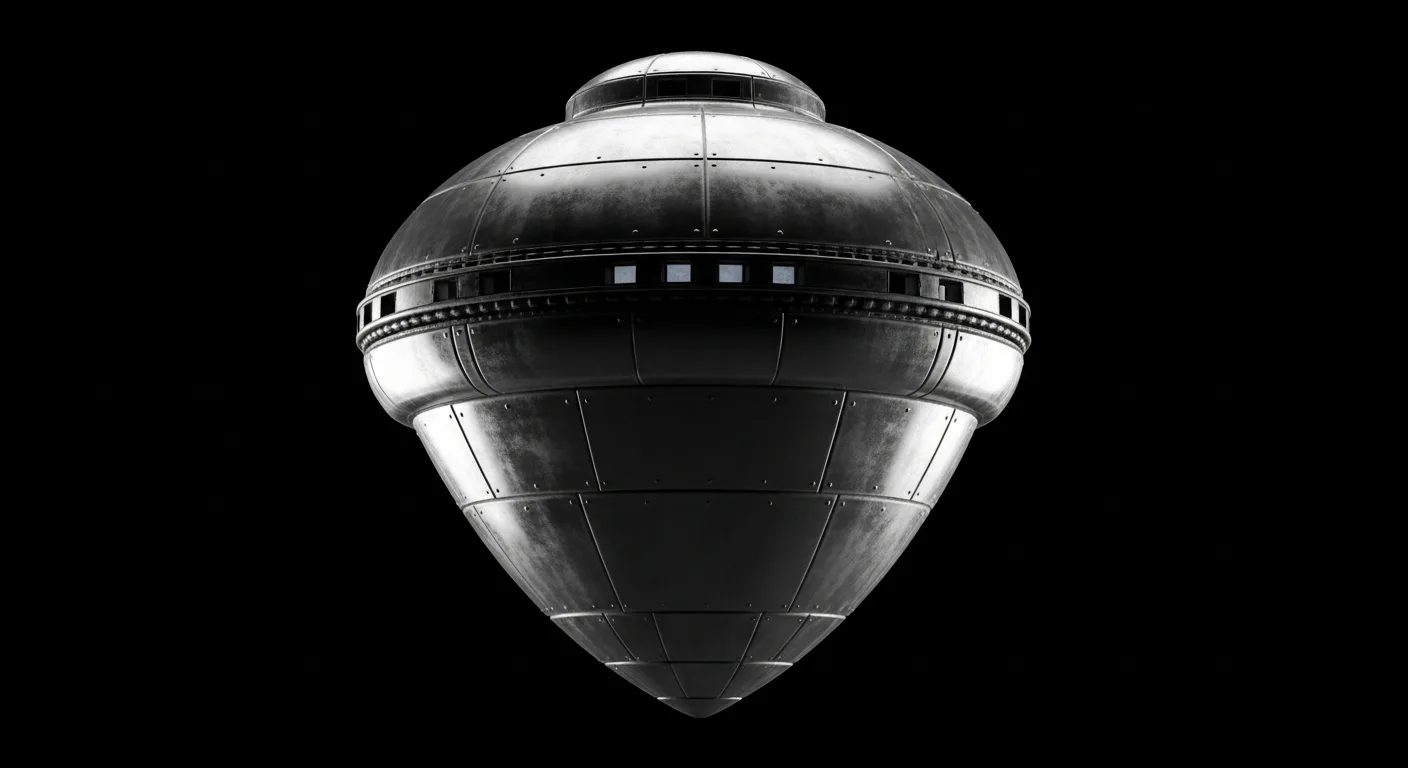
What he saw when he cleared the rise stopped him in his tracks. Approximately ninety meters away, sitting in the middle of his lavender field, was an object unlike anything he had ever encountered. It was egg-shaped or oval, roughly the size of a Renault Dauphine—the compact car ubiquitous in rural France at the time—and it rested on four sturdy legs that splayed outward from its underside, pressing into the soil between the rows of plants. The object’s surface appeared smooth and metallic, though Masse would later struggle to describe its exact color or texture, saying only that it had a dull, grayish quality. A transparent dome or cupola sat atop the craft, and beneath the body of the object, a central pivot or shaft connected to the landing legs.
Masse’s initial reaction was not fear but bewilderment. The object was so far outside his frame of reference that he could not immediately categorize it. For a moment, he wondered if it was some kind of experimental helicopter or military device. Then he noticed the figures.
The Beings
Standing near the craft, partially obscured by the lavender plants, were two small beings. They were crouched or bent over the plants, and Masse’s first impression was that they were children—perhaps the lavender thieves he had been seeking. But as he drew closer, moving quietly through the rows, he realized that these were not children, and they were not human.
The two figures stood approximately four feet tall, with proportions that were subtly but unmistakably wrong for human beings. Their heads were disproportionately large compared to their bodies—roughly three times the size one would expect for figures of their stature. The heads were hairless and smooth, with high, domed craniums that tapered slightly toward the chin. Their faces were dominated by large, dark, slanted eyes that wrapped around the sides of their heads, giving them an extraordinarily wide field of vision. Their mouths were small, little more than lipless openings, and their noses were barely perceptible. The skin of their faces appeared smooth and pale, though Masse found it difficult to judge color in the early morning light.
Both beings wore identical one-piece garments that Masse described as green coveralls or jumpsuits. The clothing appeared to fit snugly and had no visible seams, buttons, or fasteners. They wore no helmets, gloves, or other accessories that Masse could discern. Despite the strangeness of their appearance, their movements were purposeful and calm. They seemed to be examining the lavender plants with what Masse interpreted as curiosity, bending to look at the blooms and occasionally making small gurgling or humming sounds to one another.
Masse continued his approach, driven by a combination of curiosity and the farmer’s indignation at finding intruders in his field. He managed to close the distance to roughly five meters before one of the beings noticed him. The creature turned to face Masse directly, and what happened next would haunt the farmer for the rest of his life.
The Paralysis
The being that spotted Masse showed no sign of alarm or surprise. It simply reached to its side—or perhaps to a belt or strap that Masse had not previously noticed—and withdrew a small, tube-shaped device, roughly the size and shape of a large pencil. Without any gesture of hostility or warning, the being pointed this device at Masse.
Instantly, Masse found himself completely unable to move. He was frozen in place, fully conscious and aware of his surroundings, but utterly incapable of commanding his body to respond. His legs would not carry him forward or backward. His arms hung at his sides, immovable. He could not turn his head, could not speak, could not so much as twitch a finger. It was as though every voluntary muscle in his body had been switched off simultaneously, while his senses—sight, hearing, the feel of the morning air on his skin—remained perfectly intact. The experience was profoundly unnerving, not painful but deeply wrong, a violation of the fundamental relationship between will and body that every conscious being takes for granted.
Masse stood paralyzed, watching helplessly as the two beings regarded him for a moment with what he perceived as detached interest rather than hostility. They did not approach him, did not attempt to communicate, and showed no aggression. After a brief pause, they turned and walked back to their craft with an unhurried gait. They entered the object through an opening or doorway that Masse could not clearly see from his fixed vantage point, though he had the impression that they slid rather than climbed into the vessel.
The craft then began to rise. The whistling sound returned, growing in pitch and intensity as the object lifted off its four legs and ascended from the field. Masse watched—he had no choice but to watch—as the craft climbed to a height of perhaps twenty meters, then tilted slightly and accelerated away at extraordinary speed, vanishing from sight within seconds. It left no trail, no exhaust, no visible means of propulsion. One moment it was there, hovering above his ruined lavender; the next it was a speck against the brightening sky; and then it was gone entirely.
The paralysis did not end with the craft’s departure. Masse remained frozen in the field, standing among his lavender plants like a statue, for approximately fifteen minutes after the object disappeared. The release, when it came, was gradual rather than sudden—a slow return of sensation and motor control that began in his extremities and worked inward, as though his nervous system were rebooting one circuit at a time. When he could finally move, his first act was to stumble and nearly fall, his legs weak and unsteady beneath him.
The Aftermath
The immediate physical effects of the encounter were severe and prolonged. For the rest of that first day, Masse was barely functional. He managed to make his way back to his vehicle and drive home, but he was overwhelmed by a crushing, unnatural drowsiness that bore no resemblance to ordinary fatigue. His wife and family, alarmed by his appearance and behavior, initially suspected he had suffered a stroke. Masse told them what had happened, and their alarm only deepened—not because they doubted him, but because the man they knew would never invent such a story.
The drowsiness persisted for weeks. Masse, a man accustomed to rising before dawn and working long days in the fields, found himself sleeping twelve, fourteen, even sixteen hours a day. He would fall asleep at the table during meals, nod off while trying to work, and struggle to maintain consciousness during conversations. His normal sleep cycle was shattered, and it took several months before he returned to anything resembling his previous pattern. Physicians who examined him could find no conventional medical explanation for the condition. There was no evidence of neurological damage, no infection, no toxicological cause. The drowsiness simply existed, as inexplicable as its origin.
Beyond the effects on Masse himself, the encounter left physical evidence in his lavender field that would endure for years. At the precise spot where the craft had rested, the soil was altered. The lavender plants within a radius of approximately three meters from the center of the landing site died shortly after the incident. They did not merely wilt or brown; they died completely and could not be revived. More remarkably, the affected patch of soil refused to support new growth. Masse attempted to replant lavender in the area, but the new plants withered and died as well. Whatever had happened to the earth at the landing site had fundamentally changed its capacity to sustain life.
This dead zone persisted for approximately ten years. Throughout the late 1960s and into the 1970s, while the surrounding field bloomed with healthy lavender each summer, the landing site remained barren—a conspicuous circular scar in the otherwise uniform rows of purple. The soil was tested on multiple occasions by various investigators, and while the results were not always consistent, several analyses indicated changes in the soil’s composition and structure. Some researchers reported altered calcium content; others noted changes in the soil’s moisture retention properties. The precise mechanism by which the craft had sterilized the ground was never determined, but the effect itself was visible to anyone who cared to visit the field and undeniable to even the most determined skeptic.
The four depressions left by the craft’s landing legs were also clearly visible for some time after the incident. They were deep and symmetrically arranged, consistent with Masse’s description of a heavy object resting on four supports. The impressions corresponded to an object roughly the size and weight he had described, and their depth suggested that the craft had been considerably heavier than any conventional aircraft or vehicle of comparable dimensions.
The Investigation
The Valensole encounter attracted the attention of French authorities almost immediately. The Gendarmerie—France’s national police force—dispatched investigators to interview Masse and examine the site within days of the incident. Their report was thorough and professional, and it arrived at a conclusion that surprised many: there was no evidence that Masse was lying, no evidence of hoax or fabrication, and no conventional explanation for the physical traces found at the landing site. The gendarmes noted Masse’s exemplary character, his reluctance to seek publicity, and the consistency of his account under repeated questioning.
The case also drew the attention of French military and scientific authorities. France maintained an unusually open and systematic approach to investigating UFO reports, a tradition that would eventually lead to the establishment of GEPAN (Groupe d’Etudes des Phenomenes Aerospatiaux Non-identifies) within the French space agency CNES in 1977. While GEPAN did not exist at the time of the Valensole incident, the intellectual culture that would create it was already present, and Masse’s encounter was treated with a seriousness rarely afforded to UFO reports in other countries.
Investigators from multiple organizations visited the site, interviewed Masse, and analyzed the physical evidence. Among the most prominent was Aime Michel, a respected French science journalist and ufologist who had been studying patterns in French UFO reports for years. Michel found Masse to be an exceptionally credible witness and noted that his account was consistent with other reports from the same era—not because Masse was copying others, but because the details he described matched patterns that only a researcher tracking multiple cases would recognize.
Masse was subjected to psychological evaluation and found to be entirely sound of mind. He showed no signs of mental illness, no history of hallucination, and no motivation to deceive. When investigators pressed him on details, attempting to trip him up or expose inconsistencies, his account remained rock-solid. He described what he had seen in the same plain language every time, never adding dramatic flourishes, never claiming more than he had actually witnessed. On certain points, he was notably modest in his claims—he acknowledged that the early morning light made it difficult to judge certain details of the beings’ appearance, and he was careful to distinguish between what he had clearly seen and what he had merely inferred.
One detail that particularly impressed investigators was Masse’s emotional reaction to the encounter. Despite the violation of the paralysis and the strangeness of the experience, Masse consistently stated that he had not felt threatened by the beings. He described their demeanor as curious rather than hostile, and he expressed the belief that they had not intended to harm him—that the paralysis device was used defensively, to prevent him from interfering with their activities, rather than as an act of aggression. This nuanced emotional response, investigators noted, was not typical of hoaxers or attention-seekers, who tended toward more dramatic narratives of fear and danger.
A Case That Endures
The Valensole encounter occupies a distinctive position in the annals of UFO research, and its significance has only grown with the passage of time. Unlike many UFO reports that rely solely on eyewitness testimony, the Masse case offered multiple forms of corroboration: the physical traces at the landing site, the physiological effects on the witness, the soil changes that persisted for a decade, and the depressions left by the landing gear. Each of these elements was documented by multiple investigators, photographed, and in some cases subjected to laboratory analysis.
The case also stands out for the quality of its primary witness. In a field plagued by hoaxers, fantasists, and unreliable observers, Maurice Masse was a figure of uncommon credibility. His wartime service, his standing in the community, his obvious discomfort with publicity, and the unshakable consistency of his testimony over decades all contributed to a portrait of a man who had simply reported what he had seen, without embellishment or agenda. Even researchers who were skeptical of the extraterrestrial hypothesis found it difficult to impugn Masse’s honesty.
Masse himself was profoundly changed by the experience. He became more contemplative, more inclined to reflect on questions of humanity’s place in the universe. He did not become a crusader for UFO disclosure or a fixture on the lecture circuit. Instead, he returned to his lavender fields and continued the quiet, industrious life he had always known, differing from his former self only in the knowledge he carried—the certainty that on one clear morning in the summer of 1965, he had encountered something that defied everything he understood about the world.
He rarely spoke about the encounter in his later years unless directly asked, and even then he was measured and restrained. But those who knew him well observed that the experience had left a mark deeper than mere memory. Masse carried with him a kind of solemnity, an awareness of mystery, that colored his remaining years. He died in 2004, nearly four decades after the encounter, having never wavered from his original account and never sought to profit from it.
The lavender eventually returned to the landing site. Sometime in the mid-1970s, the soil at last recovered its ability to sustain life, and new plants took root where the craft had rested. The field healed, as fields do, and a visitor to Valensole today would find no visible trace of what happened there on a July morning sixty years ago. The rows of lavender stretch unbroken across the plateau, purple and fragrant in the summer sun, as though the earth itself has chosen to forget.
But the questions that Maurice Masse’s encounter raised have not been so easily put to rest. What landed in that field? Who were the beings he saw? What technology could paralyze a man without harming him, sterilize soil for a decade, and propel a craft in utter silence? These questions remain unanswered, and the Valensole case endures as a reminder that the universe may contain more than our experience has prepared us to accept. In a quiet corner of Provence, where the lavender blooms in orderly rows and the sky stretches vast and indifferent overhead, something extraordinary once happened—something that one honest, practical farmer saw clearly and reported faithfully, and that no one has ever been able to explain away.
Sources
- Project Blue Book — National Archives — USAF UFO investigation files, 1947–1969
- CIA UFO/UAP Reading Room — Declassified CIA documents on UAP