The USS Franklin D. Roosevelt UFO Incident
Crew members of an aircraft carrier photographed a silver disc-shaped object that paced the ship for several hours.
In the autumn of 1952, the Cold War was escalating on every front. The Korean War ground on, the Soviet Union had detonated its first atomic bomb three years earlier, and the Western alliance was scrambling to demonstrate its military coherence in the face of the Communist threat. Operation Mainbrace, the largest NATO naval exercise since the alliance’s formation, brought together warships from multiple nations in the North Atlantic, a massive show of force designed to prove that the Western powers could defend the sea lanes of northern Europe against Soviet aggression. Among the vessels participating was the aircraft carrier USS Franklin D. Roosevelt, one of the most powerful warships in the United States Navy. What her crew encountered during those September maneuvers would become one of the most intriguing military UFO cases of the era, notable not only for the quality of the witnesses but for the photographic evidence that was reportedly captured and then swallowed by the machinery of government secrecy.
Operation Mainbrace: The Context
Operation Mainbrace ran from September 13 to September 25, 1952, and involved more than 200 ships, over 1,000 aircraft, and approximately 80,000 military personnel from nine NATO nations. The exercise simulated a Soviet naval assault on Western Europe, with participating forces practicing convoy protection, anti-submarine warfare, carrier operations, and amphibious landings across a vast area of the North Atlantic, from the Norwegian Sea to the English Channel.
The USS Franklin D. Roosevelt, designated CVB-42, was a Midway-class aircraft carrier commissioned in 1945, one of the largest warships afloat. Her complement during Operation Mainbrace included over 4,000 crew members, many of them trained observers. Lookouts, radar operators, pilots, air traffic controllers, and officers on the bridge all possessed skills in identifying aircraft and tracking moving objects in the sky and on the sea surface. An aircraft carrier is, in essence, a floating platform for the observation and management of aerial activity, and the trained eyes aboard the Roosevelt represented some of the most qualified witnesses one could hope for in a UFO case.
The broader context of 1952 is also crucial to understanding this incident. The summer of that year had produced an unprecedented wave of UFO sightings across the United States and beyond. In July, mysterious radar returns and visual sightings over Washington, D.C. had made national headlines, prompting the scrambling of interceptor jets over the nation’s capital. The Air Force’s Project Blue Book was overwhelmed with reports, and public anxiety about unidentified flying objects was at an all-time high. The objects observed during Operation Mainbrace, it should be noted, were not confined to the Roosevelt’s sighting. Multiple UFO reports emerged from the exercise, with sightings reported by personnel from several participating nations at different locations across the exercise area. This cluster of sightings during a major military exercise has led some researchers to suggest that whatever the objects were, they appeared to take an active interest in large-scale military operations.
The Sighting
The precise date of the Roosevelt incident has been variously reported as falling in mid-September 1952, during the active phase of Operation Mainbrace. The ship was operating in the North Atlantic, likely in the waters between the British Isles and Scandinavia where much of the exercise was concentrated.
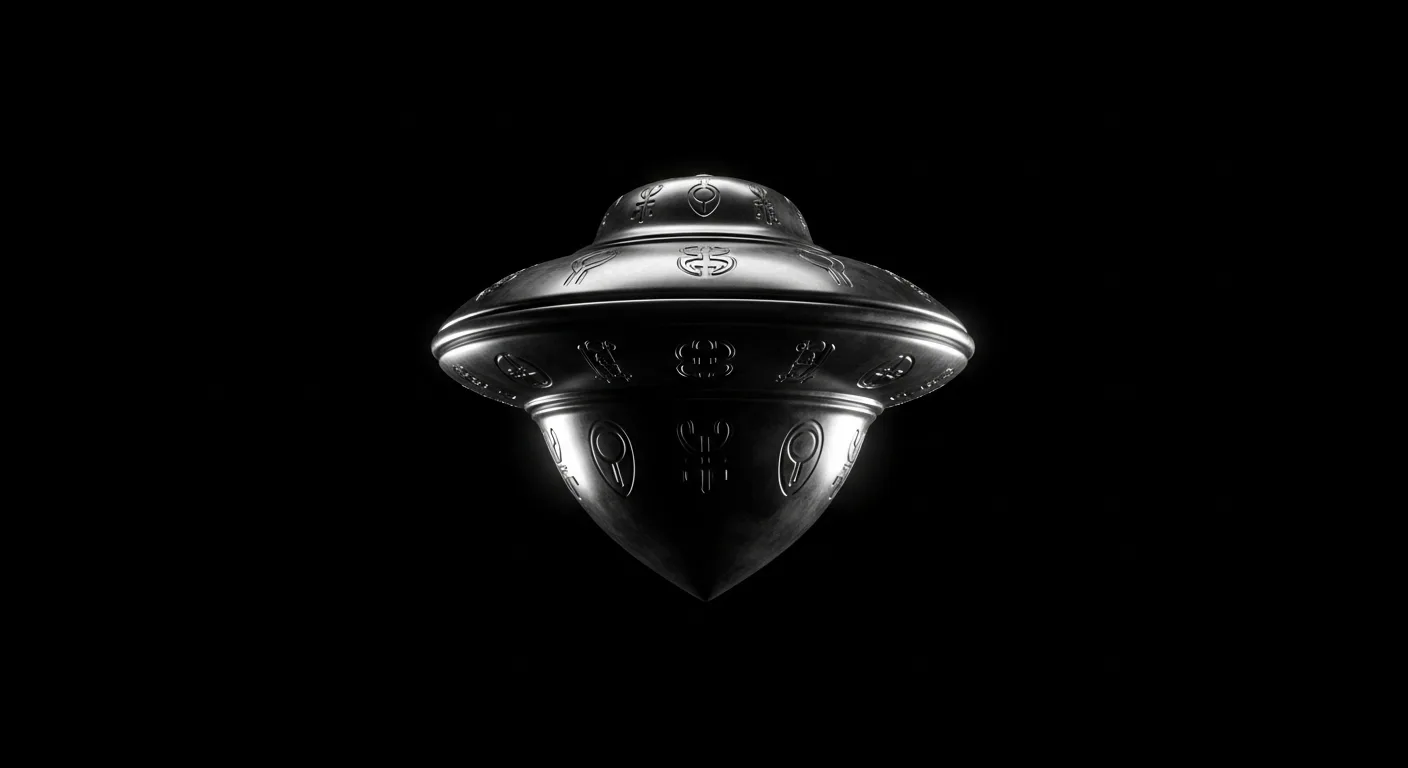
During daylight hours, lookouts on the Roosevelt spotted an unusual object in the sky. The object was described as silver or metallic in appearance, disc-shaped, and clearly defined against the sky. It was not a smudge of cloud or an ambiguous light; multiple witnesses described a solid, structured object that reflected sunlight and exhibited characteristics unlike any aircraft in the Navy’s extensive inventory.
The object’s behavior was what set it apart from any conventional explanation. It appeared to pace the carrier, maintaining a roughly consistent distance from the ship as it moved. This suggested either a remarkable coincidence of trajectory or, more disturbingly, an intelligence guiding the object that had taken an interest in the carrier and its operations. The disc would hover motionless in the sky, then accelerate rapidly to a new position, then resume hovering. It executed sharp turns that would have imposed lethal G-forces on any human occupant of a conventional aircraft. Its movements were described as fluid and instantaneous, as if the object were unbound by the laws of inertia that governed every aircraft known to military aviation.
The object maintained its presence near the carrier for what witnesses estimated was several hours, a remarkably prolonged encounter by the standards of most UFO sightings. During this time, its presence was observed from multiple vantage points on the ship, including the bridge, the flight deck, and various observation positions. The extended duration of the sighting allowed multiple witnesses to observe the object at length and to attempt to reconcile what they were seeing with known aircraft types and natural phenomena. By all accounts, they were unable to do so.
The Photographs
The prolonged nature of the encounter provided ample opportunity for the object to be photographed, and multiple crew members reportedly took photographs of the disc using both personal cameras and the ship’s official photographic equipment. In the era before digital photography, these would have been film photographs, the negatives of which would constitute physical evidence of whatever the crew had observed.
According to the accounts of crew members who came forward in later years, the photographs clearly showed a structured, disc-shaped object in the sky above or near the carrier. The images were described as sharp and unambiguous, showing a metallic craft that bore no resemblance to any known aircraft. Some accounts describe the photographs as among the clearest images of an unidentified flying object ever captured, the quality presumably benefiting from the daylight conditions and the availability of decent photographic equipment aboard a major warship.
What happened to these photographs is a matter of considerable controversy and suspicion. According to crew members’ accounts, intelligence officers aboard the Roosevelt collected all photographs of the object shortly after the sighting. This was not unusual in itself; the collection and classification of photographs taken during military exercises was standard procedure, particularly for images that might reveal sensitive information about ship configurations or operational procedures. However, the photographs of the UFO were reportedly treated with particular urgency, collected swiftly and completely, with crew members ordered not to retain copies or discuss what they had seen.
Some accounts claim that the photographs were forwarded to the Pentagon, specifically to intelligence agencies with an interest in the UFO phenomenon. Others suggest they were sent to the CIA, which in 1952 was deeply engaged in assessing whether UFO reports posed a national security concern. Whatever their destination, the photographs never resurfaced. They were not included in the files of Project Blue Book, the Air Force’s official UFO investigation program. They have not appeared in any of the government document releases that have occurred in subsequent decades. If the photographs existed, and the testimony of multiple crew members strongly suggests they did, they remain locked in classified files or have been destroyed.
The loss of this photographic evidence is a source of immense frustration for UFO researchers. In a field where physical evidence is rare and eyewitness testimony is routinely challenged, clear photographs taken by military personnel aboard a major warship would constitute extraordinarily compelling evidence. Their suppression, if that is what occurred, raises uncomfortable questions about what the photographs showed and why their contents were deemed too sensitive for public scrutiny.
The Military Response
The crew of the Roosevelt did not simply observe the object passively. According to several accounts, the ship’s air wing scrambled fighter aircraft to intercept the disc, a standard military response to unidentified objects in the vicinity of a warship. The fighters, likely F4U Corsairs or AD Skyraiders from the carrier’s air group, were vectored toward the object by the ship’s combat information center.
The results of this attempted intercept were reported to be entirely one-sided. The fighters were unable to match the object’s speed or altitude. When they approached, the disc simply moved away, accelerating to velocities that the propeller-driven aircraft could not hope to match. The object appeared to toy with its pursuers, allowing them to close to a certain distance before effortlessly pulling away. At no point did the fighters manage to get close enough for a detailed visual inspection, and their attempts to match the object’s performance were clearly futile.
This encounter between military aircraft and the unidentified object is significant because it demonstrates that the disc was not a passive phenomenon such as a weather balloon, a cloud formation, or an atmospheric illusion. It responded to the approach of the fighters, suggesting awareness of its environment and the ability to react accordingly. The fact that it could outperform military aircraft with ease placed it in a category of technology that was, and remains, beyond the acknowledged capabilities of any nation’s military forces.
After several hours of observation, the object apparently decided that its inspection of the carrier group was complete. Witnesses described it accelerating away at extraordinary speed, transitioning from a near-stationary hover to a velocity that took it out of visual range in seconds. The departure was described as instantaneous, the object simply streaking away and vanishing, leaving the crew of the Roosevelt to process what they had just witnessed.
The Witnesses Come Forward
In the years and decades following the incident, several crew members of the Roosevelt broke their silence about what they had observed during Operation Mainbrace. Their accounts, given independently and at different times, display a remarkable consistency that strengthens the case for the reality of the sighting.
The witnesses uniformly described a metallic, disc-shaped object that exhibited flight characteristics beyond the capabilities of any known aircraft. They agreed on the extended duration of the sighting, the object’s apparent interest in the carrier, the failed intercept attempt, and the high-speed departure. They also consistently reported that photographs had been taken and subsequently confiscated by intelligence personnel.
One crew member, speaking in the 1980s, described the atmosphere aboard the ship in the aftermath of the sighting. “Everyone who saw it knew it wasn’t one of ours, and it wasn’t Russian,” he stated. “The Russians didn’t have anything that could do what that thing did. Nobody did. We talked about it among ourselves for a while, but then the word came down to keep quiet about it. We were told it was classified and to forget what we’d seen. Most guys did, or at least they stopped talking about it. But you don’t forget something like that.”
Another veteran, interviewed years later, recalled the professionalism of the crew’s response despite the extraordinary nature of what they were witnessing. “We were Navy men aboard a combat vessel during a major exercise. When something unusual appeared in the sky, we did what we were trained to do. We reported it, we tracked it, we attempted to intercept it. The fact that we couldn’t identify it or match its performance didn’t change our procedures. We did our jobs. But privately, every man who saw that thing knew that the world was a stranger place than we’d been told.”
Operation Mainbrace: The Wider Pattern
The Roosevelt incident did not occur in isolation. Operation Mainbrace produced multiple UFO reports from different locations and different national forces, suggesting that the exercise as a whole attracted the attention of whatever was behind the sightings. These additional incidents strengthen the case for taking the Roosevelt sighting seriously, as they demonstrate a pattern of activity rather than an isolated anomaly.
On September 19, 1952, a Royal Air Force Meteor jet returning to the airfield at Topcliffe in Yorkshire observed a silvery, disc-shaped object that descended, stopped, rotated, and then accelerated away at tremendous speed. The pilot and his navigator both observed the object, and their report was forwarded to the Air Ministry.
On September 20, personnel aboard the USS Franklin D. Roosevelt’s sister ship or another vessel in the exercise group reported seeing three objects in the sky that moved in formation before breaking apart and departing in different directions at high speed. The same day, additional sightings were reported from Denmark, where multiple witnesses observed luminous objects performing aerial maneuvers.
On September 21, six Royal Air Force jets on exercise over the North Sea encountered a spherical object that followed their formation before accelerating away. The pilots reported the encounter through official channels, and the report was confirmed by radar operators on the ground.
This concentration of sightings during a single military exercise is remarkable. Whatever the objects were, they appeared during a period of intense military activity involving the most powerful naval and air forces in the Western world. The implications of this pattern are unsettling: either an unknown technology was surveilling NATO’s military capabilities at the height of the Cold War, or hundreds of trained military personnel from multiple nations simultaneously experienced collective misidentifications of mundane phenomena. Neither explanation is entirely comfortable.
The Significance
The USS Franklin D. Roosevelt UFO incident occupies an important place in the history of military UFO encounters. Several factors elevate it above the typical sighting report and make it a case that demands serious consideration.
First, the quality of the witnesses is exceptional. These were not untrained civilians catching a brief glimpse of something unusual in the sky. They were military personnel aboard a warship, trained in aircraft identification and accustomed to evaluating aerial phenomena as part of their daily duties. Their extended observation of the object gave them ample time to consider and reject conventional explanations.
Second, the alleged photographic evidence, though unavailable for public examination, adds a dimension to the case that most sightings lack. Multiple witnesses independently confirm that photographs were taken and confiscated, and the consistency of their accounts on this point is difficult to dismiss.
Third, the context of Operation Mainbrace and its multiple associated sightings transforms the Roosevelt incident from an isolated anomaly into part of a broader pattern. The objects appeared to be interested in military operations, a characteristic that has been noted in numerous other military UFO encounters throughout history.
Fourth, the attempted intercept by carrier-based aircraft demonstrates that the military took the sighting seriously enough to commit valuable aviation assets to investigating it. The failure of those aircraft to match the object’s performance eliminates the possibility that it was a conventional aircraft or a known adversary’s technology.
The case remains officially unexplained. The photographs, if they still exist, remain classified more than seven decades after they were taken. The witnesses, most of them now deceased, went to their graves knowing they had seen something that the official record refused to acknowledge. The waters of the North Atlantic, where the Roosevelt sailed during those September days in 1952, keep their secrets. But the accounts of the men who served aboard that carrier during Operation Mainbrace continue to challenge our understanding of what flies in our skies and why the truth about such encounters has been so systematically suppressed.
Sources
- Project Blue Book — National Archives — USAF UFO investigation files, 1947–1969
- CIA UFO/UAP Reading Room — Declassified CIA documents on UAP