The Lonnie Zamora Incident
A police officer witnessed a landed UFO and its occupants in New Mexico, leaving physical evidence that convinced Air Force investigators.
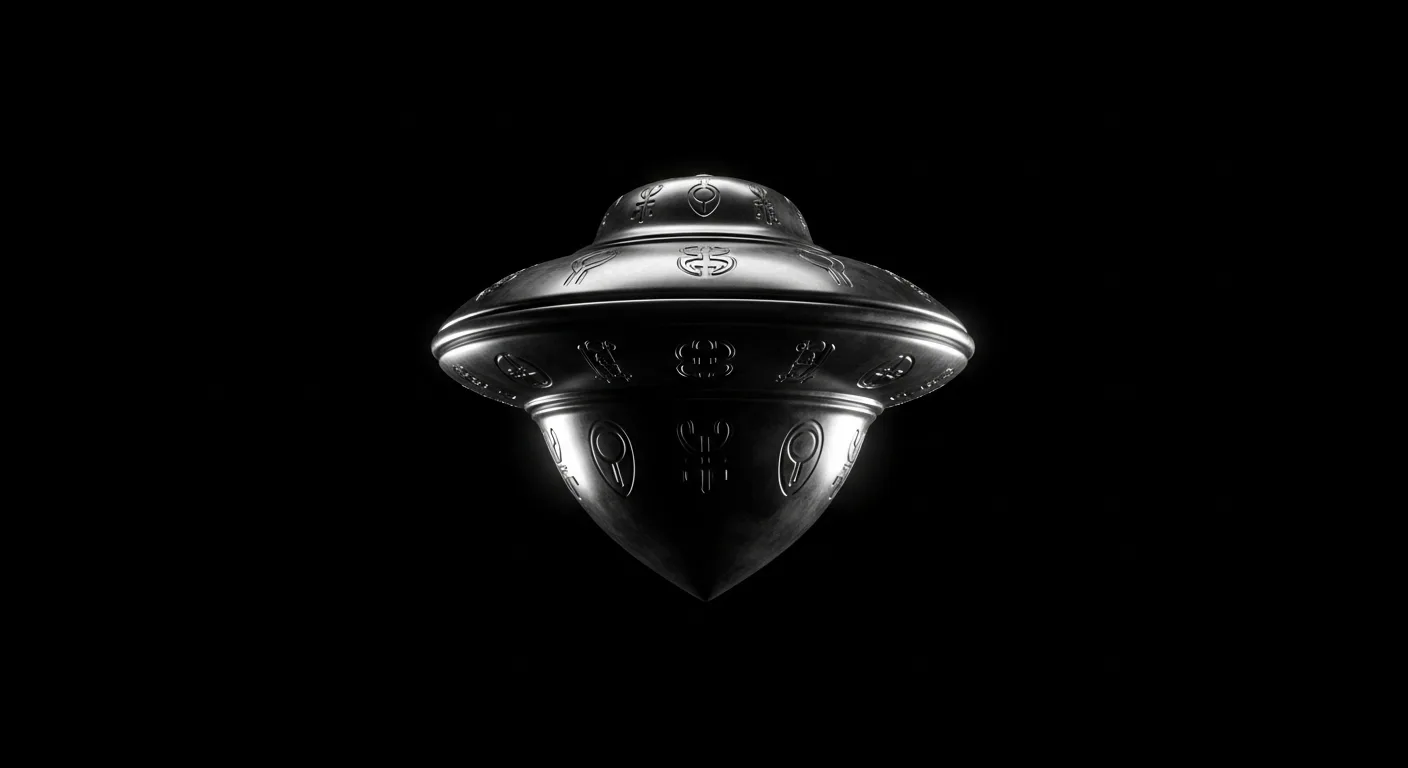
The late afternoon sun hung over the New Mexico desert on April 24, 1964, casting long shadows across the scrubland south of Socorro as Officer Lonnie Zamora of the Socorro Police Department pursued a speeding automobile along the highway. It was the kind of routine duty that defined small-town policing—a minor infraction on a quiet Friday, the sort of thing that would normally result in a ticket, a warning, and nothing more. But the routine shattered when a tremendous roar split the air and a column of flame descended from the sky to the southwest, and Zamora, acting on the instinct that defines good police work, abandoned his pursuit of the speeder and turned toward what he believed might be an explosion. He could not have known, as he wrestled his patrol car up a rough gravel road toward the source of the disturbance, that he was driving toward an encounter that would be investigated by the FBI, the United States Air Force, and the scientific establishment, and that would leave marks—in the earth, in the official record, and in the life of a man who wanted nothing more than to be an ordinary cop—that have never been satisfactorily explained.
Socorro in 1964
Socorro, New Mexico, was a town that lived quietly. With a population of roughly five thousand, it served as the seat of Socorro County and as a waypoint along the Rio Grande, nestled between the river and the arid mountains that defined the central New Mexico landscape. The town’s economy was modest, sustained by ranching, a small mining industry, and the presence of the New Mexico Institute of Mining and Technology. White Sands Missile Range lay to the south, and the Trinity Site—where the first atomic bomb had been detonated in 1945—was within the county’s borders, lending the region a certain historical gravity that belied its unassuming appearance.
The people of Socorro were practical and unhurried, accustomed to the vast spaces and clear skies of the high desert. They were not given to hysteria, superstition, or the kind of imaginative excess that might lead someone to mistake a weather balloon for a spacecraft. The desert had its own beauty and its own strangeness—dust devils, mirages, the occasional coyote trotting across the highway—but it was a familiar strangeness, understood and accepted by people who had lived with it all their lives.
Lonnie Zamora fit perfectly into this landscape. A lifelong resident of Socorro, he had joined the police force and built a career on dependability, thoroughness, and an absolute commitment to doing his job without drama or embellishment. His colleagues respected him. His neighbors trusted him. No one who knew him would have believed him capable of inventing a story for attention, and no one who met him afterward doubted that he was telling the truth as he understood it.
The Turn Toward the Unknown
When Zamora heard the roar and saw the flame, his response was professional and immediate. He believed that a dynamite storage shack in the area might have exploded, and his duty was to investigate. He radioed his dispatcher, identified his location, and turned his patrol car onto a rough dirt and gravel road that climbed a gentle mesa south of town.
The road was not designed for speed. Zamora’s patrol car struggled on the loose surface, and he had to make multiple attempts to negotiate a particularly steep section before reaching the top. From the crest of the mesa, he had a clear view of the terrain below—a landscape of gullies, scrub brush, and rocky outcrops that stretched toward the mountains in the distance.
What he saw in the nearest gully was not a burning shack.
An object sat on the desert floor, perhaps one hundred and fifty to two hundred yards from his position. It was white or whitish-silver, roughly egg-shaped or oval, and appeared to be standing on metallic legs that held it several feet above the ground. The object was smooth and appeared to be metallic, its surface catching the late afternoon light with a dull sheen that distinguished it from the surrounding terrain.
Near the object, Zamora observed two figures. They were small—he compared them to children in size, estimating them at perhaps four feet tall—and they appeared to be wearing white coveralls or jumpsuits. They were standing near the object, and one of them appeared to turn and notice Zamora’s approach. At this distance, he could not make out facial features or other details, but the figures were clearly bipedal and humanoid in form.
Zamora reported to his dispatcher that he had found what appeared to be an overturned vehicle with people nearby. He began driving toward the gully, losing sight of the object as the terrain intervened. When he stopped his car and got out, he was closer to the object and could see it more clearly, but the two figures had vanished—apparently having moved behind or entered the craft in the time that Zamora had been driving.
Face to Face with the Unknown
Standing outside his patrol car, Zamora now had an unobstructed view of the object. It was approximately fifteen to twenty feet long, egg-shaped, and resting on what appeared to be metallic landing gear. The surface was smooth and featureless except for a single marking—a red insignia on the side that Zamora described as resembling an inverted V with lines through it and a curved or crescent shape above. The object made no sound. It simply sat there in the desert, a thing that had no business being there, as out of place in the New Mexico scrubland as a cathedral would have been.
Then the roar began again. The sound started low and increased rapidly in volume and pitch, building to a level that was physically painful. Simultaneously, the underside of the object began to emit a blue-orange flame that scorched the desert brush beneath it and kicked up dust and debris. Zamora, now thoroughly frightened, turned and ran. He stumbled over the rough ground, lost his glasses, and threw himself to the ground behind his patrol car, covering his head with his arms and expecting the object to explode.
It did not explode. The roar diminished, replaced by a high-pitched whine that faded as the object gained altitude. Zamora raised his head and watched as the craft rose from the gully, its legs now retracted flush against its body, and moved away to the southwest in a smooth, accelerating trajectory. It did not wobble or tumble; it flew with the controlled precision of something designed to fly, something being piloted or guided with intelligence and purpose. Within seconds it had covered a considerable distance, shrinking to a point of light before disappearing entirely.
Zamora stood in the desert, alone, his glasses lying somewhere in the brush, his heart pounding, his mind struggling to process what had just happened. He walked back to his car and radioed for help.
The Evidence Speaks
Sergeant Sam Chavez of the New Mexico State Police was the first to arrive at the scene. He found Zamora in a state of visible agitation—pale, sweating, and clearly shaken. The two men walked together to the gully where the object had rested, and what they found there told a story that was entirely consistent with Zamora’s account.
The desert brush where the flame had struck was burned. Greasewood and other scrub plants were charred, some still smoldering, and the soil beneath them was scorched and dried. The pattern of burning was localized and directional, consistent with a jet of flame pointed downward—exactly as Zamora had described the object’s departure.
In the earth, they found four wedge-shaped impressions arranged in a trapezoidal pattern. The impressions were deep, clearly defined, and angled slightly inward, as though something heavy had rested on four converging supports. The pattern matched what one would expect from landing gear designed to support a large, heavy object on uneven terrain. The depth of the impressions suggested substantial weight—far more than a person or a small vehicle could produce.
Additional marks were found around the impressions—scrapes and disturbances in the soil that appeared to be associated with the landing and departure of the object. These marks were documented by the investigators who arrived over the following hours and days, and they provided a physical record that corroborated the testimony of the witness.
Official Attention
The Socorro case drew investigators like a magnet. FBI agent Arthur Byrnes arrived and examined the site, interviewing Zamora and documenting the physical evidence. Army personnel from White Sands Missile Range conducted their own examination, checking whether any military test or exercise could account for what Zamora had observed. They found none.
Captain Richard Holder of the Army and FBI agent Byrnes were among the first to reach the site on the evening of the sighting, and both found Zamora’s account and the physical evidence convincing. Holder measured the landing impressions, photographed the burned brush, and secured the area against contamination by curious onlookers who were beginning to gather.
Project Blue Book dispatched its chief scientific consultant, astronomer J. Allen Hynek, to investigate. Hynek, who had spent years debunking UFO reports for the Air Force, arrived in Socorro with the expectation that he would find a prosaic explanation for Zamora’s sighting. He did not find one. Instead, he found a witness whose credibility was beyond serious challenge, physical evidence that defied conventional explanation, and a case that resisted every attempt to explain it away.
Hynek later described the Socorro case as one of the most puzzling he had ever examined. He could find no evidence of hoax, no evidence of misidentification, and no evidence of any military or civilian activity that could account for the object Zamora had observed. The case was classified by Project Blue Book as “Unknown”—a designation that, in the context of an organization whose primary mission was to explain UFO reports, amounted to an admission of defeat.
A Life Changed
The Socorro encounter transformed Lonnie Zamora’s life in ways he neither wanted nor welcomed. The story made national news, drawing reporters, UFO enthusiasts, and curious seekers to the quiet town. Zamora’s name became attached to one of the most famous UFO cases in history, and the attention was deeply uncomfortable for a man whose natural inclination was toward privacy and routine.
He handled the unwanted fame with the same quiet professionalism that had characterized his police work. He did not capitalize on the encounter. He turned down offers for paid appearances and book deals. He did not join the lecture circuit or become a fixture at UFO conferences. He continued to serve as a police officer in Socorro, patrolling the same roads and serving the same community, doing his best to live the same life he had lived before that Friday afternoon when something landed in a gully and changed everything.
His account never changed. In the forty-five years between the encounter and his death in 2009, Zamora told the same story in the same way, with the same details and the same tone of reluctant honesty. He did not embellish, exaggerate, or dramatize. He described what he had seen as simply and directly as a police officer filing a routine report, and the simplicity and directness of his account proved to be its greatest strength.
The Enduring Question
The Socorro incident has been reexamined, debated, and analyzed for six decades, and no satisfactory conventional explanation has ever been established. Hoax theories founder on Zamora’s unimpeachable character and the lack of any mechanism or motive for fabrication. Misidentification theories collapse against the specificity of the observation and the physical evidence. Secret military test theories are unsupported by any documentary evidence and are contradicted by the investigations conducted by multiple agencies at the time.
What landed in the desert outside Socorro on April 24, 1964, left physical evidence that was documented by the FBI, the Air Force, and the Army. It was observed by a witness whose integrity has never been seriously challenged. It was investigated by the United States government’s official UFO research program and declared unexplained. And it was studied by one of the most prominent scientific skeptics in the country, who found it genuine, puzzling, and ultimately inexplicable.
The marks in the earth have long since been erased by wind and weather. The burned brush has regrown. The gully where the object rested looks today much as it did before Zamora arrived on that April afternoon. But the questions raised by the encounter remain as fresh and as troubling as the day they were first asked. Something was there. The evidence says so. The witness says so. The official record says so. And no one, in all the years since, has been able to say what it was.
Sources
- Project Blue Book — National Archives — USAF UFO investigation files, 1947–1969
- CIA UFO/UAP Reading Room — Declassified CIA documents on UAP