Socorro Egg-Shaped Craft
Police officer Lonnie Zamora found a landed UFO with two small beings in white coveralls. Physical traces remained at the site for investigation. The Air Force called it one of the best-documented cases.
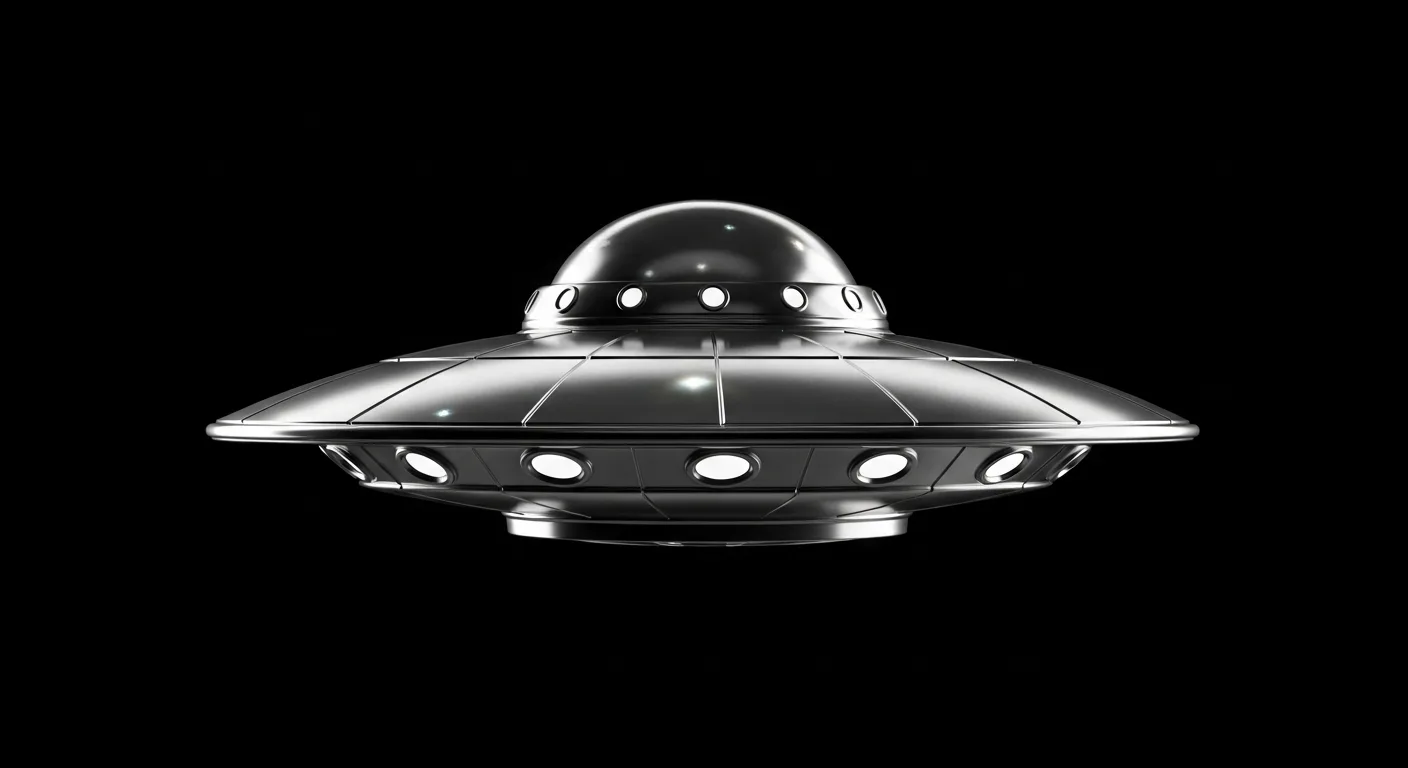
The afternoon of April 24, 1964, began as routine as any other for Patrolman Lonnie Zamora of the Socorro, New Mexico Police Department. A high-speed chase of a speeding car along the Old Rodeo Road would soon be forgotten. What Zamora encountered instead would make his small desert town famous and create one of the most thoroughly investigated and credible UFO cases in history.
Zamora was a respected officer, known for his reliability and calm demeanor. He had served on the Socorro force for years and had never made any unusual claims or sought attention. In the coming hours, days, and years, investigators from the FBI, the U.S. Air Force, and civilian research organizations would find him to be exactly what his colleagues said he was: an honest, straightforward cop who reported what he saw.
The Roar and the Flame
While pursuing the speeder, Zamora heard a loud roar from the southwest and glimpsed a brilliant flame descending toward a dynamite storage area on the outskirts of town. Fearing an explosion that might endanger the community, Zamora abandoned his chase and turned toward the source of the disturbance. It was a decision that would change his life.
He drove up a rough gravel road toward the area where he had seen the flame. The terrain was rugged, covered with desert scrub and the remnants of an old mining operation. As his patrol car crested a small rise, Zamora saw something that stopped him cold.
Approximately 800 feet away, in a shallow arroyo, sat a white, egg-shaped object roughly the size of a car turned on end. It rested on what appeared to be short legs or a frame. Near the object, he could see two small figures in white coveralls. They appeared to be examining something on the ground.
The Beings
Zamora later described the figures as approximately the size of children, perhaps four feet tall. They wore white clothing that covered them entirely. He could not make out facial features at that distance, but they appeared humanoid in shape. One of the figures seemed to turn and look toward his patrol car.
Zamora’s instinct was to investigate. These might be crash survivors who needed help, or perhaps workers who had gotten into trouble. He radioed dispatch to report what he was seeing, then got out of his car and began walking toward the object.
As he approached, one of the figures appeared to notice him. Zamora saw movement near the craft. Then, suddenly, the roar he had heard earlier resumed, louder and more intense. A brilliant blue and orange flame erupted from beneath the object.
The Departure
Fearing an explosion, Zamora turned and ran. He dove behind his patrol car for cover, losing his glasses in the process. From this position, he watched as the egg-shaped craft lifted off the ground, rising slowly at first on a column of flame. There was no smoke, he noticed, only the intense blue-orange fire and a high-pitched whine that gradually replaced the roar.
The craft rose to approximately twenty feet, then began moving away to the southwest. It cleared a dynamite shack by only a few feet, causing Zamora to fear for a moment that it might strike the structure. But it passed cleanly over, accelerated rapidly, and disappeared over the distant mountains in seconds.
Zamora was left standing alone in the desert, his heart pounding, his glasses lost somewhere in the brush.
The Physical Evidence
Within minutes, Sergeant Sam Chavez of the New Mexico State Police arrived, responding to Zamora’s earlier radio call. Together, they approached the landing site and found compelling physical evidence that something extraordinary had been there.
Four rectangular impressions in the sandy soil, arranged in a trapezoidal pattern consistent with landing gear; burned and still-smoking brush at the center of the landing area; a small, glassy area where the sand appeared to have been fused by intense heat; broken branches on bushes at the perimeter, bent outward as if from a blast of air; and a clear, V-shaped depression in the ground that investigators would later attempt to interpret.
The impressions were approximately 4 inches deep and 16 inches long. Their arrangement suggested a four-legged craft of considerable weight. The burned vegetation was still warm to the touch when Chavez arrived.
The Investigation
The Socorro incident attracted immediate attention from multiple agencies. The FBI was notified, as was the U.S. Air Force through Project Blue Book, then the official government program for investigating UFO reports. Over the following days, investigators descended on Socorro to interview Zamora, examine the physical evidence, and attempt to determine what had happened.
Dr. J. Allen Hynek, the astronomer who served as scientific consultant to Project Blue Book, personally investigated the case. Hynek, who had previously been skeptical of UFO reports, was deeply impressed by the Socorro case. He found Zamora credible, the physical evidence compelling, and the case genuinely unexplained.
In his report, Hynek wrote that the Socorro incident was one of the best-documented cases he had investigated. The physical trace evidence, the credibility of the witness, and the immediacy of the secondary investigation made it stand out from the thousands of reports in the Blue Book files.
The Insignia
One detail that Zamora reported has intrigued researchers for decades. On the side of the craft, he saw a red insignia or symbol. Under questioning, he sketched what he remembered: a vertical arrow pointing upward, surrounded by an arc or crescent shape. The exact design has been debated, with slightly different versions appearing in different accounts.
Some researchers have attempted to match this symbol to known insignia from aerospace companies, military units, or foreign space programs. None of these matches has been definitively established. If the craft was a secret military project, the insignia remains unidentified. If it was something else entirely, the symbol may be one of the few written clues to its origin.
Attempts at Explanation
Project Blue Book officially classified the Socorro incident as “Unknown.” Despite considerable effort, investigators could not explain what Zamora had seen in conventional terms.
Various explanations have been proposed over the years. Some suggested Zamora saw a Lunar Landing Research Vehicle, an experimental aircraft designed to simulate moon landings. However, records show no such vehicle was operating in New Mexico that day, and the LLRV looked nothing like what Zamora described. Others proposed a student hoax, but no evidence of such a hoax has ever been produced, and creating the physical trace evidence would have been extraordinarily difficult.
The most common debunking attempts have focused on Zamora’s character rather than his testimony, but those who knew him and those who investigated him found no reason to doubt his honesty.
Impact on Hynek
The Socorro case was a turning point for Dr. J. Allen Hynek. Prior to this investigation, he had largely supported the Air Force’s dismissive approach to UFO reports. After Socorro, his position began to shift. The case was too well-documented, the witness too credible, the evidence too physical to dismiss.
In the years that followed, Hynek became increasingly critical of Project Blue Book and its methods. He eventually became a leading figure in serious UFO research, founding the Center for UFO Studies and developing the “Close Encounters” classification system that would later be made famous by Steven Spielberg’s film.
Legacy
The Socorro incident remains one of the gold standards for physical trace UFO cases. It combined everything that serious researchers look for: a trained and credible witness, multiple forms of physical evidence, immediate investigation by multiple agencies, and documentation that has survived for over six decades.
Lonnie Zamora never sought publicity or profit from his experience. He remained on the Socorro police force and lived a quiet life, reluctantly speaking about the incident when asked but never embellishing his account. He maintained until his death that he reported exactly what he saw, and he never understood what it was.
Whatever landed in that desert arroyo on April 24, 1964, it left marks that can still be discussed and debated today. The depressions in the sand, the burned vegetation, the strange insignia on the side of an egg-shaped craft, and the two small figures in white coveralls remain unexplained. Socorro reminds us that some mysteries do not yield to investigation, no matter how thorough.
Sources
- Project Blue Book — National Archives — USAF UFO investigation files, 1947–1969
- CIA UFO/UAP Reading Room — Declassified CIA documents on UAP