Japan Airlines Flight 1628 UFO
Captain Kenju Terauchi, a veteran pilot with 10,000+ hours, reported a massive UFO—the size of two aircraft carriers—following his Boeing 747 over Alaska for 50 minutes. FAA radar confirmed the object. When Terauchi went public, Japan Airlines grounded him. The FAA covered it up.
The Encounter
At 5:11 PM Alaska time on November 17, 1986, Captain Kenju Terauchi was guiding Japan Airlines Flight 1628 — a Boeing 747-200F cargo aircraft on a routine Paris-to-Tokyo routing via Anchorage — through the dark skies over northeastern Alaska when lights appeared ahead of his aircraft. Terauchi was not the kind of man prone to seeing things. A former fighter pilot with twenty-nine years of flying experience and more than ten thousand hours in the cockpit, he had spent his career in situations where precise observation and calm assessment were matters of life and death. What he observed over the next fifty minutes would end his career as he knew it.
Two smaller objects appeared first, roughly square-shaped and glowing, flying in formation ahead of the 747. Co-pilot Takanori Tamefuji and flight engineer Yoshio Tsukuba confirmed the sighting from their positions in the cockpit. The objects were not behaving like any conventional aircraft — they maintained a fixed position relative to the 747 regardless of speed or heading changes, and their luminosity pulsed in ways that suggested internal energy rather than external reflection.
Then the smaller objects departed, and something far larger took their place.
The Mothership
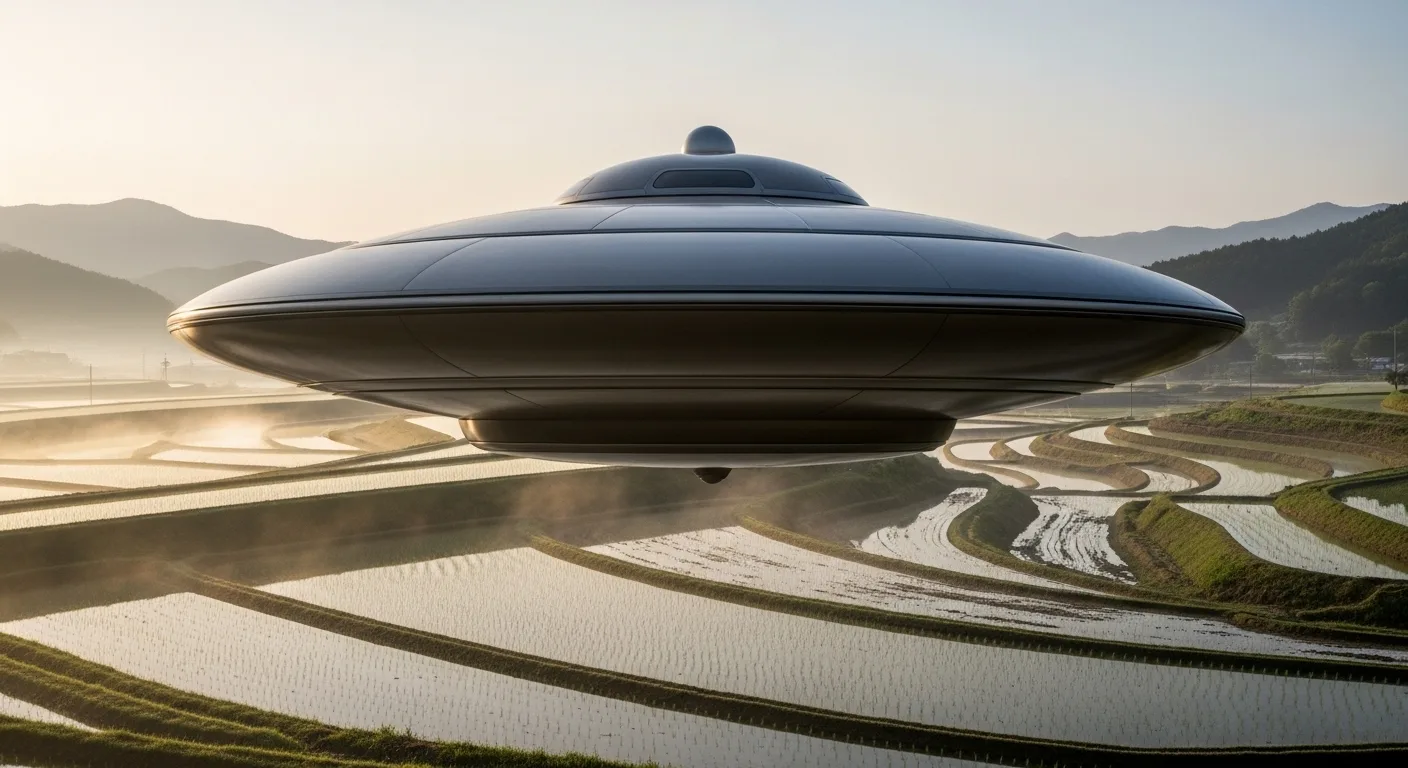
What Captain Terauchi described next strained the boundaries of what a professional aviator could be expected to report without destroying his credibility. A massive object — walnut-shaped, dark, and enormous beyond any frame of reference available to a man who flew the world’s largest commercial aircraft — appeared behind and slightly above the 747. Terauchi estimated its size as equivalent to two aircraft carriers placed side by side. The object dwarfed the Boeing 747, which itself is 231 feet long, the way a whale dwarfs a minnow. It was, by any measure, the largest aerial object ever reported by a commercial airline crew.
The encounter lasted approximately fifty minutes. During that time, the object maintained station behind the 747, matching course changes and speed adjustments as though locked to the aircraft by some invisible tether. Terauchi contacted Anchorage Air Route Traffic Control Center to report the object. The controller confirmed a radar return in the same position that Terauchi described — a primary target with no transponder signal, exactly where the captain said the object was. NORAD military radar systems also tracked the contact, providing independent confirmation from military-grade equipment.
The FAA Investigation
The Federal Aviation Administration initially took the report seriously. John Callahan, then the FAA’s Division Chief of the Accidents and Investigations branch, led the investigation personally. His team gathered the radar data, the air traffic control recordings, the crew’s testimony, and the flight recorder information. The evidence package was comprehensive — a commercial airline crew’s visual observation corroborated by civilian and military radar, documented in real time through air traffic control communications.
Then the investigation took a turn that Callahan did not expect.
A meeting was convened that included representatives from the CIA, the FBI, and members of President Reagan’s scientific staff. Callahan presented the evidence. The response was not what an investigator accustomed to following facts to conclusions would have anticipated. The attendees did not debate explanations or request further analysis. They collected the evidence — the radar tapes, the recordings, the reports — and instructed everyone present that the incident had not occurred. Do not discuss it. Do not share it with the media. The materials were classified.
The Price of Speaking
Captain Terauchi, despite the implicit threat to his career, spoke publicly about the encounter. Japan Airlines responded by grounding him. The veteran captain with ten thousand hours and twenty-nine years of service was removed from flying duties and assigned to a desk. The message to every commercial pilot in the world was unmistakable: report a UFO and your career ends. Terauchi’s punishment established a template of retaliation that would suppress pilot reporting for decades — a chilling effect that the aviation industry is only now beginning to address.
Callahan Breaks Silence
John Callahan, however, had done something the CIA and FBI did not anticipate. He had made copies of the evidence before it was confiscated. Years later, at a press conference at the National Press Club in Washington, DC, Callahan went public. He presented the radar data, described the meeting with intelligence officials, and confirmed that the FAA’s investigation had been shut down not because the evidence was insufficient, but because it was too good. The government did not want a confirmed, radar-corroborated UFO encounter by a major airline crew entering the public record.
Callahan’s testimony, backed by the preserved evidence, transformed JAL 1628 from a disputed pilot anecdote into one of the most thoroughly documented UFO cases in history. The flight recordings exist. The radar data exists. The crew testimony exists. The FAA’s own investigation files exist. And the cover-up — directed by intelligence agencies that classified the evidence and silenced the witnesses — is not a theory but a documented fact, confirmed by the FAA official who was ordered to carry it out.
What It Means
JAL Flight 1628 matters not just as a UFO case but as a case study in how the system handles encounters it cannot explain. A veteran pilot with impeccable credentials reports an object confirmed by multiple independent radar systems. The FAA investigates and finds the evidence compelling. And then the evidence is confiscated, the pilot is grounded, and the incident is officially erased. The pattern — observe, confirm, classify, deny — would repeat across decades of military and civilian encounters, from Nimitz to the New Jersey drones. JAL 1628 was not the first time it happened. But thanks to John Callahan’s courage in preserving the evidence and eventually coming forward, it became one of the hardest cases for the government to pretend never occurred.
Sources
- CIA UFO/UAP Reading Room — Declassified CIA documents on UAP