Area 51
America's most secretive military base, synonymous with UFO conspiracy theories, alleged extraterrestrial technology, and decades of government secrecy.
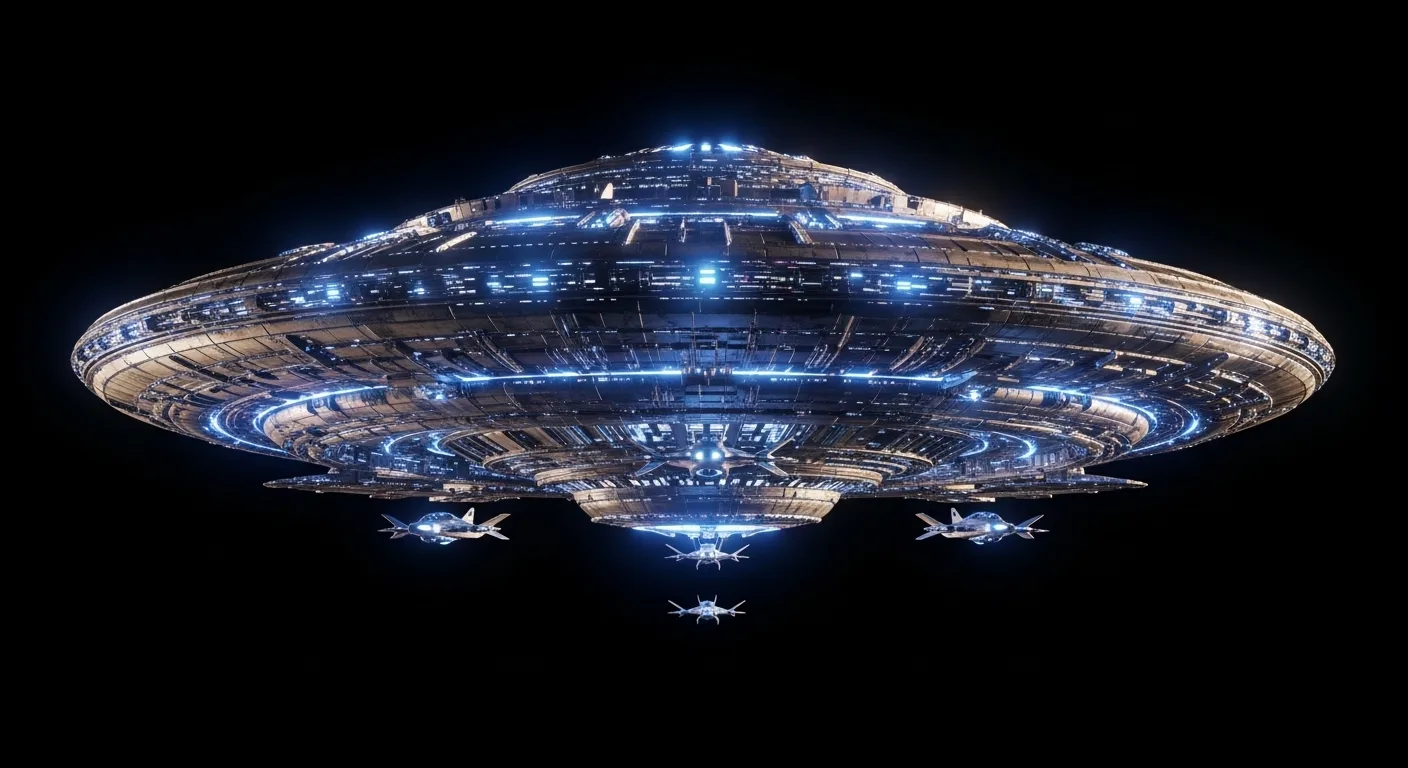
Deep within the barren expanse of the Nevada desert, surrounded by mountains and miles of restricted territory, lies a facility that has captured the imagination of millions worldwide. Area 51, officially known as Groom Lake or Homey Airport, represents the ultimate symbol of government secrecy and the enduring human fascination with the possibility of extraterrestrial life. For over seven decades, this remote military installation has been at the center of countless conspiracy theories, witness testimonies, and unexplained phenomena that continue to defy conventional explanation.
The very mention of Area 51 evokes images of crashed flying saucers, alien autopsies, reverse-engineered spacecraft, and shadowy government programs operating beyond the reach of public oversight. While skeptics dismiss these claims as fantasy, and officials maintain that the base exists solely for the development of experimental aircraft, the persistent reports from credible witnesses, the extreme security measures, and the government’s decades-long denial of the facility’s very existence have only fueled speculation about what truly occurs within its heavily guarded perimeter.
Geographic Location and Physical Description
Area 51 is situated within the Nevada Test and Training Range, approximately 83 miles (134 kilometers) northwest of Las Vegas. The facility occupies a position adjacent to Groom Lake, a dry lakebed that provides a natural runway surface extending for miles across the desert floor. The geographic coordinates place it at roughly 37.24°N latitude and 115.81°W longitude, though the exact boundaries of the restricted zone encompass a much larger area.
The surrounding landscape is characterized by the stark beauty of the Great Basin Desert, with the Groom Range to the north and the Papoose Range to the south. This remote location was deliberately chosen for its isolation—the nearest public road is miles away, and the terrain provides natural barriers against observation. The dry climate, with minimal rainfall and over 300 days of clear skies annually, creates ideal conditions for flight testing operations.
The facility itself has grown substantially since its establishment. Satellite imagery, which became publicly available in the 2000s, reveals an extensive complex featuring multiple runways (including one measuring approximately 12,000 feet), numerous hangars of varying sizes, support buildings, housing facilities, radar installations, and what appear to be underground access points. The main runway at Groom Lake is among the longest in the world, suggesting the testing of aircraft requiring extreme takeoff and landing distances.
Perhaps most intriguingly, satellite analysis has revealed evidence of extensive underground construction. Ventilation shafts, access roads leading to hillsides, and unusual surface structures suggest that a significant portion of the facility may exist below ground level—hidden from aerial observation and protected from potential attack.
The Origins: Project AQUATONE and the U-2 Program
The official history of Area 51 begins in 1955, during the height of the Cold War. The Central Intelligence Agency, working with Lockheed’s legendary Skunk Works division, needed a location to develop and test a revolutionary new reconnaissance aircraft: the U-2. This high-altitude spy plane would fly at unprecedented altitudes of 70,000 feet, far above Soviet air defenses, photographing military installations across the Iron Curtain.
Clarence “Kelly” Johnson, Lockheed’s chief engineer and one of the most brilliant aerospace designers in history, personally selected the Groom Lake site after an aerial survey of potential locations. The dry lakebed offered a perfect natural runway, the surrounding mountains provided visual screening, and the proximity to the Nevada Test Site—where nuclear weapons were being detonated—meant the area was already restricted and accustomed to high security.
The CIA designated the project “AQUATONE” and nicknamed the remote facility “Paradise Ranch” in an attempt to make the location more appealing to the engineers and pilots who would be stationed there. The name was somewhat ironic given the harsh desert conditions, extreme temperatures, and complete isolation from civilization. Nevertheless, workers arrived, temporary facilities were constructed, and by August 1955, the first U-2 prototype was ready for flight testing.
The U-2 program proved extraordinarily successful. The aircraft gathered invaluable intelligence on Soviet military capabilities, including the discovery that the much-feared “bomber gap” was a myth. However, the U-2’s operational ceiling of 70,000+ feet had an unexpected side effect: it generated a wave of UFO reports.
Commercial airline pilots, flying at altitudes of 10,000-20,000 feet, would occasionally glimpse the U-2 cruising far above them, its silver wings catching the sunlight long after sunset had reached the ground below. At such extreme altitudes, the aircraft appeared as a brilliant, fiery object moving in ways that seemed impossible for conventional aircraft. The CIA, unable to reveal the existence of the secret program, could not explain these sightings, and the UFO connection to Area 51 began to take root in the public consciousness.
The OXCART Era: Pushing the Boundaries of Aviation
Following the success of the U-2, the Groom Lake facility was selected for an even more ambitious project: the development of the A-12 OXCART, predecessor to the legendary SR-71 Blackbird. This titanium-skinned aircraft would fly at speeds exceeding Mach 3 (over 2,200 miles per hour) and altitudes above 85,000 feet, making it virtually invulnerable to interception.
The OXCART program required substantial expansion of the Area 51 facility. The runway was lengthened, new hangars were constructed to house the larger aircraft, and specialized fuel storage facilities were built for the plane’s exotic JP-7 fuel. The workforce grew, and security measures intensified correspondingly.
The A-12 first flew from Groom Lake on April 26, 1962. Over the following years, test pilots pushed the aircraft to its limits, achieving speeds and altitudes that remained classified for decades. The distinctive shape of the OXCART—its cobra-like profile and delta wings—generated even more UFO reports than the U-2 had. Witnesses who caught glimpses of the aircraft, whether on the ground during transport or in flight, had no frame of reference for such a radically different design.
The OXCART program also established practices that would define Area 51 operations for generations. Flights were conducted primarily at night or during early morning hours to minimize observation. Workers were prohibited from discussing their employment, even with family members. The aircraft were kept in climate-controlled hangars, emerging only when necessary. And when witnesses did report unusual sightings, official channels dismissed the reports or attributed them to conventional phenomena.
Have Blue and the Stealth Revolution
The 1970s brought yet another revolutionary program to Groom Lake: the development of stealth technology. The “Have Blue” project, initiated in 1976, aimed to create an aircraft virtually invisible to radar—a capability that would transform modern warfare.
Lockheed’s Skunk Works, again working under Kelly Johnson’s leadership (and later Ben Rich), designed a proof-of-concept aircraft with a radical faceted shape intended to deflect radar waves away from their source. The Have Blue prototypes were small, unstable, and challenging to fly, but they demonstrated that stealth was achievable.
Testing at Area 51 during the late 1970s proved the concept. The Have Blue aircraft, despite their relatively small size, had radar cross-sections smaller than a bird. This success led directly to the development of the F-117 Nighthawk, the world’s first operational stealth aircraft, which also underwent extensive testing at Groom Lake before entering service in 1983.
The F-117’s angular, otherworldly appearance generated a fresh wave of UFO reports. The aircraft operated almost exclusively at night, its black coating rendering it nearly invisible against the dark sky. Witnesses who spotted it described a silent, triangular craft that seemed to defy the laws of physics—descriptions that would become increasingly common in UFO reports over the following decades.
Robert Lazar and the Transformation of Area 51’s Public Image
While Area 51 had been the subject of speculation among aviation enthusiasts and conspiracy theorists for years, it was not until 1989 that the facility became a household name. That year, a man named Robert Scott Lazar came forward with claims that would forever change public perception of the secret base.
Lazar, in a series of interviews with Las Vegas television journalist George Knapp, alleged that he had been employed at a facility called “S-4,” located near Papoose Lake, approximately 15 miles south of Groom Lake. According to Lazar, S-4 was a highly classified installation built into the mountainside, consisting of a series of hangars disguised to blend with the desert terrain. Inside these hangars, Lazar claimed, were nine disc-shaped craft of extraterrestrial origin.
Lazar described being hired in late 1988 to work on the propulsion system of one of these craft, which he nicknamed the “Sport Model” due to its smooth, streamlined appearance. He claimed the craft operated using a reactor that generated gravity waves through the controlled manipulation of an element with atomic number 115—an element that did not exist on the periodic table at the time. This element, Lazar explained, underwent bombardment by protons, creating a reaction that produced antimatter. The resulting energy was used to amplify gravity waves, allowing the craft to distort space-time and achieve propulsion without conventional thrust.
The details Lazar provided were remarkably specific. He described the interior of the craft, including the small seats apparently designed for beings shorter than average humans. He sketched the reactor configuration and explained the theoretical physics underlying the propulsion system. He even described briefing documents he claimed to have read, which detailed the extraterrestrial origin of the craft and the government’s decades-long study of recovered technology.
Lazar’s claims generated immediate controversy. Investigators were unable to verify his educational credentials—he claimed degrees from MIT and Caltech, but neither institution had records of his attendance. His employment history was similarly difficult to confirm; while some evidence suggested he had worked at Los Alamos National Laboratory, as he claimed, other aspects of his background remained murky.
Supporters pointed to several elements that lent credibility to his account. Lazar accurately described the layout of the Groom Lake facility and the schedule of test flights at a time when such information was not publicly available. He passed multiple polygraph examinations (though polygraph results are not considered definitive). And most remarkably, in 2003, scientists successfully synthesized element 115, now named Moscovium—though its properties did not match Lazar’s descriptions of a stable isotope capable of sustaining nuclear reactions.
The debate over Lazar’s credibility continues to this day. Skeptics point to the lack of verifiable evidence, the inconsistencies in his background, and the physical implausibility of his claims. Believers counter that the government would naturally erase records of anyone who violated security protocols by revealing classified information, and that the existence of a previously unknown element suggests Lazar had access to information beyond public knowledge.
Regardless of whether Lazar’s claims are accurate, their impact is undeniable. His testimony transformed Area 51 from an obscure military installation known mainly to aviation buffs into the world’s most famous symbol of UFO conspiracy theories. The facility became a cultural phenomenon, inspiring countless books, films, television shows, and eventually drawing millions of curious visitors to the Nevada desert.
Security Measures: The Most Heavily Guarded Facility in America
The security surrounding Area 51 is legendary, and for good reason. The perimeter of the restricted zone extends for miles beyond the actual facility, encompassing thousands of acres of desert terrain. Trespassers face serious legal consequences, including fines of $1,000 or more and potential imprisonment.
The first line of defense is natural: the remote location and harsh terrain deter casual visitors. The nearest public approach is along a dirt road leading to a boundary marked by warning signs. These signs, printed in stark red and white, leave no ambiguity about the consequences of unauthorized entry: “Warning: Military Installation. It is unlawful to enter this area without permission of the Installation Commander. Photography is prohibited. Violators will be prosecuted to the maximum extent of the law. Use of deadly force authorized.”
Beyond the signs, a network of sensors monitors all approaches to the facility. Ground-based motion detectors, originally developed for military applications in Vietnam, register any movement larger than a small animal. Seismic sensors detect footsteps and vehicle traffic. Infrared cameras provide continuous surveillance regardless of lighting conditions. And buried sensors track changes in magnetic fields, detecting vehicles or equipment that might otherwise escape notice.
The human element of security is provided by private military contractors, colloquially known as “Cammo Dudes” due to their camouflage attire. These guards patrol the perimeter in unmarked white pickup trucks, maintaining constant vigilance over anyone approaching the boundary. They are authorized to detain trespassers until local law enforcement arrives, and warning signs make clear that lethal force may be employed if necessary.
Above the ground, the restricted airspace designated R-4808N extends from the surface to unlimited altitude. Aircraft entering this space without authorization risk interception by armed fighters, and pilots who stray too close receive immediate radio warnings to change course. The airspace restriction was notably expanded in the 1980s, pushing back the boundary where civilian observers could legally watch test flights.
For employees, security begins before they ever set foot on the facility. Background investigations are exhaustive, examining not only the potential employee’s history but that of family members and close associates. Security clearances for Area 51 work are among the most stringent in the government, with “need to know” restrictions limiting what even cleared personnel can access.
Workers commute to the facility aboard unmarked Boeing 737 aircraft operated by a contractor, flying from a dedicated terminal at Las Vegas’s Harry Reid International Airport (formerly McCarran). These flights, callsigned “JANET” (sometimes said to stand for “Just Another Non-Existent Terminal”), feature windows that are sealed or covered during approach and landing. Employees are forbidden from revealing their destination, and many family members know only that their loved ones work “at the test site.”
On the base itself, compartmentalization ensures that even workers with high-level clearances know only what is necessary for their specific tasks. Buildings and hangars are designated by color-coded or numbered systems, and access to each area requires specific authorization. Some former employees have described learning almost nothing about projects occurring in adjacent buildings, despite years of service at the facility.
Documented Test Programs and Declassified Projects
While conspiracy theories dominate public discussion of Area 51, the facility has an extensively documented history of testing experimental and captured aircraft. Many of these programs have been declassified, providing insight into the legitimate reasons for the extreme secrecy.
Foreign Technology Evaluation
Throughout the Cold War, the United States acquired examples of Soviet aircraft through various means—defectors, intelligence operations, and examination of crashed or captured equipment. These aircraft were brought to Area 51 for evaluation under programs with codenames like “HAVE DOUGHNUT” and “HAVE DRILL.”
The most significant acquisition occurred in 1966, when an Iraqi pilot defected with his MiG-21, one of the Soviet Union’s most advanced fighters. The aircraft was transported to Groom Lake, where American pilots learned its capabilities and limitations. This knowledge proved invaluable, allowing the development of tactics to counter the MiG-21 in Vietnam and elsewhere.
Similar evaluations continued throughout the Cold War and beyond. Soviet aircraft obtained from various sources—including a MiG-23 from Egypt and MiG-29s from Moldova after the Soviet Union’s collapse—were tested at Area 51, providing American pilots with realistic training against potential adversaries.
Advanced Tactical Fighter Programs
The success of the F-117 stealth fighter led to ongoing development of stealth technology at Groom Lake. While specific programs remain classified, aviation observers have documented numerous unusual aircraft operating from the facility over the decades.
Triangular craft, sometimes described as the “TR-3B” or “Black Manta,” have been reported consistently since the 1980s. Whether these represent actual classified aircraft, misidentified conventional planes, or something else entirely remains a matter of speculation. The Air Force has never acknowledged the existence of such platforms.
Unmanned aerial vehicles (drones) have also been tested extensively at Area 51. The RQ-170 Sentinel, a stealth reconnaissance drone, was reportedly developed and tested at the facility before its existence was revealed when one was captured by Iran in 2011. Larger, more capable unmanned aircraft are presumed to be under development.
The 2013 CIA Acknowledgment
For decades, the U.S. government refused to acknowledge Area 51’s existence. Maps omitted the facility, officials declined to comment on questions about it, and the very name was avoided in official communications. This changed dramatically in August 2013.
In response to a Freedom of Information Act request filed by Jeffrey Richelson of the George Washington University National Security Archive, the CIA released a 400-page document detailing the history of the U-2 program. For the first time, the government officially acknowledged Area 51 by name, confirming its location, its role in developing the U-2 and OXCART aircraft, and its continued operation.
The document provided maps showing the facility’s location and photographs of early construction activities. It confirmed many details that researchers had long suspected, including the origin of the “Paradise Ranch” nickname and the deliberate exploitation of the UFO phenomenon to maintain secrecy.
However, the release was notably limited. The document covered only programs through the 1960s, leaving decades of more recent activity still classified. Questions about alleged UFO research, underground facilities, and current programs remained unanswered.
Eyewitness Accounts and Reported Phenomena
Beyond the documented history of aircraft testing, Area 51 has accumulated decades of eyewitness accounts describing phenomena that defy conventional explanation. While skeptics attribute these reports to misidentification of classified aircraft, the witnesses themselves often disagree.
The Lights of Groom Lake
Observers watching from public land near the restricted boundary have reported unusual lights in the sky for decades. These accounts describe:
Orbs of light that hover motionlessly before accelerating at impossible speeds, disappearing from view in seconds. Witnesses describe the objects as glowing with an internal illumination rather than reflecting external light, and often changing color from white to orange to red before vanishing.
Triangular formations of lights that move in perfect synchronization, sometimes covering vast distances in moments. These formations often include a larger, central light surrounded by smaller points, maintaining rigid geometric relationships regardless of movement.
Beams of light projecting upward from the ground, sometimes sweeping across the sky as if searching for something. These beams appear to originate from within the restricted area and have been photographed on multiple occasions.
Objects demonstrating impossible maneuvers: instantaneous acceleration from hovering to thousands of miles per hour, right-angle turns that would destroy any conventional aircraft, and complete silence despite apparent high-speed movement.
Witness Testimonies
Numerous individuals claiming employment at or near Area 51 have come forward over the years with accounts of unusual activities. While these testimonies cannot be verified, common themes emerge:
Underground facilities: Multiple witnesses describe extensive underground complexes, accessible by elevators descending hundreds of feet below the surface. These facilities allegedly contain laboratories, hangars capable of housing large aircraft, and areas restricted even to personnel with high-level clearances.
Non-human technology: Some witnesses claim direct knowledge of recovered craft and materials of non-terrestrial origin. Descriptions vary, but often include references to unusual metallurgical properties, components that resist analysis, and systems operating on principles not understood by contemporary science.
Biological materials: A smaller number of witnesses allege the presence of biological specimens, sometimes described as preserved remains and sometimes as living beings. These claims are among the most controversial and least supported by corroborating evidence.
Intimidation and suppression: Former workers frequently describe intense pressure to maintain silence, including threats of prosecution, career destruction, and physical harm. Some claim ongoing surveillance years or decades after leaving government employment.
The Storm Area 51 Phenomenon
In June 2019, a California man named Matty Roberts created a Facebook event titled “Storm Area 51, They Can’t Stop All of Us.” The event, scheduled for September 20, proposed a mass gathering at the Area 51 perimeter, with participants planning to “Naruto run” (a running style from Japanese anime) past security guards to discover the facility’s secrets.
The event was intended as humor, but it struck a cultural nerve. Within weeks, over 2 million people had RSVP’d, and the story dominated international news coverage. The U.S. Air Force issued warnings that the facility remained heavily protected and that trespassing would be met with force. Local authorities in Lincoln County, Nevada—population approximately 5,000—scrambled to prepare for a potential influx of visitors that could overwhelm their resources.
The actual event proved anticlimactic in terms of any “storming” of the base. Approximately 3,000 people gathered in the nearby towns of Rachel and Hiko, attending festivals and concerts rather than attempting to breach the perimeter. A handful of individuals approached the boundary and were arrested for trespassing, but no serious incidents occurred.
However, the Storm Area 51 phenomenon demonstrated the enduring public fascination with the facility. The event spawned music festivals, documentary films, and renewed media coverage of Area 51’s history and mysteries. It also highlighted the degree to which Area 51 has transcended its status as a mere military installation to become a symbol of humanity’s desire to believe in something beyond the ordinary.
Theories and Speculation
The secrecy surrounding Area 51 has generated countless theories about what activities occur within its boundaries. These theories range from the plausible to the fantastical, but all reflect the human need to explain the unexplained.
The Extraterrestrial Hypothesis
The most popular theory holds that Area 51 houses recovered extraterrestrial spacecraft and possibly the remains of their occupants. Proponents point to several lines of evidence:
The Roswell connection: In July 1947, something crashed on a ranch near Roswell, New Mexico. The Army Air Force initially announced the recovery of a “flying disc” before quickly changing the story to a weather balloon. Conspiracy theorists believe the original announcement was accurate and that debris—and possibly bodies—were transported to Area 51 for study.
Witness testimonies: Multiple individuals claim direct knowledge of extraterrestrial materials at Area 51. While these accounts cannot be verified, their consistency and the apparent credibility of some witnesses have sustained belief in the hypothesis.
Technology gaps: Some observers note that certain military technologies seem to have emerged suddenly, without apparent developmental predecessors. Believers attribute these advances to reverse-engineering of extraterrestrial craft.
Advanced Aerospace Research
A more conservative theory suggests that Area 51 is exactly what the government claims: a testing facility for advanced aerospace technology. However, proponents of this theory argue that the technology being developed is far more advanced than publicly acknowledged.
This theory accounts for the unusual aerial phenomena reported near the facility as tests of experimental aircraft employing unconventional propulsion systems. Anti-gravity research, nuclear-powered aircraft, and other exotic technologies have been subjects of military research, and Area 51 would be a logical location for such testing.
Interdimensional Research
A more esoteric theory proposes that Area 51 hosts research into parallel dimensions or alternate realities. Proponents suggest that the “craft” observed near the facility may not be extraterrestrial but rather vehicles capable of traversing dimensional boundaries.
This theory draws on aspects of theoretical physics, including string theory’s prediction of multiple dimensions beyond the four we perceive. While purely speculative, it offers an alternative explanation for phenomena that seem to defy the laws of physics as conventionally understood.
Underground Bases and Tunnel Networks
Many theories incorporate claims of vast underground facilities beneath Area 51, extending far beyond what is visible on the surface. Some versions describe a network of tunnels connecting Area 51 to other military installations across the southwestern United States.
Satellite imagery and geological analysis provide some support for the existence of underground structures, though their extent and purpose remain unknown. Former employees have described elevator systems descending deep below ground level, and unusual ventilation structures are visible in aerial photographs.
Cultural Impact and Legacy
Regardless of what activities actually occur at Area 51, the facility has achieved a cultural significance far beyond its physical boundaries. It has become a touchstone for discussions of government secrecy, extraterrestrial life, and the limits of human knowledge.
In film and television, Area 51 has featured prominently in productions ranging from blockbusters like “Independence Day” to television series like “The X-Files” and “Stargate.” The facility provides a convenient fictional setting for stories involving alien technology, government conspiracies, and the unknown.
In literature, countless books have explored Area 51’s real and imagined history. Works range from serious journalistic investigations to speculative fiction, reflecting the facility’s ability to inspire both careful research and imaginative storytelling.
In music and art, references to Area 51 appear across genres, from electronic music to country songs. The facility has become shorthand for mystery, secrecy, and the possibility of realities beyond everyday experience.
In tourism, the area surrounding Area 51 has developed into a destination for visitors seeking to experience the mystery firsthand. The “Extraterrestrial Highway” designation (Nevada State Route 375), the Little A’Le’Inn in Rachel, and various tour operators all capitalize on public fascination with the facility.
Visiting the Area 51 Region
While the facility itself remains strictly off-limits, the surrounding area offers opportunities for those interested in experiencing the Area 51 phenomenon.
The Extraterrestrial Highway (State Route 375) runs through some of the most scenic desert landscape in Nevada, passing within view of the restricted zone’s boundary. The Nevada legislature officially designated the highway in 1996, erecting signs featuring alien imagery.
Rachel, Nevada, population approximately 50, serves as the unofficial gateway to Area 51. The Little A’Le’Inn (a play on “little alien”) offers food, lodging, and an extensive collection of UFO-related memorabilia. The town’s location provides access to viewing points where observers can watch the skies for unusual activity.
Tikaboo Peak represents the only legal vantage point from which the Groom Lake facility can be seen. The hike to the summit covers approximately 25 miles round trip and gains several thousand feet of elevation, but rewards visitors with a distant view of runways and buildings. Even at this distance, observers report being watched by security personnel.
The Black Mailbox (actually now white) on Highway 375 has become a gathering point for UFO enthusiasts. The mailbox, which belongs to a local rancher, gained fame as a meeting spot for those hoping to witness unusual aerial phenomena.
Conclusion: The Enduring Mystery
Area 51 occupies a unique place in American culture and global consciousness. It represents both the reality of classified military research and the human imagination’s tendency to fill gaps in knowledge with speculation and wonder. The facility embodies questions that have fascinated humanity throughout history: Are we alone in the universe? What does our government know that we don’t? And what technologies exist beyond the boundaries of public knowledge?
The documented history of Area 51 is remarkable enough—the U-2, the OXCART, the F-117, and countless other aircraft that pushed the boundaries of what was thought possible all took shape in the Nevada desert. The facility has contributed enormously to American national security and to the advancement of aerospace technology.
But it is the undocumented history, the rumors and allegations and witness testimonies, that has captured public imagination. Whether one believes that extraterrestrial craft sit in underground hangars or that all the UFO reports have mundane explanations, the fascination with Area 51 speaks to something fundamental in human nature: the desire to know what lies beyond the boundaries of the known.
The truth about Area 51 may never be fully revealed. Classification systems, compartmentalization, and the passage of time ensure that some secrets may remain forever hidden. But perhaps that is part of the facility’s enduring appeal. In a world where information is increasingly available at the tap of a screen, Area 51 reminds us that mysteries still exist—that there are still questions without answers, still territories where “here be dragons” might appropriately appear on the map.
Whatever secrets lie within its boundaries, Area 51 will continue to symbolize humanity’s encounter with the unknown. It stands as a reminder that our world contains more than we can see, that our governments operate beyond public view, and that the truth—whatever it may be—remains out there, waiting to be discovered.
“The absence of evidence is not the evidence of absence.” — Carl Sagan
In the Nevada desert, behind fences and guards and classification stamps, the mystery endures. Perhaps one day we will know what lies at Groom Lake. Perhaps we never will. But the asking of the question—the wonder, the speculation, the search for truth—is itself a profoundly human act, connecting us to everyone who has ever looked at the sky and wondered what might be looking back.
Sources
- Area 51 — Wikipedia
- Project Blue Book — National Archives — USAF UFO investigation files, 1947–1969
- CIA UFO/UAP Reading Room — Declassified CIA documents on UAP
- Chronicling America — Historic US newspapers (1690–1963)