United Arab Emirates Military UAP Encounter (October 2023 — Persian Gulf [2023]) — Mission Report
A 2023 mission report from the Persian Gulf details a visual UAP sighting documented by U.S. government investigators during the modern disclosure era.
Overview
The United Arab Emirates Military UAP Encounter of October 2023 represents a significant entry in the modern era of Unidentified Anomalous Phenomena (UAP) documentation. Located within the maritime airspace of the Persian Gulf, the incident involves an unidentified object observed during active military operations. The details of this encounter were officially released to the public on May 8, 2026, through the Presidential Unsealing and Reporting System for UAP Encounters (PURSUE). This release occurred during a period of heightened transparency following the 2022 establishment of a modernized investigative framework designed to centralize the reporting and analysis of anomalous aerial phenomena.
Historical and Geopolitical Context
The Persian Gulf has long served as one of the most heavily monitored and militarized maritime corridors in the world. Due to the density of naval assets, commercial shipping lanes, and strategic energy infrastructure, the region is subject to constant surveillance by various international and regional powers. This high level of-situational awareness means that any deviation from standard flight paths or atmospheric patterns is likely to be detected by sophisticated radar and electro-optical sensors.
The timing of the October 202 theorem encounter places it within the era of the All-domain Anomaly Resolution Office (AARO) disclosures. This period is characterized by a shift in how the United States government approaches unidentified sightings, moving away from the era of classified ambiguity toward a more structured, systematic approach to data collection. The presence of U.S. Department of Defense documents in the case files indicates that the encounter was captured within the scope of official military monitoring, likely involving assets tasked with maintaining regional stability and airspace security.
The Mission Report
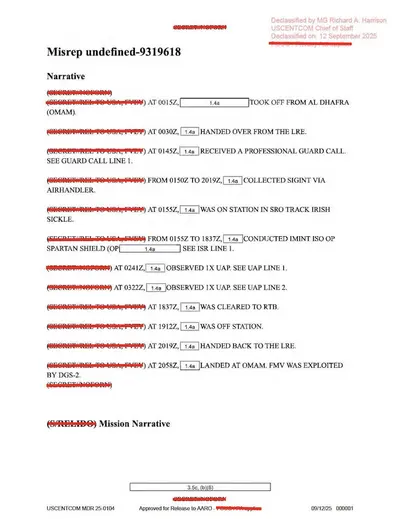
The primary source for this incident is a Mission Report (MISREP), which serves as a standardized administrative tool used by the United States military to document the specific circumstances of its operations. These reports are designed to provide a technical account of mission objectives, environmental conditions, and any deviations from the expected operational parameters. In this specific instance, the document records a visual sighting of an unidentified object reported by ground or air observers.
While the document provides a technical record of the observation, the released version does not specify the exact number of witnesses involved in the sighting. The nature of the report focuses on the visual characteristics of the object as perceived by personnel during the mission. Because the report is a standardized military form, it prioritizes the recording of the event’s occurrence within the operational theater rather than providing subjective testimony.
Classification and Analysis
The case is classified as a visual sighting, a type of encounter where the phenomenon is identified through direct optical observation by human eyes or onboard camera systems. Within the framework of the All-domain Anomaly Resolution Office, all records released under the PURSENSE program are designated as unresolved by default. This designation reflects a cautious scientific and intelligence-based approach, where the agency avoids making premature conclusions regarding the origin of the phenomenon.
As of the latest available records, the federal government has not concluded that the object was anomalous, nor has it concluded that the sighting was the result of conventional technology. The investigation remains open to both possibilities. In the broader context of UAP studies, researchers often compare such sightings to known atmospheric or man-made phenomena. Conventional candidates for objects observed during this period include experimental aircraft, weather balloons, or atmospheric optical phenomena such as sundogs and lenticular clouds. Furthermore, astronomical objects like the Moon, Venus, or meteors appearing near the horizon are frequently considered as potential explanations for visual anomalies in maritime environments. The 2023 Persian Gulf encounter remains part of this ongoing effort to differentiate between known aerial activity and truly unidentified phenomena.
Sources
- Original release on war.gov
- Department of War UFO Disclosure Portal
- AARO (All-domain Anomaly Resolution Office)
- PURSUE record identifier: DOW-UAP-D023 (Release 01, May 8, 2026)
- PURSUE record identifier: DOW-UAP-PR026 (Release 01, May 8, 2026)
- PURSUE record identifier: DOW-UAP-PR027 (Release 01, May 8, 2026)