United Arab Emirates Military UAP Encounter (October 2023 — Gulf of Oman) — Mission Report
A 2023 mission report from the Gulf of Oman details an unidentified object sighting released via the PURSUE program in 2026.
Overview
In October 2023, within the maritime airspace of the Gulf of Oman, U.S. government investigators recorded an unidentified-object incident that would later be released to the public on May 8, 2026. This disclosure occurred as part of the Presidential Unsealing and Reporting System for UAP Encounters, known as PURSUE. The incident is categorized as a case from the All-domain Anomaly Resolution Office disclosure era, a period following the 2022 establishment of the modern United States UAP investigative apparatus. The details of this specific encounter are contained within official U.S. Department of Defense documents.
Document Analysis
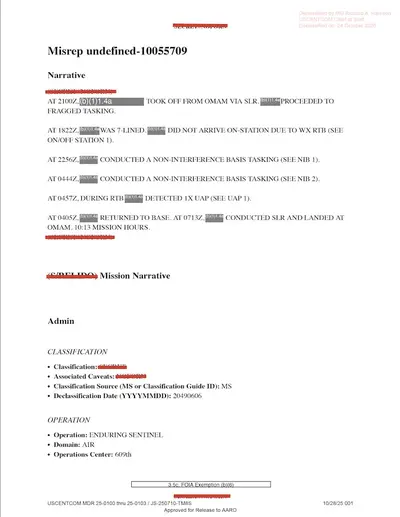
The primary source for this event is a Mission Report, or MISREP. This is a standardized reporting form utilized by the United States Military to document the specific circumstances, environmental conditions, and operational details surrounding its various missions. Because the MISREP is a functional military document intended for internal operational tracking, its contents are focused on the technicalities of the encounter rather than narrative testimony. The released document does not specify the exact number of witnesses present during the sighting.
The nature of the case is classified as a visual sighting reported by ground or air observers. Such reports typically involve the detection of an object that deviates from the expected flight paths or behaviors of known conventional craft. In the context of maritime surveillance in the Gulf of Oman, such sightings often involve sensors or visual confirmation from naval vessels or aerial patrol assets operating in high-traffic corridors.
Historical and Investigative Context
The Gulf of Oman serves as a critical maritime gateway, connecting the Persian Gulf to the Arabian Sea. Due to its strategic importance for global energy transit and its proximity to various geopolitical flashpoints, the region is subject to intense-level surveillance by international naval forces. This high density of radar, infrared, and visual monitoring makes the area a frequent site for the documentation of aerial anomalies.
The timing of this incident places it within a modern era of heightened transparency regarding Unidentified Anomalous Phenomena. Since the 2022 reorganization of the U.S. investigative framework, the government has moved toward a more systematic approach to collecting and analyzing data. This shift represents a departure from the era of more opaque, classified reporting, moving instead toward a structured disclosure system like PURSUE.
Classification and Status
All records released under the PURSUE program are designated as unresolved by the All-domain Anomaly Resolution Office (AARO) by default. This designation reflects a rigorous adherence to scientific and intelligence-based skepticism. The federal government has not concluded that the events in the Gulf of Oman were anomalous, nor has it concluded that they were conventional. The agency has not ruled out either possibility.
When evaluating sightings from this period, investigators consider several conventional candidates. These include experimental aircraft, high-altitude weather balloons, and atmospheric optical phenomena such as sundogs or lenticular clouds. Astronomical objects, such as Venus, the Moon, or meteors appearing near the horizon, are also frequently assessed. Historically, the investigation of such objects has been compared to the scrutiny applied to the Project Mogul series in the late 1940s, which utilized high-altitude balloons to detect nuclear tests. In the present case, the lack of a definitive conclusion leaves the object’s origin and nature an open question within the official record.
Sources
- Original release on war.gov
- Department of War UFO Disclosure Portal
- AARO (All-domain Anomaly Resolution Office)
- PURSUE record identifier: DOW-UAP-D027 (Release 01, May 8, 2026)