Range Fouler Debrief, Middle East, May 2020
A 2020 U.S. Navy report details an unidentified object intrusion into controlled airspace over the Persian Gulf, later released via the PURSUE program.
Incident Overview
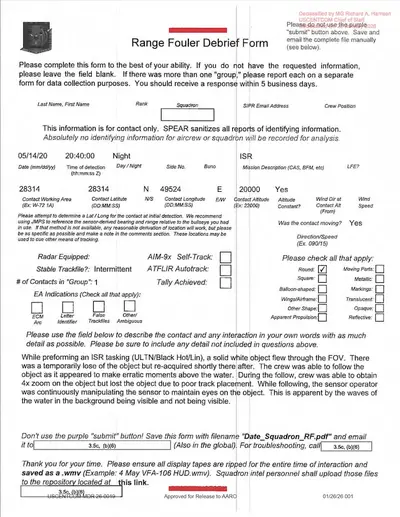
In May 2020, within the airspace of the Persian Gulf, U.S. government investigators documented an unidentified-object incident that would later become a matter of public record. The details of this encounter were released to the public on May 8, 2026, as part of the Presidential Unsealing and Reporting System for UAP Encounters (PURSUE). The documentation originates from U.S. Department of Defense files and pertains to a period characterized by heightened scrutiny of aerial anomalies. Specifically, the case falls within the operational era of the Advanced Aerospace Threat Identification Program and the Unidentified Aerial Phenomena Task Force, both of which were tasked with analyzing unconventional aerial phenomena within military contexts.
Documentation and Reporting
The primary evidence for this event is a Range Fouler Debrief, which serves as a standardized reporting instrument utilized by the United States Navy. This specific type of document is designed to catalog the precise circumstances surrounding an unauthorized intrusion into controlled airspace during active military training or live operations. Such reports are critical for maintaining flight safety and operational security, as they provide a narrative description of the observer’s experiences during a breach of restricted zones. While the debrief provides a detailed account of the encounter, the released documentation does not specify the exact number of witnesses involved in the sighting.
The nature of the case is classified as a visual sighting reported by observers situated either on the ground or within aircraft. This type of reporting is common in maritime and littoral environments where radar coverage may be complicated by terrain or atmospheric interference, necessitating human visual confirmation of unidentified objects.
Historical and Geopolitical Context
The Persian Gulf is a region of significant strategic importance, characterized by dense military presence and highly regulated airspace. During the early 2020s, the monitoring of the Gulf’s aerial corridors was a primary concern for international naval forces due to the high volume of commercial and military traffic. The presence of unidentified objects in such a sensitive corridor often triggers immediate investigative protocols to determine if the objects represent technological threats, surveillance assets, or natural phenomena.
The era in which this incident occurred was marked by a transition in how the United States government approached unidentified aerial phenomena. Moving away from the more clandestine approaches of previous decades, the establishment of specialized task forces represented an effort to institutionalize the collection and analysis of data regarding aerial anomalies. This period saw a shift toward more transparent reporting mechanisms, such as the PURSUE program, which aimed to provide a structured framework for the declassification of previously sensitive military observations.
Analytical Status and Potential Classifications
All records released under the PURSUE program are designated as unresolved by the All-domain Anomaly Resolution Office (AARO) by default. This designation reflects a lack of definitive conclusion regarding the nature of the object. The federal government has not reached a determination as to whether the event was anomalous or if it can be attributed to known technology. Consequently, the possibility of both unconventional and conventional explanations remains open.
In the context of aerial sightings from this period, investigators often consider a variety of conventional candidates. These include experimental aircraft testing, the presence of weather balloons, or atmospheric optical phenomena such as lenticular clouds and sundogs. Additionally, astronomical objects such as the Moon, Venus, or meteors appearing near the horizon are frequently evaluated during the analysis of visual sightings. The Range Fouler Debrief remains an active part of the historical record regarding the ongoing investigation into unidentified objects in the Middle East.
Sources
- Original release on war.gov
- Department of War UFO Disclosure Portal
- AARO (All-domain Anomaly Resolution Office)
- PURSUE record identifier: DOW-UAP-D038 (Release 01, May 8, 2026)
- PURSUE record identifier: DOW-UAP-PR036 (Release 01, May 8, 2026)