Ashgabat, Turkmenistan, November 5, 2004
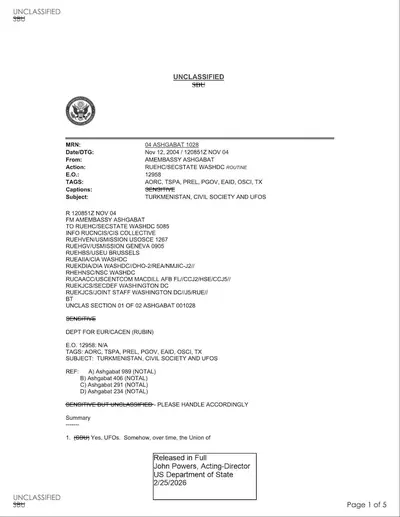
Declassified U.S. government records document an unidentified object sighting over Ashgabat, Turkmenistan, on November 5, 2004.
Overview
On November 5, 2004, an unidentified-object incident occurred in Turkmenistan, an event documented by U.S. government investigators. The details of this encounter were not made available to the general public until their release on May 8, 2026, under the auspices of the Presidential Unsealing and Reporting System for UAP Encounters (PURSUE). This case is categorized as a post-Cold-War sighting, occurring during a period of geopolitical transition before the establishment of modern, dedicated United States Unidentified Anomalous Phenomena (UAP) task forces. The existence of the incident is confirmed through declassified U.S. government records.
Context and Documentation
The documentation of this event is notable for its connection to the UFOlogists of Turkmenistan. This specific group has established a reputation for reliability when acting as a partner for United States interests within the region. The emergence of such civil society organizations in Turkmenistan has been viewed with a degree of bemusement by contemporary observers of the country’s political development, as the growth of independent organizations often occurs alongside complex shifts in domestic governance. The reliability of this group is attributed to a widespread cultural interest in unidentified flying phenomena within Turkmenistan, where such topics appear to command significant public attention.
While the released documents provide a formal record of the investigation, the specific number of witnesses involved in the November 5 sighting is not specified in the official text. The nature of the report is classified as a visual sighting, which may have been captured by observers located on the ground or by those positioned in aerial platforms.
Phenomenological Analysis
The Ashgabat incident is classified as an all-domain anomaly, a term used by the All-domain Anomaly Resolution Office (AARO) to describe objects that do not have a confirmed origin. Under the protocols of the PURSUE program, all released records are designated as unresolved by default. This means the federal government has not reached a definitive conclusion regarding whether the object was anomalous or if it can be attributed to known technology. The investigation has not ruled out either the possibility of an unknown phenomenon or a conventional explanation.
During the early 2000s, many sightings of this type were analyzed through the lens of conventional aerospace and atmospheric science. Potential candidates for such sightings often included experimental aircraft or high-altitude weather balloons. Historically, atmospheric optical phenomena, such as lenticular clouds or sundogs, have been frequently misidentified as unidentified objects. Additionally, the presence of bright astronomical bodies, such as Venus, the Moon, or meteors appearing near the horizon, often provided a natural explanation for visual anomalies. The Ashgabat case remains part of this broader historical continuum of unidentified aerial sightings that lack a definitive, conclusive resolution in the official record.